
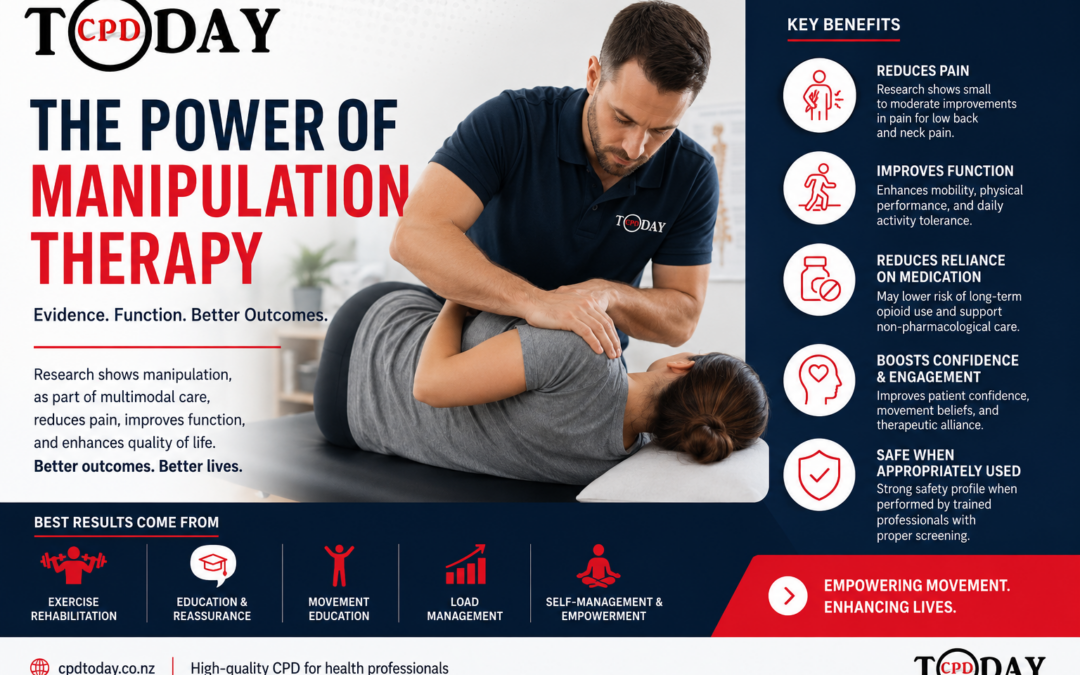
The Role of Manipulation Therapy in Improving Patient Outcomes: What the Latest Research Shows
Manual therapy and spinal manipulation remain widely used interventions in musculoskeletal healthcare, particularly for low back pain, neck pain, and movement-related dysfunction. While manipulation has historically generated debate, modern research and clinical guidelines increasingly support its role as part of an evidence-based, patient-centred treatment approach.
For osteopaths, chiropractors, physiotherapists, and other manual therapists, the key question is no longer whether manipulation “works,” but rather when, for whom, and how it can best contribute to meaningful patient outcomes.
What Is Manipulation Therapy?
Manipulation therapy refers to skilled manual techniques applied to joints and surrounding tissues to improve mobility, reduce pain, and restore function. High-velocity low-amplitude (HVLA) thrust techniques are the most recognised form, though manipulation also includes lower-force mobilisations and assisted techniques.
The primary goals are to:
- Reduce pain sensitivity
- Improve joint mobility
- Enhance neuromuscular control
- Restore functional movement
- Support patient confidence and activity levels
Manipulation is rarely used in isolation in modern practice. Current evidence strongly supports combining manual therapy with exercise, education, reassurance, and active rehabilitation.
Why Manipulation Still Matters in Modern Healthcare
Musculoskeletal pain remains one of the leading causes of disability worldwide, particularly chronic low back pain and neck pain. The challenge for clinicians is finding interventions that are effective, safe, cost-efficient, and capable of improving both short- and long-term outcomes.
Recent research demonstrates several important benefits of manipulation when appropriately indicated.
1. Improved Pain Reduction
One of the most consistently reported benefits of spinal manipulation is pain relief, especially in patients with nonspecific low back pain.
A 2026 Cochrane review involving over 11,000 participants found that spinal manipulative therapy may provide small-to-moderate improvements in pain and functional status compared with sham treatment or no treatment in chronic low back pain. (PubMed)
Research also suggests manipulation may reduce pain sensitivity and pain catastrophising, which are important contributors to chronic pain persistence. A 2024 placebo-controlled trial reported measurable reductions in pain sensitivity following spinal manipulation in chronic low back pain patients. (ScienceDirect)
This is clinically significant because reducing fear, pain amplification, and movement avoidance can help patients return to normal activity sooner.
2. Better Functional Outcomes
Pain reduction alone is not enough. Modern healthcare increasingly focuses on functional improvement — helping patients move better, work more comfortably, sleep better, and participate in daily life.
Recent evidence shows manipulation can improve:
- Functional mobility
- Range of motion
- Physical performance
- Return-to-work outcomes
- Daily activity tolerance
A 2024 review comparing international clinical practice guidelines found spinal manipulation consistently recommended for acute, subacute, and chronic low back pain alongside exercise and remaining active. (PubMed)
Similarly, neck pain guidelines published in 2025 reported that manipulation and mobilisation remain consistently recommended internationally for mechanical neck pain management. (PubMed)
Importantly, manipulation appears most effective when integrated into a multimodal treatment strategy rather than delivered as a standalone passive intervention.
3. Reduced Reliance on Medication
One of the most valuable healthcare outcomes today is reducing dependence on pain medication, particularly opioids.
Emerging evidence suggests patients receiving spinal manipulative therapy for low back pain may be less likely to progress toward long-term opioid use or opioid use disorder. (PMC)
Given the ongoing concerns surrounding opioid overuse globally, conservative non-pharmacological approaches are increasingly prioritised in healthcare systems.
The World Health Organization released its first chronic low back pain guideline in 2023, strongly supporting non-surgical, non-pharmacological interventions for chronic low back pain management. (World Health Organization)
This reflects a broader shift toward active, conservative care models where manipulation can play an important role.
4. Enhancing Patient Confidence and Engagement
Patient expectations, therapeutic alliance, and reassurance significantly influence recovery outcomes.
Recent qualitative research highlights that responses to spinal manipulation are influenced not only by biomechanics, but also by contextual and psychological factors including:
- Trust in the clinician
- Therapeutic communication
- Patient beliefs
- Feeling understood
- Confidence in movement
A 2025 BMJ Open study emphasised that patient-provider interactions substantially affect outcomes associated with spinal manipulative therapy. (BMJ Open)
This reinforces the idea that effective manipulation is not simply a mechanical intervention. It is part of a broader biopsychosocial framework that combines hands-on care with education, reassurance, and empowerment.
Is Manipulation Safe?
Safety remains one of the most discussed aspects of manipulation therapy.
Current evidence suggests that for appropriately screened patients, spinal manipulation has a strong safety profile when delivered by trained professionals.
A 2024 systematic review on cervical spinal manipulation found no increased risk of mild or moderate adverse events compared with other interventions. (PubMed)
Most side effects reported are mild and temporary, including:
- Local soreness
- Temporary stiffness
- Mild fatigue
- Short-term symptom aggravation
Serious adverse events appear to be rare, although continued vigilance, patient screening, and informed consent remain essential. (BMJ)
Good clinical practice requires clinicians to:
- Screen for red flags
- Rule out vascular and neurological risks
- Use appropriate force selection
- Adapt techniques to the individual
- Maintain clear patient communication
Modern evidence-based manipulation is about precision, safety, and clinical reasoning — not aggressive treatment.
Manipulation Works Best as Part of Multimodal Care
Perhaps the most important finding from contemporary research is that manipulation should not be viewed as a “quick fix.”
The best outcomes occur when manipulation is integrated with:
- Exercise rehabilitation
- Lifestyle advice
- Load management
- Movement education
- Strengthening
- Self-management strategies
Clinical guidelines increasingly recommend combined approaches because long-term recovery depends on helping patients build resilience and confidence — not simply reducing symptoms temporarily. (PMC)
This aligns closely with modern osteopathic and patient-centred healthcare models.
The Future of Manipulation Therapy
The future of manual therapy is evolving beyond outdated biomechanical explanations toward a more integrated understanding of pain science, neurophysiology, and patient-centred care.
Emerging research is now exploring:
- Neurophysiological effects of manipulation
- Pain modulation mechanisms
- Contextual and placebo-related effects
- Personalised treatment approaches
- Predictors of positive response
Rather than asking whether manipulation “realigns” joints, clinicians are increasingly focused on how it influences the nervous system, movement behaviour, and patient confidence.
This shift is helping manual therapy become more scientifically grounded and better integrated into multidisciplinary healthcare.
Conclusion
Manipulation remains a valuable tool in musculoskeletal healthcare when delivered appropriately and integrated into evidence-based practice.
Current research supports its role in:
- Reducing pain
- Improving physical function
- Supporting recovery from low back and neck pain
- Enhancing patient confidence
- Potentially reducing reliance on medication
However, the strongest evidence supports manipulation as part of a broader active care model that includes exercise, education, and patient empowerment.
For modern clinicians, manipulation is not about “cracking joints.” It is about helping patients move better, feel safer in movement, and regain quality of life through skilled, patient-centred care.
References
- de Zoete A, et al. Spinal manipulative therapy for adults with chronic low back pain. Cochrane Review, 2026. (PubMed)
- Zhou T, et al. Recent clinical practice guidelines for the management of low back pain: a global comparison. 2024. (PubMed)
- Peters R, et al. Recommendations for Mobilization and Manipulation in Neck Pain Guidelines. 2025. (PubMed)
- Gevers-Montoro C, et al. Reduction of Chronic Primary Low Back Pain by Spinal Manipulation. 2024. (ScienceDirect)
- Pankrath N, et al. Adverse Events After Cervical Spinal Manipulation. 2024. (PubMed)
- World Health Organization. WHO Guideline for Chronic Low Back Pain. 2023. (World Health Organization)
- Beneciuk JM, et al. Patient and physical therapist perspectives on spinal manipulative therapy. BMJ Open, 2025. (BMJ Open)
- Gevers-Montoro C, et al. Clinical Effectiveness and Efficacy of Chiropractic Spinal Manipulative Therapy. 2021. (PMC)