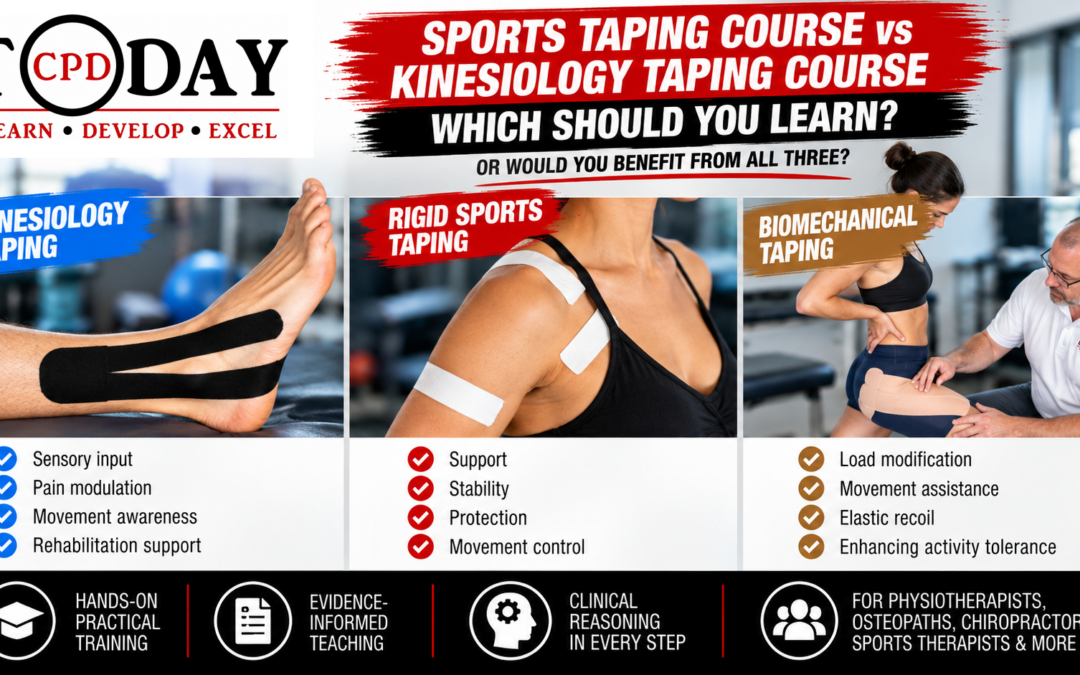
Sports Taping Course vs Kinesiology Taping Course: Which Should You Learn?
A Practical Guide for Physiotherapists, Osteopaths & Sports Therapists
If you’re searching for a taping course in the UK, you’ll probably encounter two options repeatedly:
Sports taping courses and kinesiology taping courses.
But which should you learn?
Is traditional rigid sports strapping more useful in clinical practice? Should you concentrate on kinesiology taping? Or would you benefit from learning both—and adding biomechanical taping to your clinical toolkit as well?
The answer depends less on which tape is “best” and more on a much more important question:
What are you trying to achieve for your patient?
At CPD Today, that’s central to how we teach our Clinical Strapping & Taping Course.
The right tape. For the right patient. For the right reason.
What Is a Sports Taping Course?
A traditional sports taping or sports strapping course generally focuses on rigid or semi-rigid tape.
Unlike elastic tapes, rigid sports tape provides relatively little stretch.
This makes it particularly useful when the clinical objective involves:
Supporting a joint
Increasing external stability
Protecting an injured area
Controlling unwanted movement
Restricting a particular direction of movement
Supporting return to sporting activity
Common areas taught on sports taping courses include the ankle, foot, knee, wrist, thumb and shoulder.
For clinicians working in sport, learning effective rigid strapping techniques can be extremely useful.
What Is a Kinesiology Taping Course?
A kinesiology taping course teaches the use of elastic therapeutic tape, commonly referred to as K-tape.
Unlike rigid sports tape, kinesiology tape generally allows movement rather than deliberately restricting it.
Clinical objectives may include:
Providing sensory input
Pain modulation
Increasing awareness of movement
Supporting functional activity
Helping patients participate in rehabilitation
Kinesiology taping is widely used across physiotherapy, osteopathy, sports therapy and other MSK settings.
However, good kinesiology taping training should involve considerably more than memorising where strips of coloured tape should be placed.
Clinicians should understand why they are applying it and what outcome they expect.
Sports Tape vs Kinesiology Tape: What’s the Difference?
The easiest way to understand the difference is to consider their properties and clinical objectives.
Rigid Sports Tape
Kinesiology Tape
Elasticity
Minimal
Elastic
Movement
Can restrict/control
Generally allows movement
Support
High mechanical support
Lighter support
Common objective
Stability/protection
Sensory input/symptom modulation
Typical setting
Sport/return to play
MSK/rehabilitation/sport
Application
Often layered strapping
Elastic strips/applications
Neither approach is automatically better.
They simply provide clinicians with different tools for different objectives.
When Might Rigid Sports Taping Be More Appropriate?
Imagine a patient returning to sport following an ankle sprain.
Your assessment identifies a need for additional external support and greater control of inversion during activity.
Your objective is primarily:
Support + stability + movement control
In this situation, rigid sports taping may be the logical choice.
A kinesiology application might allow substantially more movement and therefore may not achieve the same mechanical objective.
When Might Kinesiology Taping Be More Appropriate?
Now consider someone undertaking rehabilitation for persistent knee pain.
You don’t necessarily want to restrict their movement.
In fact, you want them moving and exercising.
Your objective might instead be to provide sensory input or temporarily modify symptoms while they perform their rehabilitation programme.
In that situation, kinesiology tape may be considered.
The important distinction is that you’re choosing the tape according to the objective rather than simply the diagnosis.
But There’s a Third Option: Biomechanical Taping
This is where comparing only sports tape and kinesiology tape can become limiting.
Modern clinical taping also includes biomechanical taping.
Biomechanical tapes are highly elastic and can be applied with the aim of mechanically interacting with movement.
Examples include:
Dynamic Tape® and Strapit Active Tape.
Both sit within the biomechanical taping category.
Depending on the application, objectives may include:
Load modification
Movement assistance
Elastic recoil
Reducing mechanical demand during a task
Supporting activity tolerance
This gives clinicians another option between simply restricting movement and providing predominantly sensory input.
Three Taping Approaches – Three Different Objectives
A simple way to think about the three systems is:
🔴 Rigid Sports Taping
Support • Protection • Stability • Movement control
🔵 Kinesiology Taping
Sensory input • Pain modulation • Movement awareness • Rehabilitation
⚫ Biomechanical Taping
Load modification • Movement assistance • Elastic recoil
Once clinicians understand these differences, tape selection becomes much more logical.
Should Physiotherapists Learn Sports Taping or Kinesiology Taping?
For physiotherapists working across MSK, rehabilitation and sport, there’s a strong argument for understanding more than one taping approach.
Your caseload may include:
Acute sporting injuries
Persistent MSK pain
Tendinopathy
Post-injury rehabilitation
Return-to-running patients
Recreational athletes
Competitive athletes
One type of tape is unlikely to meet every clinical objective.
Learning several approaches allows the physiotherapist to select the intervention according to the individual patient.
What About Osteopaths?
Taping can also be a useful adjunct for osteopaths.
Treatment finishes when the patient leaves the clinic, but rehabilitation and daily activity continue.
Appropriate taping may potentially be incorporated alongside:
Exercise rehabilitation
Load management
Movement advice
Return to activity
Sports rehabilitation
For osteopaths, learning rigid, kinesiology and biomechanical taping provides several options rather than relying on a single taping philosophy.
What About Sports Therapists?
For sports therapists, rigid strapping may be particularly relevant because of the demands of sport and return-to-play environments.
But athletes don’t only require protection.
They may also present with:
Tendon problems
Persistent pain
Rehabilitation needs
Training-load issues
Movement-related symptoms
Understanding kinesiology and biomechanical taping alongside traditional sports strapping therefore creates a broader practical toolkit.
Why Learning Only One Type of Tape Can Be Limiting
There’s an old saying:
If the only tool you have is a hammer, every problem starts looking like a nail.
The same principle can apply to taping.
If you’ve only attended a kinesiology taping course, you may naturally reach for kinesiology tape.
If you’ve only learned rigid sports strapping, you may approach every problem from the perspective of support and restriction.
Learning different tape properties allows you to start somewhere else:
What does this patient actually need?
Then choose the tape.
Don’t Choose Tape by Diagnosis Alone
This is one of the most important principles we teach.
Consider three people who all report knee pain.
One may need additional support during sport.
Another may benefit from short-term symptom modification while exercising.
Another may require a strategy aimed at modifying mechanical load during a particular activity.
Whatever tape you choose, how do you know whether the application has achieved anything useful?
Establish a baseline before taping.
That might be:
Pain during a squat
Walking
Running
Stairs
Heel raises
Shoulder elevation
Jumping
A sport-specific task
Apply the tape.
Then repeat the test.
Did something meaningful change?
If not, reconsider the application.
A technically perfect taping technique isn’t necessarily a clinically useful one.
Should You Take Separate Sports and Kinesiology Taping Courses?
You certainly can.
Specialist courses can be useful when you want to develop considerable depth within one particular system.
However, clinicians who are relatively new to taping may benefit from first understanding the differences between the major taping approaches.
That’s one reason the CPD Today Clinical Strapping & Taping Course teaches three approaches together.
Instead of learning:
“This is how you tape a knee.”
we want clinicians asking:
“What am I trying to achieve at this knee—and which tape has the properties that best match that objective?”
That’s a very different way of thinking.
Why Hands-On Taping Training Matters
You can watch hundreds of taping videos online.
But watching someone else tape doesn’t necessarily teach you how the material feels in your hands.
Practical training allows you to develop skills such as:
Tape handling
Anchoring
Direction
Tension
Patient positioning
Application
Removal
Reassessment
It also gives you the opportunity to make mistakes, receive feedback and adjust your technique.
That’s difficult to replicate through video alone.
Learn All Three Approaches with CPD Today
The CPD Today Clinical Strapping & Taping Course brings together:
Rigid Sports Taping
Learn practical strapping techniques where support, stability, protection and movement control are the objective.
Kinesiology Taping
Explore elastic therapeutic taping, clinical reasoning and its potential role alongside rehabilitation.
Biomechanical Taping
Learn principles of load modification and movement assistance using biomechanical tapes, including Dynamic Tape® and Strapit Active Tape.
Most importantly, you’ll learn how to decide which approach to use and why.
What Should a Good Taping Course Teach?
Before booking a course, look beyond the number of techniques advertised.
Ask whether the training teaches you:
✅ How different tapes behave ✅ How to select the appropriate tape ✅ Clinical reasoning ✅ Patient positioning ✅ Direction and tension ✅ Practical application skills ✅ Safety and contraindications ✅ Reassessment ✅ How taping integrates with rehabilitation
These skills are transferable.
Memorised recipes are much less so.
Frequently Asked Questions
Is sports taping the same as kinesiology taping?
No. Rigid sports tape provides relatively little elasticity and may be used when support, protection or movement control is required. Kinesiology tape is elastic and generally allows movement.
Which is better: sports tape or kinesiology tape?
Neither is universally better. They have different physical properties and may therefore be selected for different clinical objectives.
What is the best taping course for physiotherapists?
Look for a course that combines practical application with clinical reasoning, safety, reassessment and integration with rehabilitation. Learning several taping approaches can provide a broader clinical toolkit.
Can osteopaths learn sports taping?
Yes. Taping can provide osteopaths with an additional clinical and rehabilitation tool, provided it is used within their professional competence and appropriate patient management.
What is biomechanical taping?
Biomechanical taping uses highly elastic tape with the aim of interacting mechanically with movement, including movement assistance and load modification.
Is Dynamic Tape® the same as kinesiology tape?
No. Dynamic Tape is a biomechanical tape and has different mechanical properties and intended applications from traditional kinesiology tape.
Does CPD Today teach all three taping methods?
Yes. The CPD Today Clinical Strapping & Taping Course combines rigid sports taping, kinesiology taping and biomechanical taping within practical, clinician-focused training.
So, Which Taping Course Should You Choose?
If you only want to learn rigid sports strapping, choose a dedicated sports taping course.
If you only want to learn K-tape applications, a kinesiology taping course may meet your needs.
But if you want to understand how different tapes can be selected for different clinical objectives, consider training that exposes you to several approaches.
That’s exactly what we’ve designed the CPD Today Clinical Strapping & Taping Course to do.
🔴 Rigid Sports Taping
🔵 Kinesiology Taping
⚫ Biomechanical Taping
Hands-on. Evidence-informed. Clinically relevant.
Don’t simply learn where to put the tape.
Learn which tape to choose, why you’re choosing it and how to determine whether it worked.
The right tape. For the right patient. For the right reason.
Book your place on the CPD Today Clinical Strapping & Taping Course and develop practical skills you can take straight back into clinic.
SEO & AI Search Optimisation
SEO title: Sports Taping Course vs Kinesiology Taping Course: Which Should You Learn?
Meta description:Sports taping course or kinesiology taping course? Compare rigid, K-tape and biomechanical taping and discover which training is right for MSK professionals.
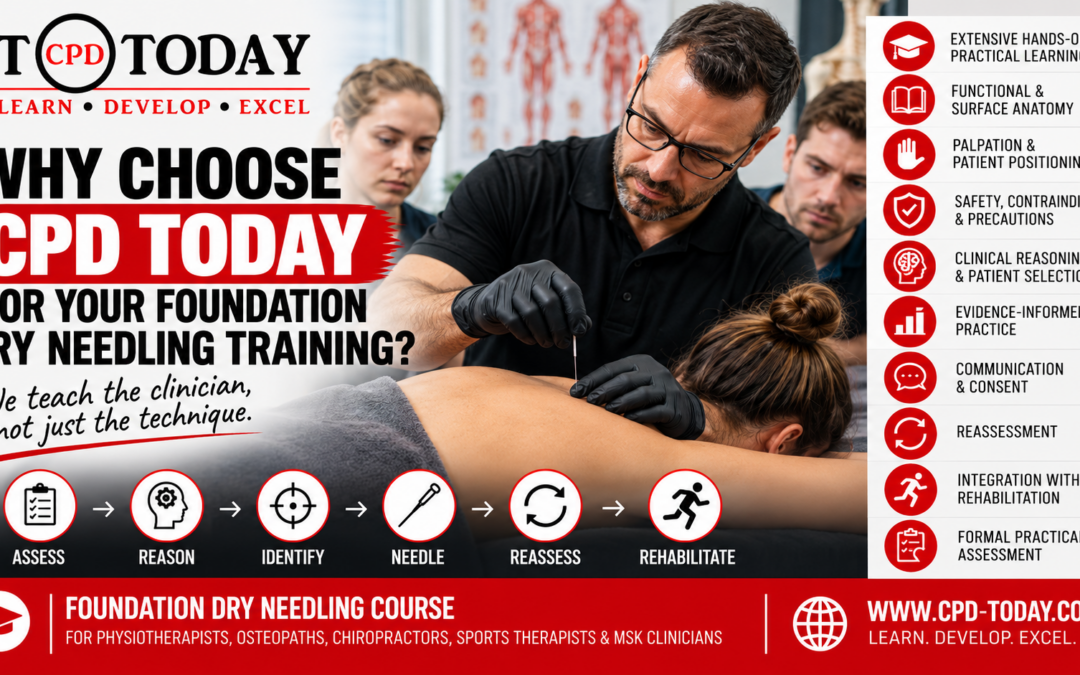
Why Choose CPD Today for Your Foundation Dry Needling Training?
Meta Title: Foundation Dry Needling Course UK | CPD Today
Meta Description: Looking for a Foundation Dry Needling Course in the UK? Discover CPD Today’s practical, evidence-informed approach to anatomy, safety, clinical reasoning, assessment and hands-on dry needling training.
Primary keyword: Foundation Dry Needling Course UK
Supporting keywords: dry needling course UK, dry needling training UK, learn dry needling UK, dry needling CPD course, dry needling course for physiotherapists, dry needling course for osteopaths, practical dry needling training
Looking for a Foundation Dry Needling Course in the UK?
If you’re considering learning dry needling, you’ll probably have already discovered that there are plenty of courses available.
So why choose CPD Today?
Our answer isn’t that we simply teach more muscles or more needling techniques.
We believe a good Foundation Dry Needling Course should develop something more important:
The clinician using the needle.
Dry needling isn’t simply about learning where to insert a needle.
You need to understand the anatomy, identify the tissue, recognise potential risks, select appropriate patients, communicate effectively, apply the technique safely, assess the response and decide what happens next.
That’s why our Foundation training follows a simple clinical framework:
What can they do now that they couldn’t do before?
Perhaps you can progress:
Strengthening
Mobility
Progressive loading
Functional movement
Exercise
Sports rehabilitation
Dry needling may sometimes provide a useful window of opportunity.
Rehabilitation allows you to use it.
That’s why our framework ends with:
REASSESS → REHABILITATE
11. You’ll Receive Tutor Feedback
There’s an important difference between:
Watching someone perform dry needling
and
Having someone watch you perform dry needling.
During practical learning, tutor feedback can help refine:
Palpation
Positioning
Hand placement
Needle handling
Technique
Communication
Clinical reasoning
Sometimes a relatively small correction can make a significant difference to how confident a technique feels.
That’s one of the major advantages of supervised practical education.
12. Our Tutors Understand Clinical Practice and Education
When choosing a dry needling course, we believe you should look at who will actually teach you.
Our teaching team brings together extensive experience in clinical MSK practice and professional education.
This matters because teaching isn’t simply demonstrating how we perform a technique.
It’s helping you learn how to perform it.
That requires observation, communication, feedback and an understanding of how clinicians learn practical skills.
13. Your Practical Ability Matters
Dry needling is a practical clinical skill.
We therefore believe course completion should represent more than simply sitting in the room for the required number of hours.
Our Foundation programme incorporates formal practical assessment.
The purpose isn’t to make delegates nervous or catch people out.
It’s to ensure the qualification has meaning.
Attendance tells us you were there.
Assessment helps demonstrate what you’ve learned.
14. We Want You to Leave With a Clinical Framework
When the course finishes, we don’t expect you to remember every sentence your tutors said.
What we do want you to remember is the process:
ASSESS
Understand the patient.
↓
REASON
Decide whether dry needling is appropriate.
↓
IDENTIFY
Use anatomy and palpation.
↓
NEEDLE
Apply an appropriate technique.
↓
REASSESS
Determine whether something changed.
↓
REHABILITATE
Use that change clinically.
That’s something you can take back into practice.
15. Foundation Training Is Part of a Development Pathway
Foundation shouldn’t be the end of your learning.
It should give you the fundamentals required to begin developing experience.
Our training pathway follows:
Foundation Dry Needling
Learn the fundamentals.
↓
Clinical Experience
Apply, practise and consolidate.
↓
Advanced Dry Needling & Electroacupuncture
Develop your skills further.
This is why we don’t try to cram every possible technique into Foundation training.
Advanced practice needs strong foundations.
Who Is the CPD Today Foundation Dry Needling Course For?
Our Foundation training is aimed at appropriately qualified healthcare and MSK professionals who want to develop dry needling skills.
Depending on eligibility, this may include:
Physiotherapists
Osteopaths
Chiropractors
Sports therapists
Other appropriately qualified MSK clinicians
Individual practitioners should ensure training and subsequent practice are appropriate to their professional scope, insurance and workplace requirements.
Do I Need Previous Dry Needling Experience?
The Foundation Course is designed to develop the fundamentals, so you don’t need to arrive already confident with dry needling.
Some delegates understandably feel apprehensive about their first practical needling session.
Confidence comes through supported practice rather than simply being expected.
What Will I Learn?
Our Foundation Dry Needling training brings together:
✔ Functional and surface anatomy ✔ Palpation ✔ Evidence-informed practice ✔ Contraindications and precautions ✔ Anatomical safety ✔ Needle handling ✔ Patient positioning ✔ Clinical reasoning ✔ Patient selection ✔ Communication and consent ✔ Treatment dosage ✔ Extensive supervised practical training ✔ Reassessment ✔ Rehabilitation ✔ Tutor feedback ✔ Practical assessment
The important point is that these aren’t isolated subjects.
They work together.
Why Not Simply Take the Cheapest Dry Needling Course?
Cost understandably matters.
But price alone tells you very little about the quality of clinical education.
When comparing courses, look at:
Practical teaching time
Tutor experience
Tutor access
Anatomy teaching
Safety
Clinical reasoning
Assessment
Course structure
Progression opportunities
A cheap course can be excellent.
An expensive course can be poor.
Compare the education—not simply the price.
Why Not Choose the Course Teaching the Most Muscles?
Because the longest technique list doesn’t necessarily produce the best learning.
We’d rather delegates understand:
Why they’re using a technique
than simply remember:
Where somebody showed them to put a needle.
Once you have strong fundamentals, expanding your techniques becomes considerably easier.
Frequently Asked Questions
Is CPD Today’s Dry Needling Course suitable for beginners?
Our Foundation Dry Needling training is designed to establish fundamental dry needling knowledge and practical skills for eligible clinicians rather than requiring previous dry needling experience.
Is the course practical?
Yes. Hands-on supervised practical learning is a central component of the training approach.
Is anatomy included?
Yes. Functional anatomy, surface anatomy and palpation are integrated into practical needling education.
Does the course cover safety?
Safety, relevant anatomy, contraindications, precautions, needle handling, patient positioning and appropriate clinical decision-making form important components of the training.
Is there an assessment?
The Foundation programme includes practical assessment so that course completion represents demonstrated learning rather than attendance alone.
Do you teach clinical reasoning?
Yes. We want delegates to understand why and when they may use dry needling rather than simply memorising needling locations.
Do you teach rehabilitation alongside dry needling?
Yes. Our approach encourages clinicians to reassess following treatment and consider how any useful change can support appropriate active rehabilitation.
What happens after Foundation training?
Clinicians can consolidate their skills through appropriate clinical experience before considering further development through Advanced Dry Needling & Electroacupuncture training.
How do I know whether I’m eligible?
Eligibility depends on professional background, qualifications and relevant requirements. Contact CPD Today before booking if you’re uncertain.
Why Choose CPD Today?
Because we don’t believe dry needling education should simply teach:
“Put the needle here.”
We want you to understand:
WHY you’re using it.
WHEN it’s appropriate.
HOW to use it safely.
WHAT you’re trying to achieve.
WHAT you should do next.
That’s the difference between learning a technique and developing a clinical skill.
Ready to Learn Dry Needling?
If you’re looking for a Foundation Dry Needling Course in the UK, explore our upcoming training dates.
New to dry needling?
Start with Foundation Dry Needling.
Develop your anatomy, safety, clinical reasoning and hands-on practical skills under supervision.
Already Foundation trained?
Progress your development with Advanced Dry Needling & Electroacupuncture.
Don’t just learn where to put the needle. Understand why you’re putting it there.
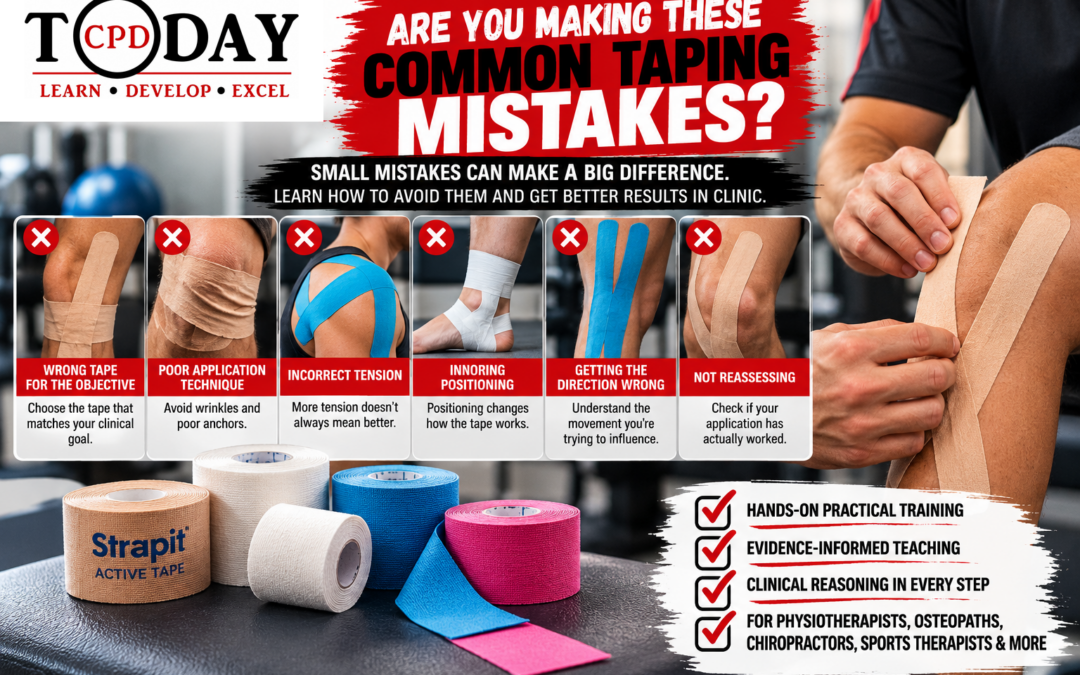
Common Strapping & Taping Mistakes Clinicians Make – and How to Avoid Them
Why Good Clinical Taping Requires More Than Knowing Where to Put the Tape
Clinical taping can look deceptively simple.
Watch a video, cut a piece of tape, copy the application and stick it onto the patient.
But effective taping requires considerably more thought.
Whether you’re using rigid sports tape, kinesiology tape or biomechanical tape, the effectiveness of an application depends on factors including assessment, tape selection, patient positioning, direction, tension, skin preparation and—most importantly—clinical reasoning.
A perfectly neat application can still be the wrong application.
At CPD Today, this is why our Clinical Strapping & Taping Course doesn’t simply teach clinicians a collection of taping recipes.
We teach you to understand:
What are you trying to achieve? Which tape should you choose? How should you apply it? And did it actually work?
Here are some of the most common mistakes clinicians make when learning clinical taping.
Mistake 1: Choosing the Tape Before Identifying the Objective
This is probably the biggest mistake.
A clinician decides:
“I’m going to kinesiology tape this knee.”
But why?
Before choosing the tape, determine the clinical objective.
Are you trying to:
Restrict unwanted movement?
Provide additional support?
Modify symptoms?
Provide sensory input?
Assist movement?
Modify mechanical load?
Improve tolerance of rehabilitation?
Your answer should influence your tape selection.
A useful framework is:
Patient → Assessment → Objective → Tape
Not:
Favourite tape → Patient
Mistake 2: Using the Same Tape for Everything
If the only taping system you’ve learned is kinesiology tape, almost every patient becomes a candidate for kinesiology tape.
The same applies to rigid taping.
But different tapes have different physical properties.
Rigid Sports Tape
Useful when the objective involves:
Support • Protection • Stability • Movement control
Including Dynamic Tape® and Strapit Active Tape, when the objective involves:
Load modification • Movement assistance • Elastic recoil
Knowing several systems gives clinicians more options.
Mistake 3: Learning Recipes Instead of Principles
Search online for almost any condition and you’ll find a taping video:
“Taping for tennis elbow.”
“Taping for Achilles tendinopathy.”
“Taping for knee pain.”
The problem is that patients aren’t recipes.
Two people with exactly the same diagnosis can have completely different:
Symptoms
Functional limitations
Sporting demands
Tissue capacity
Movement strategies
Rehabilitation goals
Therefore, they may require completely different taping applications—or no tape at all.
Instead of asking:
“What’s the taping technique for this diagnosis?”
ask:
“What am I trying to influence in this patient?”
That single change dramatically improves clinical reasoning.
Mistake 4: Assuming More Tension Means Better Taping
A common beginner mistake is pulling the tape harder because it feels as though more tension must create a greater therapeutic effect.
It doesn’t necessarily.
Excessive tension can:
Irritate the skin
Cause discomfort
Affect adherence
Alter the intended mechanical effect
Cause the tape to lift prematurely
Different taping systems also require different approaches to tension.
This is particularly important when moving between kinesiology and biomechanical tapes.
Understanding the properties of the material you’re using is essential.
Mistake 5: Ignoring Patient Positioning
Patient positioning isn’t simply about making the tape easier to apply.
It can fundamentally influence how an application behaves when the patient subsequently moves.
Consider a biomechanical application.
The position of the limb when the tape is applied can affect:
How much the tape stretches during movement
When elastic resistance develops
Direction of recoil
Mechanical assistance
Patient comfort
Small changes in position can create significant changes in an application.
This is difficult to appreciate from photographs alone.
It’s something clinicians understand much more easily when they practise hands-on.
Mistake 6: Getting the Direction Wrong
Direction matters.
This is particularly relevant with biomechanical taping.
If your objective is to use an elastic tape to assist a particular movement, you need to understand the movement you’re trying to influence and how the tape will behave during that movement.
Simply placing tape over the painful structure isn’t necessarily enough.
Ask:
Which movement am I trying to influence?
In which direction should the tape generate assistance?
What happens to the tape when the patient moves?
Biomechanical taping requires clinicians to think in terms of forces and movement, not simply anatomy.
Mistake 7: Confusing Kinesiology and Biomechanical Tape
Both stretch.
That doesn’t mean they’re the same.
Kinesiology taping is commonly used where objectives include sensory input, symptom modulation and movement awareness.
Biomechanical taping focuses more specifically on mechanical interaction with movement.
Highly elastic biomechanical tapes such as Dynamic Tape® and Strapit Active Tape can be applied to help modify mechanical demand and assist movement.
Understanding the distinction helps clinicians choose the tape according to the intended effect rather than simply because both products are elastic.
Mistake 8: Poor Skin Preparation
Even the best application is useless if it falls off shortly afterwards.
Before taping, consider:
Skin cleanliness
Oils and moisturisers
Excessive perspiration
Hair
Previous skin reactions
Wounds or damaged skin
The skin should generally be clean and dry before application.
Clinicians should also be aware of potential adhesive sensitivity and provide appropriate advice about removing the tape if irritation develops.
Good taping starts before you open the roll.
Mistake 9: Creating Wrinkles and Poor Anchors
Poor tape handling can result in:
Wrinkles
Folded edges
Excessive tension at anchors
Premature lifting
Uncomfortable applications
These might seem like minor technical issues, but they can determine whether an application lasts minutes or days.
Mistake 10: Taping the Site of Pain Without Assessing the Patient
Pain location doesn’t necessarily identify what needs to be influenced.
For example, a runner may report pain around the knee.
Simply placing tape around the knee because “that’s where it hurts” doesn’t constitute a clinical assessment.
You may need to consider:
Training load
Strength
Movement
Functional tasks
Tissue capacity
Previous injury
Sporting demands
Rehabilitation stage
The tape should follow the assessment.
Not replace it.
Mistake 11: Not Reassessing After Applying the Tape
This is one of the easiest mistakes to correct.
Before applying tape, choose something meaningful to test.
For example:
Squatting
Heel raises
Stairs
Shoulder elevation
Walking
Running
Jumping
A sport-specific movement
Record symptoms or function.
Apply your tape.
Then repeat the test.
Assess → Apply → Reassess
Has something changed?
If the patient’s painful squat was 7/10 beforehand and remains 7/10 afterwards, you need to question whether the application has achieved its objective.
Don’t assume that because the tape looks impressive, it is doing something useful.
Mistake 12: Using Tape Instead of Rehabilitation
Tape can be useful.
But tape doesn’t replace physical capacity.
Long-term management of many MSK conditions may require:
Progressive strengthening
Appropriate loading
Movement rehabilitation
Education
Conditioning
Return-to-sport preparation
Tape should generally be considered an adjunct to active rehabilitation, not the rehabilitation itself.
A useful objective may be:
Use the tape to help the patient tolerate the activity required to become less reliant on the tape.
Mistake 13: Making Patients Dependent on Tape
This follows naturally from the previous point.
If patients begin believing:
“I can’t exercise unless I’m taped.”
we may unintentionally reinforce dependence.
Where appropriate, explain why you’re using the tape.
For example:
“We’re using this temporarily to help make this activity more comfortable while we progressively build your strength and capacity.”
This places the tape within the rehabilitation plan rather than presenting it as something the patient permanently needs.
Mistake 14: Assuming Tape Must Work Because the Patient Feels It
A patient feeling the tape doesn’t automatically demonstrate a meaningful clinical benefit.
This is another reason reassessment matters.
Ask whether there has been a relevant change in:
Pain
Movement
Function
Confidence
Activity tolerance
Clinical taping should have an objective that can be reassessed.
Mistake 15: Copying Social Media Without Understanding Why
Social media can be useful for discovering techniques.
But a 30-second video rarely explains:
Why that tape was selected
The assessment findings
Why that direction was chosen
How much tension was used
Patient positioning
Contraindications
How the patient responded
Whether the application actually worked
Learning where to put tape is easy.
Understanding why is the skill.
Why Hands-On Taping Training Matters
You can learn the theory of taping online.
Developing practical skill is different.
During hands-on training you can:
Feel different tape properties
Practise tension
Experiment with positioning
Develop handling skills
Apply different techniques
Be taped yourself
Compare applications
Receive feedback
Reassess functional movements
This practical experience can dramatically improve confidence.
Learn Rigid, Kinesiology and Biomechanical Taping Together
One of the key strengths of the CPD Today Clinical Strapping & Taping Course is that we don’t restrict clinicians to one system.
You’ll explore:
Rigid Sports Taping
For applications involving support, stability, protection and movement control.
Kinesiology Taping
For applications involving sensory input, pain modulation, movement awareness and rehabilitation.
Biomechanical Taping
Including Dynamic Tape® and Strapit Active Tape, with a focus on movement assistance and load modification.
Learning these approaches together allows you to compare their properties and understand when one approach might be more appropriate than another.
Clinical Reasoning Before Tape
Our approach can be summarised in five stages:
1. Assess
What is the patient’s problem?
2. Define
What exactly are you trying to change?
3. Select
Which tape has the appropriate properties?
4. Apply
Use appropriate positioning, direction and tension.
5. Reassess
Did you actually achieve the objective?
This is far more valuable than memorising dozens of applications.
Who Is the CPD Today Strapping & Taping Course For?
The course is designed for MSK and rehabilitation professionals, including:
Physiotherapists
Osteopaths
Chiropractors
Sports therapists
Rehabilitation professionals
Other appropriately qualified practitioners
It is suitable both for clinicians who are relatively new to taping and practitioners who already use tape but want to broaden their skills and improve their clinical reasoning.
What Will You Take Back to Clinic?
Our aim is for you to leave with more than a certificate.
You’ll develop practical experience in:
Selecting appropriate tape
Rigid sports strapping
Kinesiology taping
Biomechanical taping
Dynamic Tape®
Strapit Active Tape
Patient positioning
Tension and direction
Clinical reasoning
Functional reassessment
Integrating taping with rehabilitation
Most importantly, you’ll understand why you’re applying the tape.
Frequently Asked Questions
What is the most common taping mistake?
One of the most important is choosing an application before identifying the clinical objective. Assessment should determine what you’re trying to change and therefore which tape may be appropriate.
How tight should clinical tape be?
There isn’t one correct amount of tension for every application. It depends on the tape, technique, patient and clinical objective. Excessive tension isn’t automatically better.
Should you reassess after taping?
Yes. Where possible, identify a relevant symptom, movement or functional task before taping and repeat it afterwards.
Is biomechanical tape the same as kinesiology tape?
No. Although both are elastic, they can be used with different clinical objectives. Biomechanical taping focuses particularly on mechanical load modification and movement assistance.
Are Dynamic Tape® and Strapit Active Tape both biomechanical tapes?
Yes. Both can be used within a biomechanical taping approach. The important skill is understanding the principles of load modification and movement assistance rather than treating each brand as a completely separate taping philosophy.
Can taping replace rehabilitation?
Generally, no. Taping is better considered an adjunct that may help selected patients participate in active rehabilitation.
Clinical taping becomes far more useful when you stop asking:
“Where do I put the tape?”
and start asking:
“What am I trying to achieve?”
The CPD Today Clinical Strapping & Taping Course combines hands-on practical training with evidence-informed clinical reasoning across:
**Rigid Sports Taping
Kinesiology Taping
Biomechanical Taping**
You’ll learn techniques, but you’ll also learn how to adapt those techniques to the individual patient in front of you.
Learn • Develop • Excel
The right tape. For the right patient. For the right reason.
Book your place on the CPD Today Clinical Strapping & Taping Course and develop practical taping skills you can use immediately in clinic.
SEO setup
SEO title: 15 Common Strapping & Taping Mistakes Clinicians Make
Meta description: Discover 15 common sports, kinesiology and biomechanical taping mistakes and learn how better assessment, tape selection and clinical reasoning can improve your taping.
10 Skills You Should Be Able to Demonstrate After a Foundation Dry Needling Course
SEO Title: 10 Skills You Should Learn on a Foundation Dry Needling Course | CPD Today
Meta Title: Foundation Dry Needling Course UK: 10 Essential Skills
Meta Description: What should you learn on a Foundation Dry Needling Course? Discover 10 essential dry needling skills including anatomy, safety, palpation, clinical reasoning and rehabilitation.
What Should You Actually Learn on a Foundation Dry Needling Course?
Completing a Foundation Dry Needling Course should involve considerably more than learning where to insert needles.
A good course should develop your ability to assess a patient, understand the relevant anatomy, identify appropriate tissues, recognise when dry needling may—or may not—be appropriate, apply techniques safely, evaluate the response and integrate treatment into a wider rehabilitation programme.
At CPD Today, we believe the real question isn’t:
“How many muscles will I learn to needle?”
It’s:
“What will I be able to do safely, confidently and clinically when I return to practice?”
Here are 10 skills we believe clinicians should develop during high-quality Foundation Dry Needling training.
Quick Answer: What Should a Foundation Dry Needling Course Teach?
A comprehensive Foundation Dry Needling Course should develop competence across:
Functional and surface anatomy
Palpation and tissue identification
Safe needle handling
Patient positioning
Contraindications, precautions and safety
Clinical reasoning and patient selection
Appropriate treatment dosage
Communication and consent
Reassessment
Integration with rehabilitation
These skills are interconnected.
Being able to insert a needle is only one small part of becoming a competent dry needling practitioner.
1. Identify Relevant Anatomy Confidently
Anatomical knowledge is one of the foundations of safe dry needling.
It’s not enough to know approximately where a muscle sits.
Clinicians need to consider:
Origin and insertion
Muscle orientation
Tissue depth
Bony landmarks
Adjacent muscles
Nerves
Blood vessels
Joints
Thoracic structures where relevant
Other vulnerable anatomical structures
You should understand both the structure you’re targeting and what surrounds it.
Why does this matter?
Because dry needling is an invasive technique.
Once a needle passes through the skin, anatomical knowledge becomes one of your most important safety tools.
How we teach this at CPD Today
We don’t separate anatomy completely from practical teaching.
Delegates repeatedly move through:
Identify → Palpate → Position → Consider safety → Needle
This helps translate textbook anatomy into practical clinical anatomy.
Course takeaway
Don’t memorise where the needle goes. Understand what lies beneath it.
2. Palpate and Identify the Target Tissue
Knowing anatomy from a textbook and finding anatomy on a real person are different skills.
Patients vary in:
Body composition
Muscle bulk
Tissue depth
Anatomical landmarks
Previous injury
Previous surgery
Positioning
A Foundation Dry Needling Course should therefore develop surface anatomy and palpation, not simply show photographs of needle placement.
You should be able to identify relevant landmarks and develop confidence that you’re treating the intended tissue.
Why practical training matters
This is difficult to learn from a video.
An instructor can watch your palpation and positioning and immediately suggest an adjustment.
Sometimes a small change in hand position can significantly improve confidence in identifying the target.
That’s one reason supervised hands-on training is central to the CPD Today approach.
3. Handle Needles Safely and Confidently
For someone who has never used an acupuncture needle before, the first few techniques can understandably feel unfamiliar.
That’s normal.
A Foundation Course should progressively develop practical skills including:
Appropriate needle handling
Preparation
Hygiene
Patient positioning
Hand positioning
Needle insertion
Needle removal
Safe disposal
Appropriate response to minor adverse events
Confidence shouldn’t come from rushing.
It should come from understanding, repetition and feedback.
How we teach it
Delegates first observe techniques before practising them in a supervised environment.
Tutors can then provide immediate feedback on practical details that are difficult to identify yourself.
The progression becomes:
Watch → Practise → Feedback → Refine → Practise again
4. Position the Patient Appropriately
Patient positioning can sometimes receive less attention than needle placement.
It shouldn’t.
Good positioning may:
Improve access to the target tissue
Make landmarks easier to identify
Change muscle tension
Improve patient comfort
Improve clinician ergonomics
Influence the relationship between anatomical structures
Learning a dry needling technique therefore isn’t simply:
“Where does the needle go?”
You should also understand:
“How should I position this patient and why?”
This is another area where hands-on practical teaching has significant value.
5. Recognise Contraindications, Precautions and Safety Issues
A good dry needling practitioner doesn’t simply know when to needle.
They also know when not to needle.
Before treatment, clinicians should consider relevant contraindications and precautions alongside the patient’s medical history, presentation and individual risk.
Foundation training should therefore cover areas such as:
Patient consent
Infection-control considerations
Relevant medical history
Medication considerations
Pregnancy considerations
Needle anxiety or phobia
Skin integrity
Anatomically sensitive regions
Recognition and management of adverse events
These shouldn’t simply be a list on a PowerPoint slide.
Safety should run throughout practical training.
Our principle
Knowing when not to use a technique is part of knowing how to use it.
6. Use Clinical Reasoning to Decide When Dry Needling Is Appropriate
This may be one of the most important skills of all.
Knowing how to perform a technique doesn’t tell you whether a patient actually needs it.
Before reaching for a needle, clinicians should ask:
What is this patient’s presentation?
What does my assessment demonstrate?
What am I trying to change?
Why am I considering dry needling?
Is there a reasonable clinical rationale?
Are there contraindications or precautions?
What will I do afterwards?
At CPD Today, we don’t want delegates thinking:
“The patient has shoulder pain, therefore I need to needle the shoulder.”
Instead:
Assess → Reason → Select the intervention.
Every needle should have a reason
If you can’t explain why you’re using dry needling, reconsider whether you need to use it.
7. Choose an Appropriate Dry Needling Dose
Dry needling has a treatment dose.
More isn’t automatically better.
Treatment variables can include:
Number of needles
Number of tissues treated
Duration
Level of stimulation
Technique
Patient sensitivity
Previous response
Treatment objectives
An inexperienced clinician may assume that more needles or more stimulation means more effective treatment.
That’s not necessarily the case.
Good clinical practice involves selecting an appropriate intervention for the person in front of you.
Clinical pearl
The aim isn’t to discover how much needling a patient can tolerate.
It’s to determine how much intervention is appropriate.
8. Communicate Effectively and Obtain Appropriate Consent
Technical ability is only part of clinical competence.
Patients need to understand what you’re proposing.
Before dry needling, clinicians should be able to explain:
What dry needling is
Why they’re considering it
What the patient might experience
Potential benefits and limitations
Relevant risks
Possible post-treatment responses
Alternative options
The patient should then have an opportunity to ask questions and make an informed decision.
Communication continues during treatment too.
Questions such as:
“How does that feel?”
“Are you comfortable?”
“Would you like me to stop?”
matter.
Good dry needling isn’t simply technically competent.
It’s patient-centred.
9. Reassess the Patient After Dry Needling
This is an area we believe deserves much more attention.
If you don’t reassess, how do you know whether your intervention produced a clinically useful change?
Before needling, identify something relevant and measurable.
That might be:
Pain during a movement
Range of motion
A functional task
Exercise tolerance
Strength
Movement confidence
Then:
Assess → Treat → Reassess
Did something change?
If yes, what can you do with that change?
If no, what does that tell you?
Don’t simply add more needles
If treatment doesn’t produce the expected response, automatically increasing treatment intensity isn’t necessarily the answer.
Reassessment informs your next clinical decision.
10. Integrate Dry Needling with Exercise and Rehabilitation
This is where dry needling becomes part of modern MSK practice rather than an isolated passive treatment.
Imagine a patient finds shoulder movement painful.
Following appropriate assessment and treatment, dry needling reduces their symptoms enough for them to move more comfortably.
Excellent.
But treatment shouldn’t necessarily finish there.
Ask:
What can the patient do now that they couldn’t do before?
Perhaps you can progress:
Strengthening
Mobility
Tendon loading
Movement retraining
Functional exercise
Sport-specific rehabilitation
Dry needling may help create a window of opportunity.
Rehabilitation helps you use it.
Our philosophy
Needle → Reassess → Rehabilitate
rather than:
Needle → Book another needling appointment.
The 10 Skills at a Glance
A high-quality Foundation Dry Needling Course should help you develop:
Skill
Why it matters
Anatomy
Know what you’re treating and what surrounds it
Palpation
Identify relevant structures clinically
Needle handling
Develop safe practical technique
Positioning
Improve access, comfort and technique
Safety
Recognise contraindications and precautions
Clinical reasoning
Know when and why to use dry needling
Dosage
Select an appropriate level of intervention
Communication
Support consent and patient-centred care
Reassessment
Determine whether treatment helped
Rehabilitation
Integrate needling into wider MSK management
Notice something?
Only a small proportion of this list is simply about putting a needle into a muscle.
That’s deliberate.
What Should You Be Able to Do When You Leave a Foundation Dry Needling Course?
A certificate is useful.
But the real outcome should be what you can demonstrate.
After appropriate Foundation training, you should have developed a framework that allows you to:
Assess the patient
↓
Identify relevant anatomy
↓
Decide whether dry needling is appropriate
↓
Explain the intervention
↓
Select an appropriate technique
↓
Perform the technique safely
↓
Reassess
↓
Progress the patient’s management
That’s much more valuable than memorising a long list of muscles.
Why Practical Assessment Matters
If dry needling is a practical skill, we believe practical competence matters.
It isn’t enough simply to sit through lectures and receive a certificate for attendance.
Delegates should have opportunities to demonstrate that they can apply what they’ve learned.
That is why the CPD Today Foundation Dry Needling programme includes practical learning and assessment as part of the training process.
The purpose isn’t to make delegates anxious.
It’s to support a meaningful standard of learning.
A dry needling qualification should represent demonstrated learning—not simply attendance.
What Makes a Good Foundation Dry Needling Course?
If you’re comparing Dry Needling Courses in the UK, don’t simply ask:
“How many muscles do you teach?”
Instead ask:
How much practical training is included?
Who teaches the course?
What is their clinical experience?
What is their teaching experience?
Is anatomy taught practically?
Is palpation included?
How is safety taught?
Are contraindications and precautions covered?
Is clinical reasoning included?
Do I receive individual feedback?
Is rehabilitation discussed?
Is my practical ability assessed?
What support is available afterwards?
Is there a pathway for further development?
Those questions tell you considerably more about the quality of training than the length of a muscle list.
What Makes the CPD Today Foundation Dry Needling Course Different?
Our aim is simple:
We teach the clinician, not just the technique.
Our Foundation Dry Needling Course combines:
Evidence-informed education
Understand where dry needling may fit within contemporary MSK practice.
Functional anatomy
Learn the anatomy relevant to practical needling.
Surface anatomy and palpation
Translate textbook knowledge onto real people.
Safety
Understand contraindications, precautions and relevant anatomical considerations.
Extensive hands-on training
Spend meaningful time actually developing practical skills.
Tutor feedback
Receive guidance while you’re learning—not weeks later.
Clinical reasoning
Understand why, when and whether you should use a technique.
Reassessment
Learn to evaluate the patient’s response.
Rehabilitation
Understand how dry needling can complement active management.
Practical assessment
Demonstrate what you’ve learned.
Who Is the CPD Today Foundation Dry Needling Course For?
Our training is designed for appropriately qualified healthcare and musculoskeletal professionals.
Depending on individual eligibility and professional requirements, this may include:
Physiotherapists
Osteopaths
Chiropractors
Sports therapists
Other appropriately qualified MSK clinicians
If you’re unsure whether your qualification meets the entry requirements, contact us before booking.
Do I Need Previous Dry Needling Experience?
Foundation training is specifically designed to develop the fundamentals.
You don’t need to arrive already confident with needles.
In fact, many delegates begin with little or no previous needling experience.
But dry needling is a hands-on invasive clinical skill.
A video can show you how an experienced practitioner performs a technique.
It can’t watch you perform it.
It can’t notice your:
Hand position
Palpation
Patient positioning
Needle handling
Hesitation
Technique selection
And it can’t provide immediate individual feedback.
That’s why supervised practical training is central to our Foundation Course.
Foundation Is the Beginning, Not the End
Completing Foundation training should establish the skills required to begin developing your clinical experience appropriately.
Then comes consolidation.
As you use your skills, new questions naturally emerge.
That’s where further professional development becomes valuable.
Our pathway is designed around:
Foundation Dry Needling
Build the fundamentals.
↓
Clinical Experience
Apply and consolidate.
↓
Advanced Dry Needling & Electroacupuncture
Develop your skills further.
Advanced practice should build upon strong foundations.
Frequently Asked Questions About Foundation Dry Needling Courses
What do you learn on a Foundation Dry Needling Course?
A comprehensive course should include anatomy, palpation, safety, contraindications, needle handling, patient positioning, clinical reasoning, treatment dosage, reassessment and integration with rehabilitation.
How long does it take to learn dry needling?
Basic needle handling can be introduced relatively quickly, but developing clinical competence requires anatomy knowledge, supervised practical training, feedback and continued clinical experience.
Can physiotherapists learn dry needling?
Dry needling is used by many physiotherapists as part of MSK practice, subject to appropriate training, professional scope, employer requirements where relevant and insurance.
Can osteopaths learn dry needling?
Appropriately trained osteopaths may incorporate dry needling where this is consistent with their competence, professional responsibilities and insurance arrangements.
Can sports therapists take a dry needling course?
Eligibility may depend on qualification level, professional membership and insurance. Check the individual course entry requirements before booking.
Do I need previous experience?
A Foundation Course is intended for clinicians developing their fundamental dry needling skills, so previous dry needling experience isn’t generally the purpose of entry-level training.
Should a dry needling course include practical assessment?
Because dry needling is a practical skill, demonstrating practical learning can provide a more meaningful indication of competence than attendance alone.
Can I learn dry needling online?
Online education can support theoretical learning, but initial dry needling training benefits significantly from supervised face-to-face practical education and instructor feedback.
What is the difference between Foundation and Advanced Dry Needling?
Foundation training develops fundamental anatomy, safety, reasoning and practical skills. Advanced training builds on previous appropriate training and clinical experience.
What is the best dry needling course in the UK?
Rather than relying on a single “best” label, compare courses on practical training time, tutor experience, anatomy, safety, clinical reasoning, assessment, feedback and post-course development. Choose training that matches your professional requirements and current experience.
Looking for a Foundation Dry Needling Course in the UK?
If you’re considering learning dry needling, don’t choose your course solely on price, location or how many muscles are advertised.
Ask what you’ll actually be able to do afterwards.
At CPD Today, our Foundation Dry Needling Course is designed to develop:
Anatomy.
Safety.
Practical skills.
Clinical reasoning.
Confidence.
Reassessment.
Rehabilitation.
Because learning dry needling shouldn’t simply mean learning where to put a needle.
It should help you become a better clinician.
Ready to develop your dry needling skills?
View upcoming CPD Today Foundation Dry Needling Course dates and book your place.
Already Foundation trained?
Explore our Advanced Dry Needling & Electroacupuncture Course and continue developing your skills.
Why Hands-On Training Matters When Learning Dry Needling
Meta Description: Looking for a dry needling course in the UK? Discover why supervised hands-on training, anatomy, clinical reasoning and instructor feedback matter when learning dry needling.
Secondary phrases: dry needling training UK, learn dry needling, Foundation Dry Needling Course, practical dry needling course, dry needling course for physiotherapists, dry needling course for osteopaths
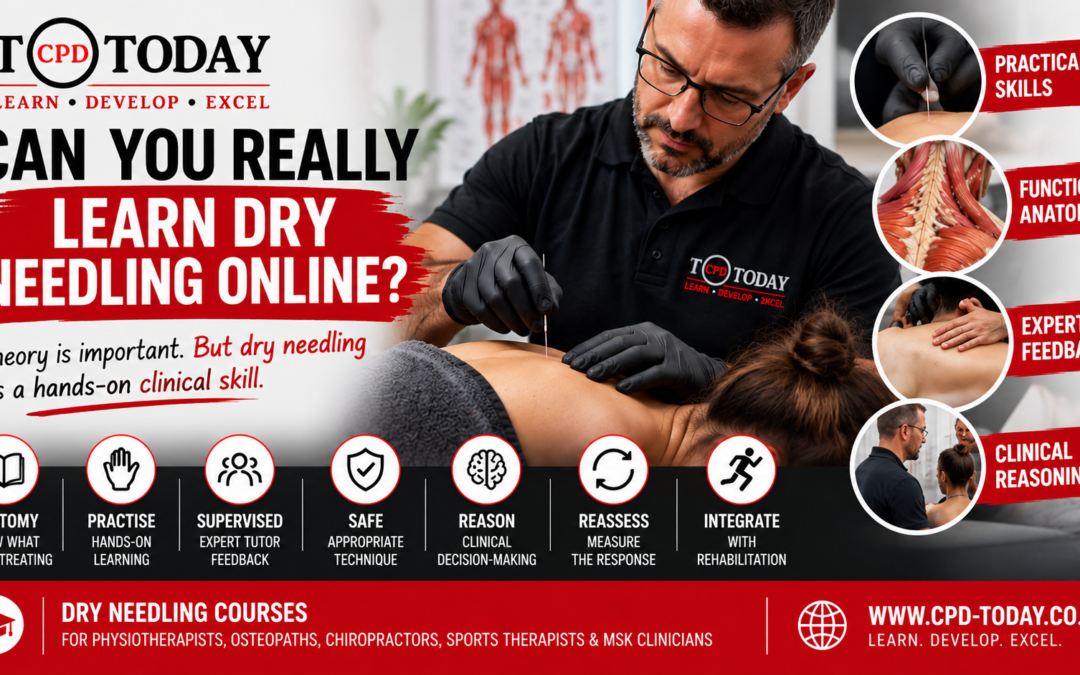
Can You Really Learn Dry Needling Online?
There has never been more clinical education available online.
You can watch videos, study anatomy, read research papers, attend webinars and complete online CPD without leaving home.
For many areas of professional development, that’s incredibly useful.
But dry needling is different.
Dry needling is a practical, invasive clinical skill. Learning the theory is important, but eventually you have to translate that knowledge into what happens when you’re standing next to a real patient with a needle in your hand.
That’s why at CPD Today, our Foundation Dry Needling Course places such a strong emphasis on face-to-face, supervised practical training.
We don’t just want you to know about dry needling.
We want you to develop the practical skills and clinical reasoning required to use it appropriately.
Watching Dry Needling Isn’t the Same as Performing It
Watching an experienced clinician perform dry needling can make the technique appear relatively straightforward.
Identify the muscle.
Position the patient.
Insert the needle.
But when you perform the technique yourself for the first time, you quickly realise there’s considerably more involved.
You need to think about:
Anatomy
Palpation
Patient positioning
Needle handling
Needle direction
Tissue depth
Surrounding structures
Patient communication
Consent
Treatment dosage
Your own hand position
And you need to consider all of those things while communicating confidently with the patient.
That requires practice.
Why Supervised Practice Matters
Imagine you’re learning a dry needling technique.
You identify the anatomical landmarks, palpate the target tissue and position your needle.
You think everything looks correct.
But an experienced instructor notices that changing your hand position slightly would improve your technique.
That correction might take ten seconds.
But it could fundamentally change how you perform that technique in future.
That’s the value of supervised practical education.
An instructor can observe things you may not recognise yourself.
Immediate Feedback Develops Better Technique
During practical training, our tutors can help delegates refine areas such as:
Palpation
Patient positioning
Hand position
Needle handling
Needle direction
Communication
Treatment selection
Clinical reasoning
That immediate feedback is difficult to replicate through online learning alone.
A video can demonstrate a technique.
It can’t watch you perform it.
Anatomy Comes Alive When You Apply It
Most clinicians attending our courses already have considerable anatomical knowledge.
But there’s an important difference between identifying a muscle in an anatomy book and confidently identifying it on a real person.
Patients vary.
Muscle bulk varies.
Body composition varies.
Landmarks vary.
Position changes anatomical relationships.
That’s why our practical sessions combine:
Anatomy → Palpation → Positioning → Technique
rather than teaching them as completely separate subjects.
It’s Not About Memorising Needle Positions
One of the easiest ways to teach dry needling would be to show delegates photographs and say:
“Put the needle here.”
We deliberately don’t want our training to work like that.
Because what happens when the patient in front of you doesn’t look like the person in the photograph?
Instead, we want you to understand:
What structure am I targeting?
How do I identify it?
What surrounds it?
Why am I treating it?
Is dry needling appropriate?
Understanding the anatomy and reasoning allows you to adapt.
Memorising a photograph doesn’t.
Practical Training Builds Confidence
Many delegates attending their first dry needling course understandably feel nervous.
Some have never held an acupuncture needle before.
That’s perfectly normal.
We don’t expect you to arrive confident.
Building that confidence is part of the course.
Skills are introduced progressively, allowing delegates to develop familiarity with needle handling before progressing through practical techniques.
With demonstration, supervised practice and tutor feedback, something that initially feels unfamiliar can gradually become much more comfortable.
Learn in an Environment Where You Can Ask Questions
Clinical learning rarely follows a perfectly straight line.
During practical training, questions naturally appear:
“Am I definitely on the right muscle?”
“Could I change the patient’s position?”
“How deep should I be thinking here?”
“What would you do with a larger patient?”
“Would you use this technique in this presentation?”
These discussions are extremely valuable.
They’re also difficult to predict when designing prerecorded educational material.
Face-to-face learning allows the teaching to respond to what delegates actually need.
We Teach the Reasoning, Not Just the Needle
Being able to perform a technique doesn’t automatically mean you should use it.
That’s why our Foundation Course places considerable emphasis on clinical reasoning.
Before dry needling, we encourage clinicians to ask:
What is the patient’s presentation?
What does my assessment demonstrate?
Why am I considering dry needling?
What am I trying to change?
Are there contraindications or precautions?
How will I assess the response?
What will I do afterwards?
This changes the thought process from:
“Which muscle should I needle?”
to:
“What does this patient actually need?”
Safety Needs More Than a PowerPoint Slide
Safety is fundamental to dry needling.
But learning safety shouldn’t simply mean sitting through a presentation about contraindications.
Safety needs to be integrated into practical teaching.
When learning a technique, delegates should consider:
Relevant anatomy
Nearby structures
Patient positioning
Needle direction
Appropriate technique
Contraindications
Precautions
Hygiene
Patient communication
This makes safety part of how you perform the technique, rather than something you learned several hours earlier in a lecture.
Why Small Teaching Groups and Tutor Access Matter
When comparing dry needling courses, don’t only look at the number of techniques listed.
Ask yourself:
How much actual supervision will I receive?
Practical education works best when tutors can observe delegates, answer questions and provide individual feedback.
A long list of muscles on a course programme might look impressive.
But we’d rather you leave understanding the techniques you’ve learned than rush through an enormous checklist.
Quality of learning matters more than quantity of techniques.
What Should You Expect From a Foundation Dry Needling Course?
If you’re considering learning dry needling, we’d recommend looking for a course that includes:
Strong anatomy teaching
You should understand the structures you’re treating and those around them.
Extensive practical training
Dry needling is a practical skill. You need time to practise.
Instructor feedback
Someone should observe and help refine your technique.
Safety education
Contraindications, precautions and anatomical safety should be embedded throughout the course.
Clinical reasoning
You should understand when and why you might use dry needling.
Reassessment
You should learn how to evaluate whether your intervention actually produced a useful change.
Rehabilitation
Dry needling should fit within wider patient management rather than becoming an isolated treatment.
These principles form the foundation of how we teach at CPD Today.
What Makes the CPD Today Foundation Dry Needling Course Different?
Our aim isn’t to produce clinicians who can simply say:
“I know how to put a needle into a muscle.”
We want delegates to leave understanding the entire clinical process.
Assess
Understand the patient and their presentation.
Reason
Decide whether dry needling is appropriate.
Identify
Use anatomy and palpation to identify the relevant structures.
Use that change to progress the patient’s management.
This creates a much more clinically useful framework than simply memorising needling locations.
Who Is Our Foundation Dry Needling Course For?
Our Foundation training is designed for appropriately qualified healthcare and musculoskeletal professionals who want to develop dry needling skills.
Depending on eligibility, this may include:
Physiotherapists
Osteopaths
Chiropractors
Sports therapists
Other appropriately qualified MSK practitioners
Previous dry needling experience isn’t normally the point of Foundation training.
The course is designed to develop those foundations.
Clinicians should confirm their individual professional scope and insurance requirements before incorporating dry needling into practice.
What If I’m Nervous About Learning Dry Needling?
You’re unlikely to be the only person in the room.
Learning an invasive technique can initially feel very different from learning another manual therapy technique.
That’s why the progression of teaching matters.
We want delegates to move from:
Understanding
↓
Watching
↓
Practising
↓
Receiving feedback
↓
Practising again
↓
Developing confidence
You aren’t simply given a needle and expected to get on with it.
What Happens After the Foundation Course?
Your learning shouldn’t stop when the course finishes.
The next stage is consolidating your skills appropriately in clinical practice.
Over time you’ll discover:
Which techniques you use most
Which presentations you find most appropriate
Where you need more practice
Which clinical questions arise
Where you want to develop further
For clinicians who already have appropriate Foundation training and clinical experience, our Advanced Dry Needling & Electroacupuncture training provides a natural next stage of professional development.
This creates a training pathway:
Foundation → Clinical Experience → Advanced Development
rather than a collection of unrelated CPD courses.
Foundation or Advanced Dry Needling?
If you’ve never received appropriate dry needling training, Foundation Dry Needling is generally the logical starting point.
If you’re already trained, confident with fundamental techniques and regularly using dry needling clinically, Advanced Dry Needling & Electroacupuncture may be more appropriate.
Don’t choose Advanced simply because the word sounds better.
Advanced practice requires strong foundations.
Why Choose CPD Today for Dry Needling Training?
We believe good CPD should change what happens when you return to clinic.
We aren’t interested in simply helping you collect another certificate.
We want you to become a better clinician.
Frequently Asked Questions
Can I learn dry needling online?
Online education can be valuable for theoretical learning, anatomy revision and evidence. However, initial dry needling training benefits significantly from supervised practical education because it is a hands-on invasive clinical skill.
Do I need previous dry needling experience?
A Foundation Dry Needling Course is intended to establish fundamental knowledge and practical skills, so previous dry needling experience isn’t generally expected.
Will I practise dry needling during the course?
Practical training is a major component of CPD Today’s approach, allowing delegates to develop skills under supervision and receive tutor feedback.
Is dry needling difficult to learn?
Needle handling itself can be developed relatively quickly, but good dry needling practice also requires anatomy, palpation, safety, clinical reasoning and appropriate patient selection.
Who can attend a dry needling course?
Eligibility depends on professional qualifications, scope of practice, insurance and the individual course requirements. Check your eligibility before booking.
What should I look for when choosing a dry needling course?
Look beyond price and the number of muscles advertised. Consider practical teaching time, instructor experience, anatomy, safety, clinical reasoning, tutor access and how the training integrates dry needling into wider patient management.
Ready to Learn Dry Needling?
If you’re searching for a practical Dry Needling Course in the UK, choose training that gives you more than a collection of techniques.
The CPD Today Foundation Dry Needling Course is designed to help eligible clinicians develop the anatomy, practical skills, safety awareness and clinical reasoning required to begin integrating dry needling into MSK practice.
New to dry needling?
Start with our Foundation Dry Needling Course.
Already appropriately trained?
Develop your skills with Advanced Dry Needling & Electroacupuncture.
Don’t just watch dry needling. Learn it. Practise it. Understand it.
Rigid, Kinesiology or Biomechanical Tape: Which Tape Should You Choose?
A Clinical Guide to Choosing the Right Taping Approach
If you use taping in musculoskeletal practice, one of the most important questions isn’t:
“How do I tape this condition?”
It is:
“What am I actually trying to achieve with the tape?”
Rigid sports tape, kinesiology tape and biomechanical tape can all have a role in modern MSK rehabilitation, but they have different properties and can be used for different clinical objectives.
Rigid tape may be selected when greater external support or movement restriction is required. Kinesiology tape may be considered when pain modulation and sensorimotor input are the objective. Biomechanical tapes, including Dynamic Tape® and Strapit Active Tape, can be used when the aim is to influence mechanical load or assist movement.
Understanding these differences is central to the CPD Today Clinical Strapping & Taping Course.
We don’t simply teach clinicians how to copy taping applications.
We teach you to choose the right tape, for the right patient, for the right reason.
The Three Main Clinical Taping Approaches
For practical clinical reasoning, it is useful to consider three broad approaches:
1. Rigid Sports Taping
Support • Protection • Movement Control
2. Kinesiology Taping
Sensory Input • Pain Modulation • Movement Awareness
3. Biomechanical Taping
Load Modification • Movement Assistance • Elastic Recoil
There can be overlap between these objectives, but understanding the different properties of each tape helps clinicians make more informed decisions.
Quick Comparison: Which Tape Does What?
Rigid Sports Tape
Kinesiology Tape
Biomechanical Tape
Elasticity
Minimal
Elastic
Highly elastic
Primary clinical rationale
Support/control
Sensorimotor/pain modulation
Mechanical assistance/load modification
Restricts movement
Can do
Generally no
Generally no
Allows functional movement
Depends on application
Yes
Yes
Mechanical support
High
Relatively limited
Dynamic
Movement assistance
Limited
Not usually primary objective
Key objective
Examples
Zinc oxide/rigid tape
K-tape
Dynamic Tape®, Strapit Active Tape
Typical use
Protection/stability
Symptoms/rehabilitation
Movement/load management
The important point is that there isn’t one “best” tape.
The appropriate tape depends on what you’re trying to achieve.
When Should You Choose Rigid Sports Tape?
Rigid sports taping has been used within sports medicine for decades.
Because it has little elasticity, it can provide substantial external support.
A clinician may choose rigid tape when they want to:
Restrict excessive movement
Protect an injured structure
Increase joint support
Improve perceived stability
Support return to activity
Reduce the risk of recurrent injury in selected situations
One of the classic examples is the ankle.
Example: Lateral Ankle Sprain
Consider an athlete returning to sport following a lateral ankle sprain.
If your clinical objective is to reduce excessive inversion while allowing the athlete to participate, rigid sports taping may be appropriate.
Here the reasoning is:
Problem: unwanted/excessive movement.
Objective: control that movement.
Tape choice: rigid sports tape.
The tape’s lack of elasticity becomes an advantage because movement restriction is part of the objective.
When Should You Choose Kinesiology Tape?
Kinesiology tape behaves very differently.
It stretches considerably more than rigid sports tape and is generally applied without trying to substantially restrict normal movement.
Potential clinical objectives include:
Pain modulation
Cutaneous sensory input
Sensorimotor feedback
Movement awareness
Supporting rehabilitation
Helping patients tolerate activity
The evidence surrounding kinesiology taping is sometimes presented as simply “it works” or “it doesn’t”.
The reality is more nuanced.
Systematic reviews and meta-analyses have reported short-term improvements in pain and/or function for some musculoskeletal conditions, while results for other conditions and longer-term outcomes remain mixed.
This is why kinesiology tape is better considered an adjunct to rehabilitation, rather than a stand-alone treatment.
Kinesiology Taping and Chronic MSK Conditions
This is particularly relevant when treating persistent musculoskeletal presentations.
Research has explored kinesiology taping in conditions including:
Chronic low back pain
Knee osteoarthritis
Patellofemoral pain
Shoulder pain
Neck pain
Other persistent MSK presentations
Some systematic reviews have identified improvements in pain or disability, although the magnitude and certainty of benefits vary.
Therefore, the sensible clinical position isn’t:
“Kinesiology tape cures chronic pain.”
Nor is it:
“Kinesiology tape doesn’t work.”
Instead:
Kinesiology taping may provide useful short-term symptom modification for selected patients, particularly when it helps them participate in active rehabilitation.
That is a much more defensible evidence-informed position.
Example: Pain During Rehabilitation
Imagine a patient with knee pain who finds squatting uncomfortable.
Their rehabilitation requires progressive strengthening, but pain is limiting their confidence.
You apply kinesiology tape.
You reassess the squat.
Their pain reduces and they can perform the exercise more comfortably.
The tape hasn’t necessarily “fixed” their knee.
But it may have helped them perform the rehabilitation that contributes to longer-term improvement.
That can still be clinically valuable.
When Should You Choose Biomechanical Tape?
Biomechanical taping introduces another clinical objective.
Highly elastic tapes such as Dynamic Tape® and Strapit Active Tape can be applied to interact mechanically with movement.
Potential objectives include:
Modifying mechanical load
Assisting movement
Reducing demand on selected tissues
Redistributing forces
Supporting functional activity
Improving tolerance to rehabilitation
Rather than simply asking where the patient hurts, biomechanical taping encourages clinicians to think about:
Movement + force + load + capacity.
Dynamic Tape® and Strapit Active Tape
Dynamic Tape® and Strapit Active Tape can both be used within a biomechanical taping approach.
They do not need to be considered separate treatment philosophies.
The underlying clinical reasoning is the same:
How can the elastic properties of the tape be used to influence the mechanical demands of movement?
This shifts the focus away from brand and towards biomechanics.
The External Spring Concept
A useful way to visualise biomechanical taping is as an external elastic spring.
As biomechanical tape stretches, elastic energy can be stored within the material.
As it recoils, it generates an elastic force.
When an application is appropriately designed, this mechanical behaviour may be used to assist movement or modify demand.
The effect depends on factors including:
Tape properties
Direction
Tension
Patient position
Anchoring
Movement being performed
This is one reason biomechanical taping benefits considerably from practical instruction.
Example: Achilles Tendinopathy
Consider a runner with load-sensitive Achilles tendinopathy.
The long-term objective is usually not to permanently unload the tendon.
The tendon needs progressively appropriate loading to develop capacity.
However, the runner may temporarily struggle with the mechanical demands of walking, running or rehabilitation.
A biomechanical taping application could potentially be used to help modify some of that demand.
The tape supports rehabilitation rather than replacing it.
So Which Tape Should You Choose?
Rather than starting with the patient’s diagnosis, start with your clinical objective.
Do I want to restrict or control movement?
Consider rigid sports tape.
Do I want sensory input or short-term symptom modification while maintaining movement?
Consider kinesiology tape.
Do I want to mechanically assist movement or modify load?
Consider biomechanical tape.
That simple framework can dramatically improve clinical decision-making.
One Diagnosis Doesn’t Equal One Tape
This is an important concept.
Take knee pain.
Depending on your assessment, you might choose:
Rigid tape if you want stronger mechanical control or support.
Kinesiology tape if you’re attempting to modify symptoms or provide sensory input during rehabilitation.
Biomechanical tape if your objective is to influence mechanical demand during a functional movement.
Three patients.
Same broad area of symptoms.
Three potentially different strategies.
This is why memorising “the knee taping technique” isn’t enough.
Assess → Select → Apply → Reassess
At CPD Today, we encourage clinicians to use a simple framework.
1. Assess
Identify the patient’s symptoms, movement problem and functional limitation.
2. Define Your Objective
What specifically do you want the tape to achieve?
3. Select
Choose the taping system with the properties most appropriate for that objective.
4. Apply
Use appropriate positioning, direction, tension and technique.
5. Reassess
Repeat the movement or task you assessed beforehand.
Did anything meaningful change?
If not, reconsider the application.
Don’t Choose Tape by Colour
This sounds obvious, but it highlights an important issue.
Clinicians sometimes become attached to a particular taping system because it is what they were originally taught.
Everything then gets treated with the same tape.
But good clinical practice should work in the opposite direction:
Patient → Objective → Tape selection
not:
Favourite tape → Find somewhere to put it.
Understanding several taping approaches gives clinicians far more flexibility.
Why Learning All Three Approaches Matters
This is one of the major reasons the CPD Today Clinical Strapping & Taping Course teaches rigid, kinesiology and biomechanical taping together.
If you only know rigid taping, your options are limited.
If you only know kinesiology taping, your options are limited.
If you only know biomechanical taping, your options are limited.
Understanding all three means you can select an approach based upon the clinical problem rather than the technique you happen to know.
More Than a Taping Course
Our aim isn’t simply to teach you a long list of applications.
We want clinicians to understand:
Why different tapes behave differently
How tape properties influence clinical use
When restriction is appropriate
When movement should be maintained
How sensory input may influence symptoms
How mechanical load can be modified
How positioning affects an application
How tape tension changes the effect
How to integrate taping with rehabilitation
How to reassess whether an application has worked
That turns taping from a collection of recipes into a clinical reasoning skill.
Hands-On Practical Training
Taping is a practical skill.
You can watch hundreds of online videos and still struggle with:
Correct tension
Anchoring
Direction
Patient positioning
Handling the tape
Avoiding wrinkles
Creating appropriate mechanical effects
Adapting techniques to different body types
These skills improve through practice and feedback.
During CPD Today training, clinicians have the opportunity to apply techniques themselves, experience being taped and develop confidence through supervised practical learning.
Who Is the Course For?
The CPD Today Clinical Strapping & Taping Course is suitable for healthcare professionals working with musculoskeletal conditions, rehabilitation and sport, including:
Physiotherapists
Osteopaths
Chiropractors
Sports therapists
Rehabilitation practitioners
Other appropriately qualified MSK professionals
Whether you’re completely new to taping or already use tape regularly, learning multiple approaches can considerably expand your clinical toolkit.
Practical Applications
Throughout the course, taping principles can be explored in relation to common MSK presentations such as:
Ankle sprains
Knee pain
Patellofemoral pain
Achilles tendinopathy
Plantar heel pain
Shoulder pain
Tennis and golfer’s elbow
Tendinopathies
Running injuries
Sporting injuries
Functional rehabilitation
But importantly, we don’t want you simply memorising an application for each condition.
We want you to understand enough to adapt your technique to the individual patient.
Frequently Asked Questions
What is the difference between rigid, kinesiology and biomechanical tape?
Rigid sports tape primarily provides support and can restrict movement. Kinesiology tape is elastic and is commonly used for sensory input, symptom modulation and rehabilitation. Biomechanical tape is highly elastic and can be applied with the aim of mechanically assisting movement or modifying load.
Which tape is best for sports injuries?
There isn’t one best tape for every sports injury. The appropriate choice depends on the injury, stage of rehabilitation and clinical objective.
Is kinesiology tape evidence-based?
Systematic reviews suggest potential short-term benefits for pain and function in some musculoskeletal conditions, but findings vary. It is best viewed as a potential adjunct to active rehabilitation rather than a stand-alone treatment.
Are Dynamic Tape® and Strapit Active Tape biomechanical tapes?
Yes. Both can be used according to biomechanical taping principles involving movement assistance and load modification.
Is biomechanical tape better than kinesiology tape?
No. They have different properties and may be selected for different clinical objectives.
Should taping replace exercise rehabilitation?
No. Taping should generally complement rather than replace appropriate exercise, progressive loading, education and rehabilitation.
Learn to Choose the Right Tape with CPD Today
The most valuable taping skill isn’t memorising hundreds of applications.
It’s knowing what you’re trying to achieve and which tool gives you the best chance of achieving it.
Load Modification • Movement Assistance • Functional Support
You’ll combine hands-on practical learning with clinical reasoning and evidence-informed teaching, developing skills you can take directly back into clinical practice.
Don’t Just Learn How to Tape. Learn How to Think About Taping.
If you’re a physiotherapist, osteopath, chiropractor, sports therapist or other MSK professional wanting to improve your clinical taping skills, our course is designed to give you a much broader understanding than learning one taping system alone.
Learn • Develop • Excel with CPD Today.
The right tape. For the right patient. For the right reason.
Book Your Place on the CPD Today Clinical Strapping & Taping Course
Develop your practical skills, expand your treatment options and gain the confidence to make better-informed taping decisions in everyday MSK practice.
Suggested SEO
SEO title: Rigid vs Kinesiology vs Biomechanical Tape: Which Should You Choose?
Meta description: Rigid, kinesiology or biomechanical tape? Learn the key differences, clinical uses and how to choose the right taping approach for your patient.
Primary keyword: rigid vs kinesiology vs biomechanical tape