Enhance Your Clinical Skills with CPD Today
Dry needling has become one of the most valuable treatment techniques used by modern musculoskeletal healthcare professionals. Whether you are an osteopath, physiotherapist, chiropractor or sports therapist, dry needling can provide an effective addition to your clinical toolbox, helping patients reduce pain, improve movement and recover from injury more efficiently.
At CPD Today, our evidence-based Dry Needling Courses combine current research with extensive practical training, giving clinicians the confidence and competence to safely integrate dry needling into everyday practice.
What is Dry Needling?
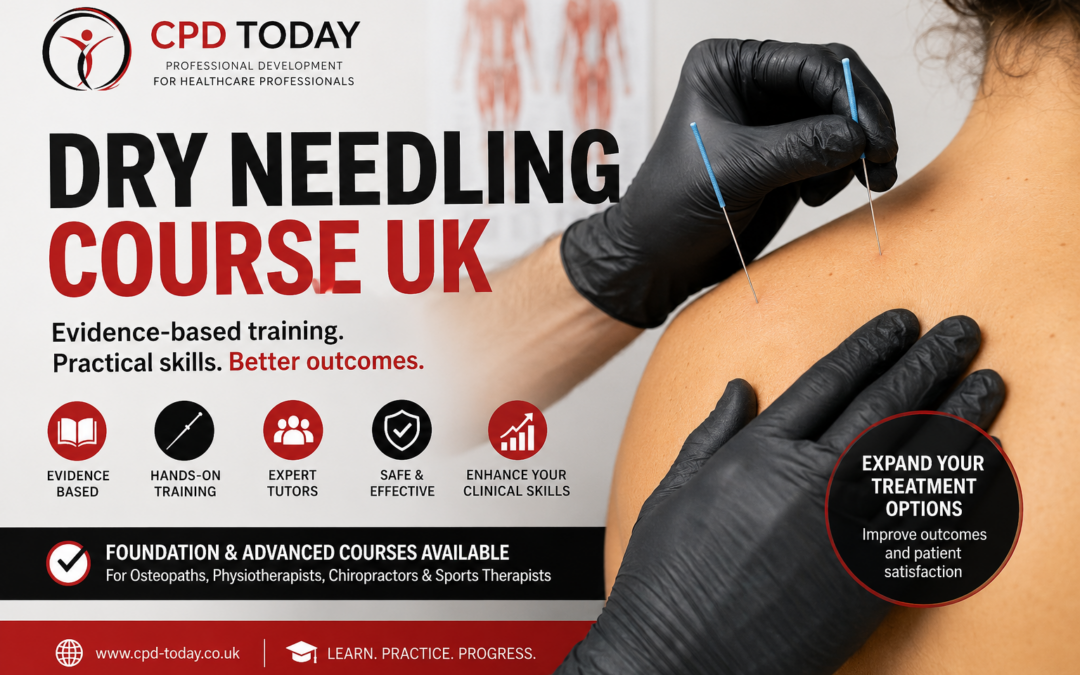
Dry needling is a treatment technique involving the insertion of fine, sterile acupuncture needles into muscles, trigger points and connective tissues to reduce pain and improve function.
Unlike traditional acupuncture, which is based on Traditional Chinese Medicine, modern dry needling is founded on contemporary anatomy, physiology, neurophysiology and pain science.
It is commonly used alongside:
- Manual therapy
- Joint mobilisation and manipulation
- Rehabilitation programmes
- Exercise prescription
- Soft tissue techniques
- Patient education
The aim is not simply to reduce symptoms but to improve movement, restore normal muscle function and support long-term recovery.
How Does Dry Needling Work?
Research suggests dry needling may work through several physiological mechanisms, including:
Mechanical Effects
Insertion of the needle can disrupt dysfunctional muscle fibres and trigger points while improving local tissue mobility.
Neurological Effects
Needling stimulates the nervous system, helping to reduce pain sensitivity through spinal and supraspinal mechanisms.
Improved Blood Flow
Needling may increase local circulation, encouraging tissue healing and reducing muscle tightness.
Reduced Muscle Tone
Dry needling often produces an immediate reduction in muscle tension, allowing improved movement and easier rehabilitation.
Pain Modulation
The technique may activate endogenous pain inhibitory pathways, helping patients experience reduced pain levels.
Conditions That May Benefit From Dry Needling
Dry needling can be incorporated into the management of many musculoskeletal conditions, including:
- Neck pain
- Low back pain
- Shoulder pain
- Rotator cuff disorders
- Tennis elbow
- Golfer’s elbow
- Plantar fasciitis
- Achilles tendinopathy
- Hip pain
- Knee pain
- Headaches
- Cervicogenic headaches
- Migraine (when muscular contributors are present)
- Temporomandibular Disorders (TMJ)
- Sciatica with muscular involvement
- Sports injuries
- Muscle strains
- Myofascial pain syndrome
Dry needling should always form part of a comprehensive clinical assessment and treatment programme rather than being used as a stand-alone intervention.
What Does the Research Say?
Growing evidence supports the use of dry needling for selected musculoskeletal conditions, particularly when combined with exercise and manual therapy.
Research has demonstrated improvements in:
- Pain intensity
- Range of movement
- Muscle activation
- Functional outcomes
- Trigger point sensitivity
The strongest clinical outcomes are generally achieved when dry needling is integrated into a broader evidence-based management plan that includes education, rehabilitation and hands-on treatment.
Why Learn Dry Needling?
Healthcare professionals increasingly seek practical skills that enhance patient care while remaining evidence informed.
Dry needling offers several benefits:
- Expands your treatment options
- Improves confidence managing persistent pain
- Enhances manual therapy techniques
- Supports faster rehabilitation
- Increases clinical reasoning skills
- Provides another effective option when manual therapy alone is insufficient
Many clinicians also find that patients actively seek practitioners who offer dry needling as part of their musculoskeletal services.
Why Choose a CPD Today Dry Needling Course?
At CPD Today, we believe excellent education goes beyond learning where to place a needle.
Our courses emphasise:
Evidence-Based Practice
Every technique is underpinned by current clinical evidence and modern pain science.
Safety First
We place significant emphasis on safety, contraindications, precautions, informed consent and clinical reasoning.
Extensive Practical Training
Our courses maximise hands-on learning, allowing delegates to develop confidence under expert supervision.
Small Group Teaching
Smaller class sizes provide greater individual feedback and more practical time.
Experienced Faculty
Courses are delivered by experienced clinicians with backgrounds in musculoskeletal practice, education and postgraduate training.
Foundation Dry Needling Course
Our Foundation Course is ideal for clinicians new to dry needling.
Topics include:
- Relevant anatomy
- Needle handling
- Safety procedures
- Infection control
- Trigger point assessment
- Clinical reasoning
- Common musculoskeletal conditions
- Practical needling techniques
- Integrating dry needling into patient management
Suitable for:
- Osteopaths
- Physiotherapists
- Chiropractors
- Sports Therapists
- Other appropriately qualified healthcare professionals
Advanced Dry Needling Course
Once you’ve mastered the fundamentals, our Advanced Dry Needling Course expands your clinical skills into more complex anatomical regions.
Advanced topics include:
- TMJ and muscles of mastication
- Anterior cervical region
- Deep spinal muscles
- Rib dysfunction
- Popliteus
- Pronator teres and supinator
- Carpal tunnel related structures
- Advanced clinical reasoning
- Electric acupuncture techniques
- Complex patient presentations
This course is designed for clinicians who already possess a solid understanding of dry needling fundamentals and wish to broaden their scope of practice safely.
Who Should Attend?
Our courses are suitable for qualified healthcare professionals working in musculoskeletal practice, including:
- Osteopaths
- Physiotherapists
- Chiropractors
- Sports Therapists
- Rehabilitation professionals
- Final-year healthcare students (where appropriate)
Frequently Asked Questions
Is dry needling painful?
Most patients experience minimal discomfort. Some muscles are more sensitive than others, but treatment is generally well tolerated.
Is dry needling safe?
Yes. When performed by appropriately trained healthcare professionals using sterile single-use needles and sound clinical reasoning, dry needling is considered a safe treatment.
Is dry needling the same as acupuncture?
No. Dry needling is based on modern anatomy, neuroscience and musculoskeletal medicine, whereas traditional acupuncture follows Traditional Chinese Medicine principles.
Do I need previous experience?
No. Our Foundation Course is designed for clinicians with no previous dry needling experience.
Can physiotherapists perform dry needling?
Yes, following appropriate postgraduate training and within professional scope of practice.
Can osteopaths learn dry needling?
Absolutely. Many osteopaths integrate dry needling alongside osteopathic techniques and rehabilitation.
What should I bring to the course?
Comfortable clothing suitable for practical sessions. All needles and course materials are provided.
Will I receive a certificate?
Yes. Delegates receive certification upon successful completion of the course.
How much practical teaching is included?
A significant proportion of the course is dedicated to supervised practical sessions to build confidence and competence.
Why choose CPD Today?
Our courses combine evidence-based teaching, expert faculty, extensive practical experience and a strong focus on clinical reasoning, helping clinicians develop skills they can confidently apply in everyday practice.
Book Your Dry Needling Course
Whether you are looking to develop new clinical skills or enhance your existing musculoskeletal practice, CPD Today’s Dry Needling Courses provide practical, evidence-based education delivered by experienced clinicians.
From foundation training through to advanced dry needling and electric acupuncture, our courses are designed to improve your confidence, clinical reasoning and patient outcomes.
If you’re ready to expand your treatment options and advance your career, explore our upcoming courses and join hundreds of healthcare professionals who have trained with CPD Today.
Learn. Practice. Progress.