
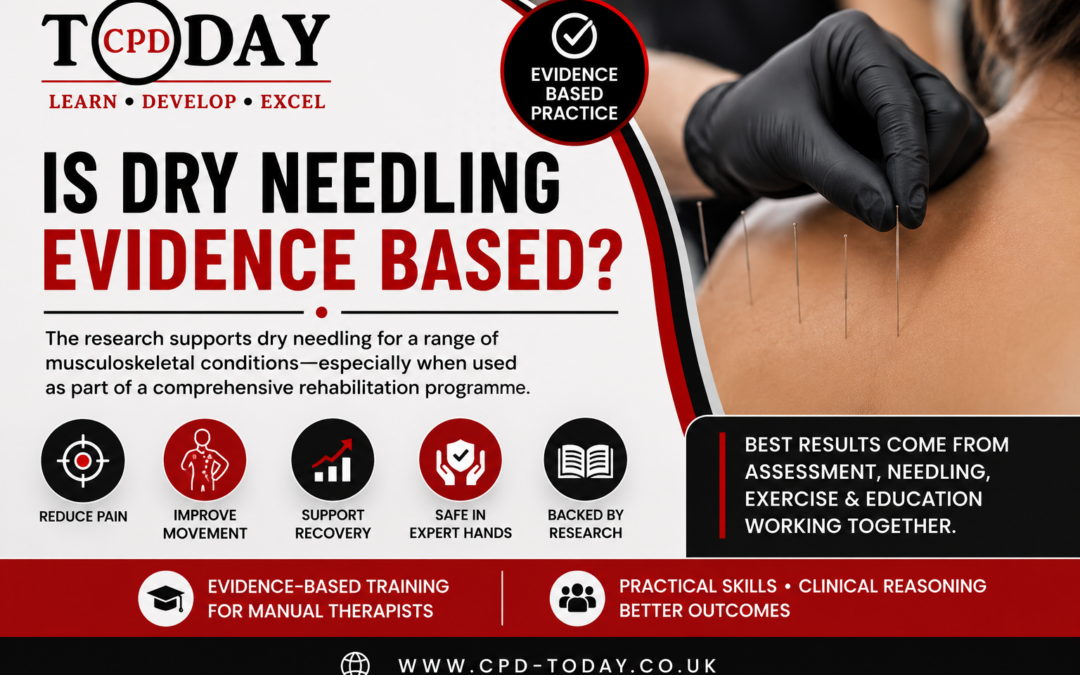
The Evidence for Dry Needling: What Does the Research Say?
Meta Description: Discover what the latest research says about dry needling. Explore the evidence, benefits, limitations and clinical applications of dry needling in modern musculoskeletal practice.
The Evidence for Dry Needling: What Does the Research Say?
Dry needling has become an increasingly popular treatment option for musculoskeletal pain, with many physiotherapists, osteopaths, chiropractors and other healthcare professionals incorporating it into everyday clinical practice.
However, one question is asked time and time again:
“Is dry needling evidence based?”
The answer is yes—but with an important caveat.
Current research supports dry needling for a range of musculoskeletal conditions, particularly when it is used as part of a comprehensive rehabilitation programme rather than as a stand-alone treatment. Like many interventions in healthcare, its effectiveness depends on appropriate patient selection, sound clinical reasoning and integration with other evidence-based treatments.
What Is Dry Needling?
Dry needling is an evidence-informed treatment that uses fine, sterile, single-use needles to target muscles, myofascial trigger points and other soft tissues that may contribute to pain and movement dysfunction.
Unlike traditional acupuncture, dry needling is based on modern scientific principles, including:
- Functional anatomy
- Neurophysiology
- Pain science
- Biomechanics
- Clinical reasoning
Treatment is guided by a detailed musculoskeletal assessment rather than traditional Chinese medicine concepts, making it a valuable adjunct within modern rehabilitation.
What Does the Research Show?
Over the last two decades, hundreds of randomised controlled trials, systematic reviews and meta-analyses have investigated the effectiveness of dry needling.
Overall, the evidence suggests dry needling can provide short- to medium-term improvements in pain, function and movement, particularly when combined with exercise therapy, education and manual therapy.
Research indicates dry needling may help:
- Reduce pain intensity
- Improve range of movement
- Reduce muscle tenderness
- Improve muscle activation
- Decrease myofascial trigger point sensitivity
- Improve physical function
- Enhance participation in rehabilitation
- Support return to work and sport
The strongest evidence supports dry needling as one component of a multimodal treatment programme, rather than as a stand-alone intervention.
Conditions Supported by Current Evidence
Low Back Pain
Moderate-quality evidence suggests dry needling can reduce pain and disability in patients with mechanical low back pain, particularly when combined with exercise and rehabilitation.
Neck Pain
Research demonstrates improvements in pain and cervical movement when dry needling is incorporated into treatment for acute and chronic neck pain.
Shoulder Pain
Systematic reviews report moderate evidence for reducing pain and improving function in patients with rotator cuff-related shoulder pain and subacromial pain syndrome.
Plantar Fasciitis
Emerging evidence indicates dry needling may reduce heel pain and improve walking ability when combined with appropriate loading programmes.
Tennis Elbow
Studies suggest dry needling may improve grip strength while reducing pain in patients with lateral elbow tendinopathy.
Temporomandibular Disorders (TMJ)
Growing evidence supports the use of dry needling for reducing jaw pain, muscle tension and improving mouth opening in selected patients with temporomandibular disorders.
How Does Dry Needling Work?
Although research continues to evolve, several physiological mechanisms have been proposed.
Pain Modulation
Needling stimulates the nervous system, activating descending inhibitory pathways that can reduce pain sensitivity.
Mechanical Effects
Dry needling may decrease excessive muscle tension and improve tissue extensibility.
Improved Local Circulation
Needling appears to increase local blood flow, potentially supporting tissue healing and recovery.
Neurophysiological Changes
Research suggests dry needling influences both peripheral and central pain processing, helping to normalise muscle function and reduce pain.
Facilitating Rehabilitation
By reducing pain and muscle guarding, dry needling often enables patients to engage more effectively with exercise therapy and rehabilitation programmes.
What Are the Limitations?
Like all interventions, dry needling is not a universal solution.
Research varies considerably regarding:
- Needling techniques
- Treatment frequency
- Target tissues
- Patient populations
- Outcome measures
- Follow-up periods
Consequently, no single protocol is appropriate for every patient.
Modern evidence-based practice combines:
- The best available research
- Clinical expertise
- Patient values and preferences
This combination remains the cornerstone of high-quality musculoskeletal care.
Dry Needling Should Not Replace Rehabilitation
One of the clearest messages from current research is that dry needling works best when integrated into a broader rehabilitation programme.
The most effective management typically combines dry needling with:
- Patient education
- Exercise therapy
- Manual therapy
- Load management
- Functional rehabilitation
- Lifestyle advice
- Self-management strategies
This approach reflects current international clinical guidelines for managing musculoskeletal pain.
Why Clinical Reasoning Matters
The evidence does not support indiscriminate needling.
Successful outcomes depend on:
- Accurate diagnosis
- Appropriate patient selection
- Thorough assessment
- Safe and competent technique
- Clear treatment goals
- Ongoing reassessment
Dry needling is not simply about inserting needles—it is about making informed clinical decisions that enhance patient outcomes.
Learn Evidence-Based Dry Needling with CPD Today
At CPD Today, we believe great clinicians combine scientific evidence with exceptional practical skills and sound clinical reasoning.
Our Foundation and Advanced Dry Needling courses are designed specifically for healthcare professionals and focus on:
- Current evidence and research
- Functional anatomy
- Safe needling techniques
- Contraindications and precautions
- Clinical reasoning
- Hands-on practical training
- Integrating dry needling into modern musculoskeletal rehabilitation
Rather than teaching isolated techniques, our courses help clinicians understand when, why and how to use dry needling safely, confidently and effectively.
Whether you are beginning your dry needling journey or expanding your existing skills, our courses are designed to support evidence-based clinical practice.
Clinical Takeaway
Current evidence suggests that dry needling can be an effective treatment for a range of musculoskeletal conditions, particularly when used as part of a comprehensive rehabilitation programme that includes education, exercise therapy and manual therapy. It should not be viewed as a stand-alone treatment but as one component of evidence-based patient care. Clinicians who combine strong clinical reasoning with high-quality practical skills are best placed to achieve meaningful improvements in pain, function and patient outcomes.
Frequently Asked Questions
Is dry needling evidence based?
Yes. Numerous systematic reviews and meta-analyses support dry needling for several musculoskeletal conditions, particularly when combined with rehabilitation.
Does dry needling cure pain?
No. Dry needling can reduce pain and improve movement, but it is most effective when integrated into a comprehensive management plan.
Is there strong evidence for every condition?
No. Evidence strength varies between conditions, and research continues to evolve.
Why shouldn’t dry needling be used on its own?
Pain is influenced by biological, psychological and social factors. Combining dry needling with exercise, education and rehabilitation generally provides superior outcomes.
Who can learn dry needling?
Dry needling should only be performed by appropriately trained healthcare professionals working within their professional scope of practice and following local regulatory and insurance requirements.
References
- Kietrys DM, Palombaro KM, Azzaretto E, et al. (2013). Effectiveness of Dry Needling for Upper-Quarter Myofascial Pain: A Systematic Review and Meta-analysis. Journal of Orthopaedic & Sports Physical Therapy, 43(9), 620–634. https://www.jospt.org/doi/10.2519/jospt.2013.4668
- Liu L, Huang QM, Liu QG, et al. (2015). Effectiveness of Dry Needling for Myofascial Trigger Points Associated with Neck and Shoulder Pain. Archives of Physical Medicine and Rehabilitation, 96(5), 944–955. https://doi.org/10.1016/j.apmr.2014.12.015
- Hu HT, Gao H, Ma RJ, et al. (2018). Dry Needling for Low Back Pain: A Systematic Review and Meta-analysis. Archives of Physical Medicine and Rehabilitation, 99(1), 144–152. https://doi.org/10.1016/j.apmr.2017.06.008
- Navarro-Santana MJ, Sánchez-Infante J, Gómez-Chiguano GF, et al. (2021). Effects of Trigger Point Dry Needling for Non-traumatic Shoulder Pain. Physical Therapy, 101(2). https://doi.org/10.1093/ptj/pzaa216
- Gattie E, Cleland JA, Snodgrass SJ. (2017). The Effectiveness of Trigger Point Dry Needling for Musculoskeletal Conditions by Physical Therapists: A Systematic Review and Meta-analysis. Journal of Orthopaedic & Sports Physical Therapy, 47(3), 133–149. https://www.jospt.org/doi/10.2519/jospt.2017.7096
- National Institute for Health and Care Excellence (NICE). Chronic pain (primary and secondary) in over 16s: assessment of all chronic pain and management of chronic primary pain (NG193). https://www.nice.org.uk/guidance/ng193
Continue Your Learning
If you’re looking to develop your knowledge and practical skills, explore CPD Today’s Foundation and Advanced Dry Needling courses. Our evidence-based, hands-on training is designed for physiotherapists, osteopaths, chiropractors and other manual therapists who want to integrate dry needling safely and effectively into modern musculoskeletal practice.
Further reading:
- What Is Dry Needling?
- Dry Needling vs Acupuncture
- Dry Needling Safety: Contraindications and Precautions
- Dry Needling for Low Back Pain
- Dry Needling for Shoulder Pain
- Advanced Dry Needling & Electroacupuncture