
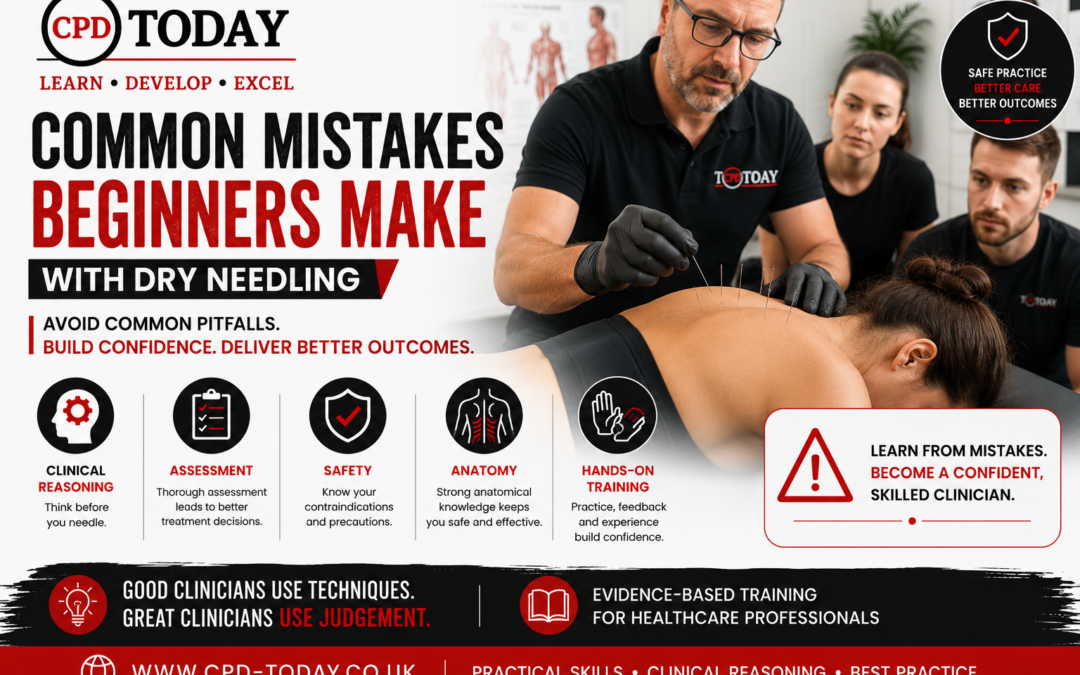
Common Mistakes Beginners Make with Dry Needling (And How to Avoid Them)
Meta Description: Discover the most common mistakes new clinicians make when learning dry needling and learn how to improve safety, confidence and patient outcomes through better clinical reasoning and practical skills.
Common Mistakes Beginners Make with Dry Needling (And How to Avoid Them)
Learning dry needling is an exciting step for many physiotherapists, osteopaths, chiropractors and other manual therapists. It adds another valuable tool to your clinical practice and, when used appropriately, can help patients manage pain, improve movement and support rehabilitation.
However, like any new clinical skill, confidence develops with experience. Many beginners make similar mistakes during their early practice—not because they lack ability, but because they are still developing their anatomical knowledge, clinical reasoning and practical technique.
The good news is that these mistakes are avoidable with high-quality training, supervised practice and a commitment to evidence-based care.
Mistake 1: Focusing on Needle Placement Instead of Clinical Reasoning
One of the biggest misconceptions is that successful dry needling is simply about inserting a needle into a painful muscle.
In reality, dry needling should always begin with a thorough assessment and a clear understanding of why treatment is appropriate.
Before reaching for a needle, ask yourself:
- What is the diagnosis?
- Is dry needling indicated?
- What outcome am I trying to achieve?
- Is another treatment more appropriate?
Great clinicians make treatment decisions—not just technical ones.
Mistake 2: Neglecting Functional Anatomy
Dry needling is built on anatomy.
Relying solely on memorised landmarks without understanding the underlying muscles, nerves, blood vessels and organs increases the risk of poor outcomes and unnecessary complications.
Take time to continually revise:
- Functional anatomy
- Surface anatomy
- Neurovascular structures
- Muscle actions
- Referred pain patterns
Confidence grows with anatomical understanding.
Mistake 3: Ignoring Contraindications and Precautions
Not every patient is suitable for dry needling.
Beginners sometimes become so focused on practising techniques that they overlook important factors such as:
- Anticoagulant medication
- Active infection
- Pregnancy
- Bleeding disorders
- Immune compromise
- Patient anxiety
- Needle phobia
Safe clinicians know that sometimes the best decision is not to needle.
Mistake 4: Trying to Treat Everything with Dry Needling
Dry needling is a valuable tool—but it is only one part of modern musculoskeletal care.
It should complement, not replace:
- Exercise therapy
- Manual therapy
- Patient education
- Load management
- Rehabilitation
Patients rarely recover because of one treatment alone.
Mistake 5: Rushing the Assessment
New clinicians often feel eager to start needling as quickly as possible.
However, a thorough assessment is the foundation of effective treatment.
This should include:
- Subjective history
- Objective examination
- Functional assessment
- Movement analysis
- Clinical diagnosis
- Goal setting
Good assessment leads to better treatment decisions.
Mistake 6: Poor Communication
Patients often feel anxious about needles.
Explaining:
- What dry needling is
- Why it is recommended
- What they may feel
- Possible side effects
- Aftercare advice
helps build trust and improves the patient experience.
Good communication is just as important as technical skill.
Mistake 7: Forgetting That Less Can Be More
Many beginners believe that treating more muscles means better results.
In reality, excessive needling may simply increase post-treatment soreness without improving outcomes.
Targeted treatment based on clinical reasoning is usually more effective than treating every painful structure.
Mistake 8: Inadequate Infection Control
Safe practice should become second nature.
Always:
- Wash your hands
- Use sterile, single-use needles
- Dispose of needles correctly
- Maintain a clean clinical environment
- Follow local infection control guidance
Patient safety should never be compromised.
Mistake 9: Avoiding Reassessment
Treatment should not end when the needles are removed.
Always reassess:
- Pain
- Movement
- Function
- Patient confidence
This helps determine whether treatment has achieved its intended outcome and guides future management.
Mistake 10: Expecting Immediate Results Every Time
While many patients experience rapid improvements, others require a combination of treatments over time.
Avoid promising instant results.
Instead, explain that dry needling forms part of a broader rehabilitation programme designed to improve long-term function and recovery.
Managing expectations leads to better patient satisfaction.
How to Build Confidence as a New Dry Needling Clinician
Confidence develops through:
- Regular supervised practice
- Continued anatomy revision
- Reflecting on patient outcomes
- Asking questions
- Continuing professional development
- Learning from experienced clinicians
The best practitioners never stop learning.
Why Choose CPD Today?
At CPD Today, our Foundation and Advanced Dry Needling courses are designed to help clinicians avoid these common mistakes from the very beginning.
We focus on:
- Clinical reasoning
- Functional anatomy
- Safety
- Practical skills
- Contraindications
- Evidence-based practice
- Hands-on supervised learning
- Integrating dry needling into rehabilitation
Our goal is to develop clinicians who are not only technically competent but also safe, confident and capable of making sound clinical decisions.
Clinical Takeaway
Most beginner mistakes in dry needling are not technical—they are clinical. Strong assessment skills, anatomical knowledge, effective communication and sound clinical reasoning are far more important than simply learning where to place a needle. By focusing on these fundamentals and continuing to develop through high-quality education and supervised practice, clinicians can build confidence and deliver safer, more effective patient care.
Frequently Asked Questions
Is it normal to lack confidence after a dry needling course?
Yes. Confidence develops through supervised practice, experience and continued learning. Most clinicians become more comfortable as they treat a wider range of patients.
What is the biggest mistake beginners make?
Focusing on needle placement rather than patient assessment and clinical reasoning. Successful treatment starts with understanding the patient, not just the technique.
Should dry needling replace manual therapy or exercise?
No. Dry needling works best as part of a comprehensive rehabilitation programme that includes exercise, education and other evidence-based treatments.
How can I improve my dry needling skills?
Regular practice, revising anatomy, reflecting on cases and attending advanced CPD courses all help build confidence and clinical competence.
Why is clinical reasoning so important?
Clinical reasoning helps you decide when dry needling is appropriate, when to modify treatment and when another approach may be more suitable. It is the foundation of safe and effective practice.
Continue Your Learning
If you’re ready to build confidence and refine your skills, explore CPD Today’s Foundation and Advanced Dry Needling courses. Our evidence-based, hands-on training is designed to help healthcare professionals avoid common pitfalls, develop strong clinical reasoning and integrate dry needling safely and effectively into modern musculoskeletal practice.
Related articles:
- What Is Dry Needling?
- Dry Needling vs Acupuncture
- The Evidence for Dry Needling
- Safety Guidelines for Dry Needling
- Contraindications for Dry Needling
- Which Dry Needling Course Should I Take?
- Advanced Dry Needling & Electroacupuncture