
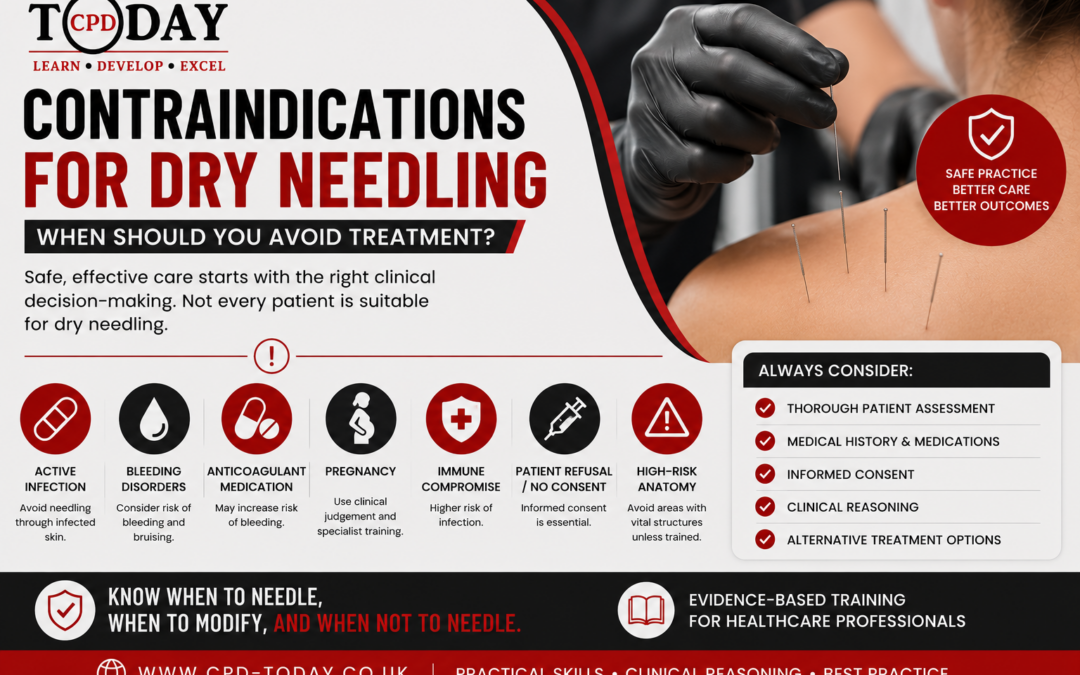
Contraindications for Dry Needling: When Should Dry Needling Be Avoided?
Meta Description: Learn the contraindications and precautions for dry needling, including patient assessment, informed consent, pregnancy, anticoagulants, infection, and safe clinical decision-making for healthcare professionals.
Contraindications for Dry Needling: When Should Dry Needling Be Avoided?
Dry needling is a safe and effective treatment for many musculoskeletal conditions when performed by appropriately trained healthcare professionals. However, no treatment is suitable for every patient, and understanding when not to perform dry needling is just as important as knowing how to perform it.
Effective dry needling begins with a thorough assessment, sound clinical reasoning and an understanding of the patient’s medical history. Identifying contraindications and precautions helps minimise risk, improve patient safety and ensure the most appropriate treatment is chosen.
This guide outlines the commonly recognised contraindications and precautions for dry needling. Clinicians should always follow their professional body’s guidance, local regulations and insurance requirements.
Why Understanding Contraindications Matters
Dry needling should never be viewed as a routine intervention. Every patient presents with unique medical conditions, medications and individual circumstances that may influence whether treatment is appropriate.
Good clinical practice involves asking:
- Is dry needling indicated?
- Is it safe for this patient?
- Are there better alternatives?
- Does the potential benefit outweigh any risk?
These questions form the foundation of evidence-based clinical decision-making.
Absolute Contraindications
Absolute contraindications are situations where dry needling should not be performed.
These commonly include:
Patient Refusal
Dry needling should never be performed without informed consent. Patients have the right to decline treatment at any stage.
Lack of Informed Consent
Patients must understand:
- Why treatment is recommended
- Potential benefits
- Possible risks
- Alternative treatment options
- Expected side effects
Without informed consent, treatment should not proceed.
Local Infection
Avoid needling through:
- Cellulitis
- Abscesses
- Open wounds
- Active skin infections
Doing so may increase the risk of spreading infection.
Inability to Cooperate
Patients who cannot remain still or communicate appropriately may not be suitable for treatment due to increased risk of injury.
Relative Contraindications and Precautions
Many patients can still receive dry needling safely, but additional care and clinical judgement are required.
Anticoagulant Medication
Patients taking anticoagulants may have an increased risk of bruising or bleeding.
Treatment is not always contraindicated but should be modified where appropriate.
Bleeding Disorders
Patients with clotting disorders require careful assessment before treatment.
Consider:
- Severity
- Needle depth
- Anatomical location
- Potential consequences of bleeding
Pregnancy
Pregnancy is not an absolute contraindication to dry needling.
However, clinicians should possess appropriate training and avoid certain anatomical regions where required. Clinical reasoning and patient-specific assessment are essential.
Diabetes
Patients with diabetes may have:
- Delayed healing
- Peripheral neuropathy
- Altered sensation
- Increased infection risk
Treatment may still be appropriate with suitable precautions.
Compromised Immune Function
Patients receiving chemotherapy, immunosuppressant medication or living with immunocompromising conditions may require additional consideration because of altered healing and infection risk.
Lymphoedema
Needling within an area affected by lymphoedema should only be considered after careful assessment because of increased infection risk and altered tissue health.
Joint Replacements and Metal Implants
Although dry needling is often possible, clinicians should avoid direct contact with implants and remain aware of altered anatomy.
Epilepsy
Patients with well-controlled epilepsy can often be treated safely, although clinicians should consider seizure history and minimise unnecessary triggers.
Severe Anxiety or Needle Phobia
Patients with significant anxiety may experience vasovagal reactions or struggle to tolerate treatment.
Alternative treatment options may be more appropriate.
Anatomical Contraindications
Some body regions require particularly advanced anatomical knowledge.
Examples include:
- Thorax
- Cervical spine
- Supraclavicular region
- Abdomen
- Axilla
- Groin
- Popliteal fossa
These areas contain important organs, nerves and blood vessels and should only be treated by clinicians with appropriate training and experience.
When Dry Needling May Not Be the Best Option
Even if no formal contraindications exist, dry needling may not always represent the most appropriate intervention.
For example:
- Symptoms are improving with exercise alone.
- The patient prefers alternative treatment.
- There is no clear clinical indication.
- Another evidence-based intervention offers greater benefit.
- The patient’s goals can be achieved without needling.
The best clinicians know when not to needle.
Clinical Reasoning Comes First
Dry needling should never become a routine treatment applied to every painful muscle.
Instead, clinicians should continually ask:
- Does this treatment support the patient’s goals?
- Is it supported by current evidence?
- Is it appropriate today?
- Are there safer or more effective alternatives?
Strong clinical reasoning improves both patient outcomes and patient safety.
Learn Safe Clinical Decision-Making with CPD Today
At CPD Today, we teach far more than needling techniques.
Our Foundation and Advanced Dry Needling courses focus on:
- Patient assessment
- Contraindications
- Relative precautions
- Functional anatomy
- Clinical reasoning
- Safe needling techniques
- Evidence-based practice
- Practical hands-on supervision
We believe confident clinicians are those who know when to needle, when to modify treatment and when not to needle at all.
Clinical Takeaway
Understanding contraindications is fundamental to safe dry needling practice. While relatively few situations absolutely prohibit treatment, many require careful assessment, modification of technique or consideration of alternative management strategies. Evidence-based clinicians combine anatomical knowledge, patient-centred communication and sound clinical reasoning to ensure every treatment decision prioritises patient safety.
Frequently Asked Questions
Is pregnancy a contraindication to dry needling?
Not necessarily. Pregnancy is generally considered a relative precaution rather than an absolute contraindication. Appropriate assessment, clinical reasoning and training are essential.
Can patients taking blood thinners receive dry needling?
Many can, although clinicians should consider bleeding risk, treatment location and individual patient factors before proceeding.
Can dry needling be performed over an infected area?
No. Dry needling should not be performed through active skin infections, cellulitis or open wounds.
Is informed consent mandatory?
Yes. Patients should understand the purpose, benefits, risks and alternatives before treatment begins.
Who should perform dry needling?
Dry needling should only be performed by appropriately trained healthcare professionals working within their professional scope of practice and following local regulatory and insurance requirements.
References
- Brady S, McEvoy J, Dommerholt J, Doody C. (2014). Adverse Events Following Trigger Point Dry Needling: A Prospective Survey of Chartered Physiotherapists. Journal of Manual & Manipulative Therapy, 22(3), 134–140.
- Boyce D, Wempe H, Campbell C, et al. (2020). Adverse Events Associated with Therapeutic Dry Needling. International Journal of Sports Physical Therapy, 15(1), 103–113.
- Dommerholt J. (2011). Dry Needling—Peripheral and Central Considerations. Journal of Manual & Manipulative Therapy.
- World Health Organization. WHO Guidelines on Basic Training and Safety in Acupuncture. (Referenced for safe needle handling and infection prevention principles.)
- National Institute for Health and Care Excellence (NICE). Healthcare-associated infections: Prevention and Control in Primary and Community Care.
Continue Your Learning
Expand your understanding of dry needling with our related articles:
- What Is Dry Needling?
- Dry Needling vs Acupuncture
- The Evidence for Dry Needling
- Safety Guidelines for Dry Needling
- Dry Needling for Low Back Pain
- Foundation Dry Needling Course
- Advanced Dry Needling & Electroacupuncture
At CPD Today, our evidence-based courses help healthcare professionals develop the knowledge, practical skills and clinical reasoning needed to integrate dry needling safely and effectively into modern musculoskeletal practice.