
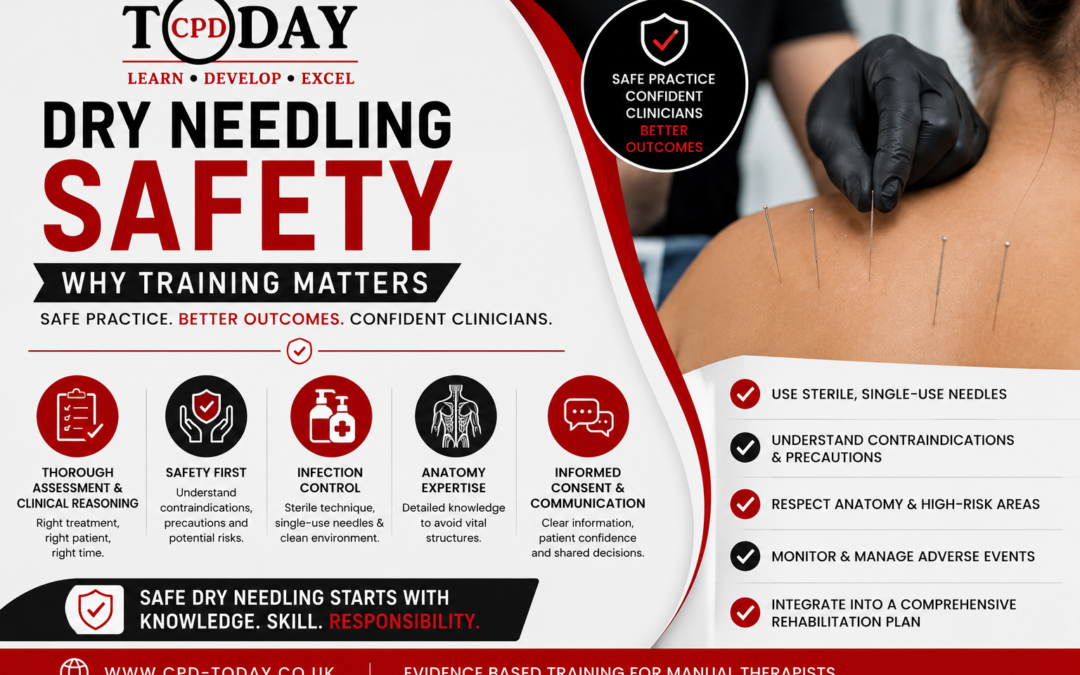
Safety Guidelines for Dry Needling: Best Practice for Safe and Effective Treatment
Meta Description: Learn the essential safety guidelines for dry needling, including contraindications, precautions, infection control, informed consent and safe clinical practice for healthcare professionals.
Safety Guidelines for Dry Needling: Best Practice for Safe and Effective Treatment
Dry needling is a valuable treatment option for managing musculoskeletal pain and movement disorders. When performed by appropriately trained healthcare professionals, it has an excellent safety profile and can be an effective addition to rehabilitation.
Like any clinical intervention, however, dry needling requires thorough anatomical knowledge, sound clinical reasoning and strict adherence to safety protocols.
Whether you are new to dry needling or looking to refine your practice, understanding current safety guidelines is essential for delivering safe, effective and evidence-based patient care.
Is Dry Needling Safe?
Yes. Research has shown that dry needling is generally considered safe when performed by suitably trained clinicians who understand anatomy, contraindications, infection control and patient selection.
Most adverse events reported in the literature are minor and temporary, including:
- Mild soreness
- Bruising
- Small amounts of bleeding
- Temporary fatigue
- Short-lived symptom aggravation
Serious complications are extremely uncommon but reinforce the importance of comprehensive training and adherence to safe practice.
The Foundations of Safe Dry Needling
Safe dry needling begins long before the needle is inserted.
Every treatment should include:
- A comprehensive musculoskeletal assessment
- Clinical reasoning
- Clear diagnosis
- Identification of contraindications
- Patient education
- Informed consent
- Appropriate documentation
Dry needling should never be used simply because a patient is in pain—it should always have a clear clinical rationale.
Contraindications
Certain situations mean dry needling should not be performed.
These may include:
- Patient refusal
- Lack of informed consent
- Active local infection
- Cellulitis
- Needle phobia preventing safe treatment
- Inability to remain still during treatment
- Uncontrolled medical conditions where needling presents unacceptable risk
Clinicians should always work within local professional guidance and their scope of practice.
Precautions
Some patients may still be suitable for dry needling, but additional care is required.
Examples include:
- Anticoagulant medication
- Bleeding disorders
- Diabetes with impaired healing
- Pregnancy
- Compromised immune function
- Lymphoedema
- Metal implants
- Joint replacements
- Epilepsy
- Frailty
- Significant anxiety
These situations require careful clinical judgement rather than automatic exclusion.
Infection Control
Strict infection prevention procedures are fundamental to safe practice.
Healthcare professionals should always:
- Wash hands before and after treatment
- Use sterile, single-use needles
- Dispose of needles immediately into approved sharps containers
- Maintain a clean treatment environment
- Wear gloves where appropriate
- Follow local infection prevention policies
Cross-contamination should never be tolerated.
Understanding High-Risk Anatomy
One of the most important aspects of dry needling education is developing an in-depth understanding of anatomy.
Clinicians must appreciate:
- Safe needle depth
- Needle angle
- Underlying neurovascular structures
- Lung fields
- Abdominal organs
- Major blood vessels
- Peripheral nerves
Areas requiring particular caution include:
- Thorax
- Cervical spine
- Supraclavicular region
- Axilla
- Abdomen
- Popliteal fossa
- Groin
Knowledge of anatomy—not memorisation of techniques—is what keeps patients safe.
Avoiding Serious Complications
Although rare, clinicians should understand the signs and symptoms of complications including:
- Pneumothorax
- Infection
- Vasovagal reactions
- Nerve irritation
- Significant bleeding
- Allergic reactions (for associated products)
Patients should receive clear post-treatment advice explaining what is normal and when they should seek medical attention.
Patient Communication and Consent
Good communication improves both safety and patient confidence.
Before treatment clinicians should explain:
- Why dry needling is recommended
- Expected benefits
- Possible side effects
- Alternative treatment options
- Expected post-treatment soreness
- Aftercare advice
Patients should always have the opportunity to ask questions before providing informed consent.
Clinical Reasoning Is Your Best Safety Tool
Safe clinicians do not simply needle painful muscles.
Instead they ask:
- Is dry needling appropriate?
- Will it improve this patient’s outcome?
- Are there better alternatives?
- Does the evidence support its use?
- Can the patient tolerate treatment safely?
Clinical reasoning remains the most important component of safe dry needling practice.
Why High-Quality Training Matters
Learning dry needling from experienced educators is essential.
Training should include:
- Functional anatomy
- Surface anatomy
- Safe needle handling
- Contraindications
- Clinical reasoning
- Practical supervision
- Adverse event management
- Evidence-based application
Weekend courses that focus solely on needle placement without developing clinical reasoning may not adequately prepare clinicians for independent practice.
Learn Safe Dry Needling with CPD Today
At CPD Today, patient safety underpins everything we teach.
Our Foundation and Advanced Dry Needling courses combine:
- Evidence-based teaching
- Detailed anatomy
- Hands-on practical supervision
- Clinical reasoning
- Safe needling techniques
- Recognition of contraindications and precautions
- Management of adverse events
- Integration with rehabilitation and manual therapy
Our aim is not simply to teach clinicians how to insert needles—but to help them become safe, confident and evidence-based practitioners.
Clinical Takeaway
Dry needling has an excellent safety profile when performed by appropriately trained healthcare professionals who possess strong anatomical knowledge, sound clinical reasoning and follow recognised infection control and safety procedures. Safe practice is about much more than technical skill—it requires careful patient assessment, informed consent, appropriate clinical decision-making and ongoing professional development. High-quality education ensures clinicians have the confidence to deliver effective treatment while minimising risk.
Frequently Asked Questions
Is dry needling safe?
Yes. When performed by appropriately trained healthcare professionals following recognised safety guidelines, dry needling is considered a safe treatment with a low risk of serious complications.
What are the most common side effects?
Temporary soreness, mild bruising, small amounts of bleeding and short-term fatigue are the most frequently reported side effects.
Can dry needling cause pneumothorax?
Although extremely rare, pneumothorax is a recognised complication when needling around the thorax. Thorough anatomical knowledge, appropriate technique and proper training are essential to minimise this risk.
Do patients need to give consent?
Yes. Informed consent should always be obtained before treatment, with patients understanding the benefits, risks, alternatives and expected post-treatment effects.
Who should perform dry needling?
Dry needling should only be performed by appropriately trained healthcare professionals working within their professional scope of practice and complying with local regulatory and insurance requirements.
References
- Brady S, McEvoy J, Dommerholt J, Doody C. (2014). Adverse Events Following Trigger Point Dry Needling: A Prospective Survey of Chartered Physiotherapists. Journal of Manual & Manipulative Therapy, 22(3), 134–140.
- Boyce D, Wempe H, Campbell C, et al. (2020). Adverse Events Associated with Therapeutic Dry Needling. International Journal of Sports Physical Therapy, 15(1), 103–113.
- Dommerholt J. (2011). Dry Needling—Peripheral and Central Considerations. Journal of Manual & Manipulative Therapy.
- World Health Organization. WHO Guidelines on Basic Training and Safety in Acupuncture. (Widely referenced for safe needle handling and infection control principles.)
- National Institute for Health and Care Excellence (NICE). Healthcare-associated infections: prevention and control in primary and community care.
Continue Your Learning
Expand your knowledge with our related articles:
- What Is Dry Needling?
- Dry Needling vs Acupuncture
- The Evidence for Dry Needling
- Dry Needling for Low Back Pain
- Dry Needling for Neck Pain
- Dry Needling for Shoulder Pain
- Foundation Dry Needling Course
- Advanced Dry Needling & Electroacupuncture Course
At CPD Today, we are committed to delivering evidence-based, practical education that equips clinicians with the skills, confidence and clinical reasoning to use dry needling safely and effectively in modern musculoskeletal practice.