
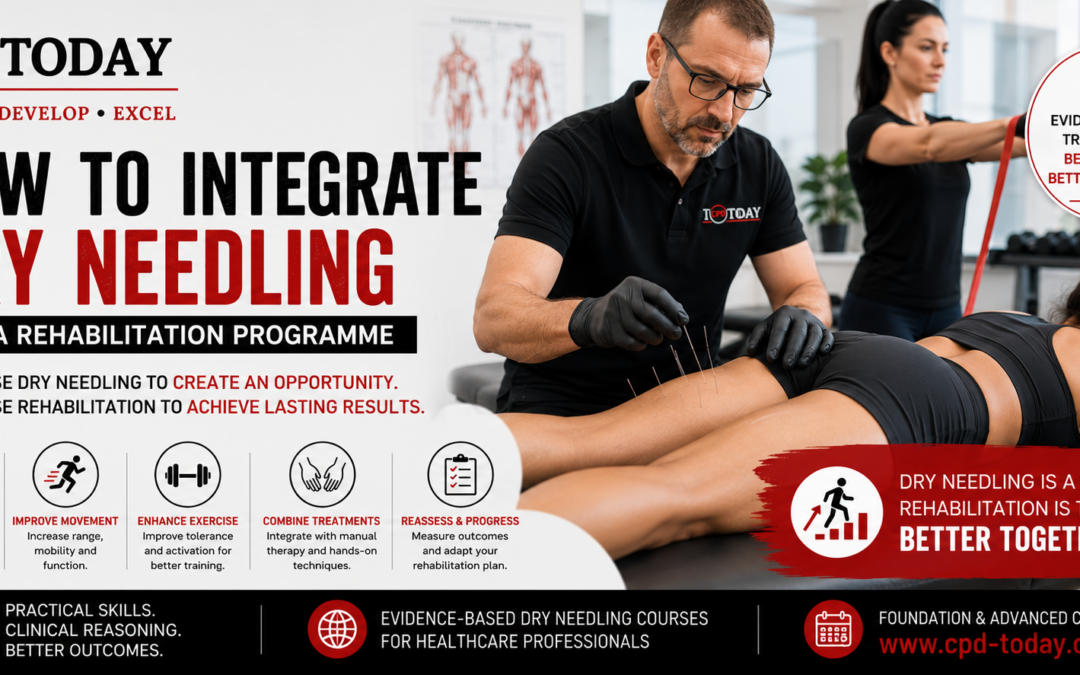
How to Integrate Dry Needling into a Rehabilitation Programme
Meta Description: Learn how to combine dry needling with exercise, manual therapy and patient education to deliver evidence-based musculoskeletal rehabilitation and improve patient outcomes.
How to Integrate Dry Needling into a Rehabilitation Programme
Dry needling is one of the most effective adjuncts available to musculoskeletal clinicians—but it should rarely be used in isolation.
Research consistently shows that the greatest improvements in pain and function occur when dry needling is integrated into a comprehensive rehabilitation programme that includes exercise, patient education and manual therapy.
For clinicians, this means shifting the question from “Should I use dry needling?” to “How can dry needling help my patient engage more effectively in rehabilitation?”
Dry Needling Is a Tool—Not the Entire Treatment
Dry needling can help:
- Reduce pain
- Decrease muscle guarding
- Improve movement
- Increase range of motion
- Improve muscle activation
- Make rehabilitation exercises more comfortable
However, these effects are often temporary unless followed by appropriate rehabilitation.
The goal is to use this treatment window to improve long-term function rather than simply providing short-term pain relief.
Step 1: Start with a Comprehensive Assessment
Every treatment should begin with a detailed assessment.
Consider:
- History of the condition
- Aggravating and easing factors
- Functional limitations
- Movement quality
- Strength deficits
- Joint mobility
- Neural involvement
- Psychosocial factors
- Patient goals
Clinical reasoning should determine whether dry needling is appropriate—not habit or routine.
Step 2: Define Your Treatment Goals
Before inserting a needle, ask yourself:
- What am I trying to achieve?
- Which impairment is limiting function?
- How will today’s treatment improve rehabilitation?
Examples include:
- Reducing pain to allow exercise
- Improving shoulder movement before strengthening
- Reducing calf muscle tone before gait retraining
- Improving jaw movement before TMJ exercises
Every treatment should have a clear purpose.
Step 3: Use Dry Needling to Create an Opportunity
Dry needling should create an opportunity for movement.
Immediately following treatment, reinforce the gains with:
- Mobility exercises
- Stretching (where appropriate)
- Motor control exercises
- Strengthening
- Functional retraining
- Sport-specific rehabilitation
Patients are more likely to maintain improvements when they actively use their increased movement.
Step 4: Combine with Manual Therapy
Dry needling often works well alongside:
- Joint mobilisation
- Manipulation (where appropriate)
- Soft tissue techniques
- Myofascial techniques
- Movement retraining
The combination should always be tailored to the individual patient’s presentation.
Step 5: Educate the Patient
Patient education is essential.
Explain:
- Why dry needling has been recommended
- What improvements to expect
- Why exercise remains important
- Expected post-treatment soreness
- Recovery advice
- Self-management strategies
Patients who understand their treatment are more likely to engage with rehabilitation and achieve better outcomes.
Step 6: Reassess
Always measure change.
Reassess:
- Pain
- Movement
- Strength
- Function
- Patient confidence
If treatment has not produced meaningful change, reassess your diagnosis and management plan rather than repeating the same intervention.
Common Conditions Where Integration Works Well
Dry needling can support rehabilitation for:
- Low back pain
- Neck pain
- Shoulder pain
- Rotator cuff disorders
- Tennis elbow
- Plantar fasciitis
- Achilles tendinopathy
- Hip pain
- TMJ disorders
- Sports injuries
In each case, it should complement—not replace—exercise and education.
Common Mistakes
Avoid:
- Using dry needling as the only treatment
- Failing to prescribe rehabilitation exercises
- Not reassessing outcomes
- Treating painful muscles without clinical reasoning
- Over-treating multiple muscles unnecessarily
- Ignoring patient goals
Why Clinical Reasoning Matters
Successful rehabilitation is not about using more techniques.
It is about selecting the right intervention at the right time for the right patient.
Dry needling should always fit within the wider rehabilitation strategy.
Learn to Integrate Dry Needling with CPD Today
At CPD Today, we teach far more than practical needling techniques.
Our Foundation and Advanced Dry Needling courses focus on:
- Evidence-based practice
- Clinical reasoning
- Functional anatomy
- Patient assessment
- Safe needling
- Exercise integration
- Manual therapy integration
- Rehabilitation planning
You’ll leave with the confidence to use dry needling as part of a complete musculoskeletal management programme rather than as a stand-alone technique.
Clinical Takeaway
Dry needling is most effective when it forms part of a comprehensive rehabilitation programme. By combining it with thorough assessment, patient education, exercise therapy and manual therapy, clinicians can use temporary improvements in pain and movement to achieve meaningful, long-term functional outcomes. Dry needling should enhance rehabilitation—not replace it.
Frequently Asked Questions
Should every patient receive exercises after dry needling?
In most cases, yes. Exercises help reinforce treatment effects and promote long-term improvements.
Can dry needling replace manual therapy?
No. Dry needling is best viewed as another tool that complements manual therapy and rehabilitation.
How soon should patients exercise after treatment?
Provided there are no contraindications and symptoms allow, many patients can begin appropriate rehabilitation exercises immediately after treatment.
Does research support combining dry needling with rehabilitation?
Yes. Current evidence suggests dry needling is most effective when integrated into a multimodal, evidence-based treatment programme.
What is the biggest mistake clinicians make?
Using dry needling in isolation without addressing the underlying movement dysfunction or providing an appropriate rehabilitation programme.
References
- Gattie E, Cleland JA, Snodgrass SJ. The Effectiveness of Trigger Point Dry Needling for Musculoskeletal Conditions by Physical Therapists. J Orthop Sports Phys Ther. 2017.
- Hu HT, Gao H, Ma RJ, et al. Dry Needling for Low Back Pain: A Systematic Review and Meta-analysis. Arch Phys Med Rehabil. 2018.
- Navarro-Santana MJ, et al. Effects of Trigger Point Dry Needling for Non-traumatic Shoulder Pain. Physical Therapy. 2021.
- National Institute for Health and Care Excellence (NICE). Musculoskeletal conditions: assessment and management.