
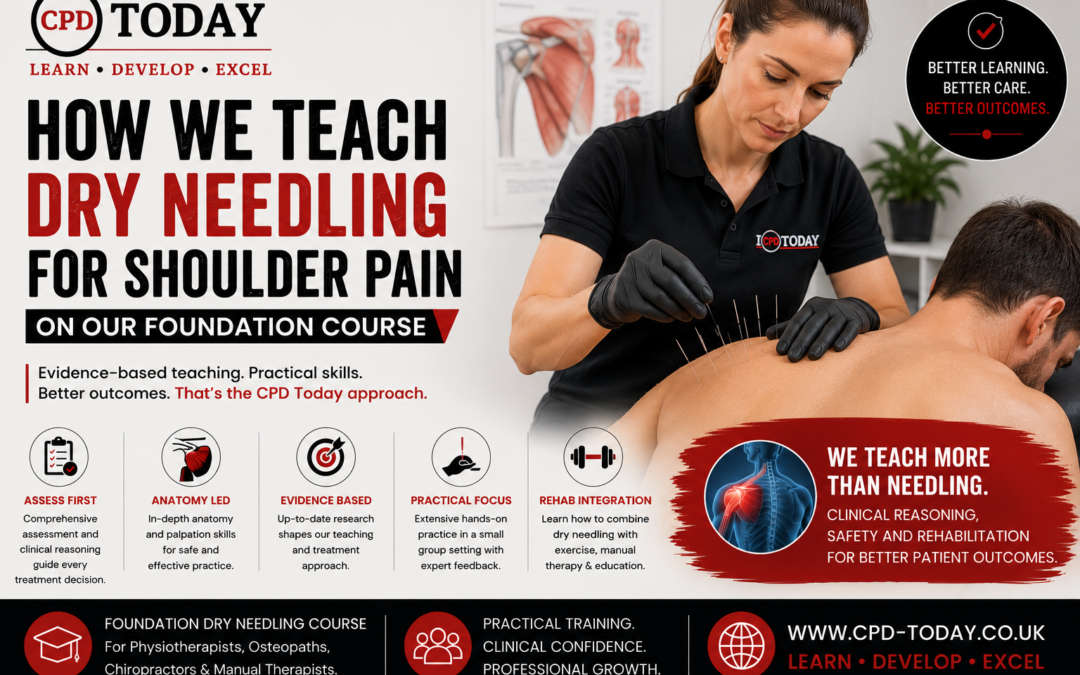
How We Teach Dry Needling for Shoulder Pain on Our Foundation Course
Meta Description: Discover how CPD Today teaches dry needling for shoulder pain on our Foundation Course. Learn our evidence-based approach to assessment, anatomy, clinical reasoning and rehabilitation.
How We Teach Dry Needling for Shoulder Pain on Our Foundation Course
Shoulder pain is one of the most common reasons patients seek treatment from physiotherapists, osteopaths, chiropractors and other musculoskeletal clinicians. It’s also one of the conditions delegates are most excited to learn about on our Foundation Dry Needling Course.
But here’s something that often surprises new delegates…
We don’t start by teaching where to put a needle.
Instead, we start by asking a much more important question:
“Why are you choosing to needle this patient?”
At CPD Today, we believe successful dry needling begins with clinical reasoning—not technical skill alone. Knowing how to insert a needle is important, but knowing when, why and whether to use dry needling is what separates a competent practitioner from an exceptional one.
This philosophy underpins everything we teach.
Shoulder Pain Is More Complex Than It Appears
Many clinicians arrive expecting a simple formula:
Shoulder pain = needle the supraspinatus.
In reality, shoulder pain is rarely that straightforward.
Patients presenting with shoulder symptoms may have:
- Rotator cuff-related shoulder pain
- Subacromial pain syndrome
- Myofascial trigger points
- Altered scapular control
- Cervical referral
- Thoracic stiffness
- Neural sensitivity
- Poor movement patterns
Every patient requires an individual assessment.
Our Foundation Course encourages delegates to think beyond isolated muscles and consider the patient as a whole.
We Teach Assessment Before Needling
Before delegates pick up a needle, they spend time developing a structured clinical assessment.
This includes:
- Patient history
- Symptom behaviour
- Functional limitations
- Observation
- Active movement
- Passive movement
- Strength testing
- Clinical reasoning
- Differential diagnosis
Only once delegates understand why a patient is experiencing shoulder pain do we move on to discussing whether dry needling is appropriate.
This ensures treatment decisions are based on evidence rather than routine.
Anatomy Comes Before Technique
Dry needling is built on anatomy.
Rather than memorising needling points, we teach delegates how to identify and understand the structures they are treating.
For shoulder pain, this includes developing confidence in:
- Surface anatomy
- Palpation skills
- Muscle function
- Neurovascular anatomy
- Safe needle angles
- Appropriate needle depth
- High-risk anatomical regions
Understanding anatomy is one of the most effective ways to improve both safety and clinical confidence.
Clinical Reasoning Drives Every Decision
One of the most common mistakes we see is clinicians asking:
“Which muscle should I needle?”
A better question is:
“What impairment is limiting this patient’s function?”
For example:
- Is pain preventing movement?
- Is muscle guarding reducing range of motion?
- Is movement dysfunction contributing to symptoms?
- Will dry needling help the patient participate more effectively in rehabilitation?
These are the questions we encourage delegates to ask throughout the course.
Learning Through Hands-On Practice
Practical teaching is central to the CPD Today experience.
Delegates spend significant time practising:
- Safe patient positioning
- Anatomical landmarking
- Palpation
- Needle handling
- Communication
- Patient consent
- Clinical reasoning
- Practical needling under supervision
Small group teaching allows delegates to receive individual feedback and refine both their practical skills and clinical decision-making.
We Don’t Teach Dry Needling in Isolation
One of the key messages throughout the Foundation Course is that dry needling is one component of modern musculoskeletal care.
We show delegates how to combine dry needling with:
- Exercise therapy
- Manual therapy
- Rehabilitation
- Patient education
- Load management
- Self-management advice
Research consistently demonstrates that multimodal treatment produces better outcomes than relying on any single intervention alone.
Common Mistakes We Help Delegates Avoid
During the course, we discuss the mistakes commonly made by new clinicians, including:
- Choosing treatment before completing an assessment
- Needling every painful muscle
- Ignoring rehabilitation
- Poor anatomical understanding
- Forgetting to reassess outcomes
- Failing to explain treatment clearly to patients
Learning from these mistakes in a supervised environment helps delegates build confidence before returning to clinical practice.
Evidence Shapes Everything We Teach
Our teaching is grounded in current research and best practice.
Throughout the course we discuss:
- What the evidence supports
- Current clinical guidelines
- Patient selection
- Safety considerations
- Contraindications
- Clinical effectiveness
- Realistic treatment expectations
Our aim is to develop clinicians who understand both the science and the practical application of dry needling.
Why Delegates Choose CPD Today
Healthcare professionals choose CPD Today because they want more than a technique—they want a framework for safe, effective clinical practice.
Our Foundation Course combines:
- Evidence-based teaching
- Extensive hands-on practical sessions
- Small group learning
- Detailed anatomy
- Clinical reasoning
- Rehabilitation principles
- Experienced instructors
- Ongoing support
Many delegates tell us they leave the course with a completely different perspective on how dry needling should be integrated into patient care.
A Typical Learning Journey
By the end of the Foundation Course, delegates have progressed from asking:
“Where do I put the needle?”
to asking:
“Is dry needling the right intervention for this patient, and how can I use it to support their rehabilitation?”
That shift in thinking is one of the biggest differences between learning a technique and developing clinical expertise.
Clinical Pearl
Treat the patient, not the muscle.
The shoulder is rarely painful because of one isolated structure. Successful dry needling depends on understanding the patient’s movement, symptoms and goals—not simply identifying a tender point.
Clinical Takeaway
At CPD Today, we believe that confidence with dry needling comes from understanding why you are treating, not just how to treat. By focusing on assessment, anatomy, clinical reasoning and rehabilitation, our Foundation Course equips clinicians with the skills to integrate dry needling safely and effectively into modern musculoskeletal practice. Our goal is not simply to teach techniques but to develop thoughtful, evidence-based practitioners who can make informed decisions and deliver better patient outcomes.
Frequently Asked Questions
Do I need previous dry needling experience?
No. Our Foundation Course is designed for clinicians with little or no prior experience and starts with the fundamentals before progressing to practical techniques.
Will I learn how to treat shoulder pain?
Yes. Shoulder pain is used as a practical clinical example to teach assessment, anatomy, safe needling and rehabilitation principles.
Is there plenty of practical teaching?
Absolutely. The course places a strong emphasis on supervised hands-on practice, ensuring delegates build confidence in both technique and clinical reasoning.
Do you teach exercises as well as needling?
Yes. We demonstrate how dry needling can be integrated with exercise therapy, manual therapy and patient education to support long-term outcomes.
Who is the Foundation Course suitable for?
The course is designed for appropriately qualified healthcare professionals, including physiotherapists, osteopaths, chiropractors, sports therapists and other manual therapists working within their professional scope of practice.
Ready to Develop Your Dry Needling Skills?
If you’re looking for a Dry Needling Foundation Course that goes beyond simply teaching techniques, CPD Today offers evidence-based, hands-on training designed to build confidence, enhance clinical reasoning and improve patient outcomes.
Join experienced educators, learn in small practical groups and discover how to integrate dry needling into modern musculoskeletal practice with confidence.
Explore our upcoming Foundation Dry Needling courses at www.cpd-today.co.uk.