
The Complete Guide to Clinical Strapping & Taping for Healthcare Professionals
Evidence-Based Strapping & Taping Courses for Physiotherapists, Osteopaths, Chiropractors & Sports Therapists
Clinical strapping and taping has become an integral part of modern musculoskeletal (MSK) practice. Whether you’re supporting an acute sports injury, managing a chronic tendinopathy, or helping a patient return to activity, selecting the right taping technique can improve confidence, optimise movement and complement a comprehensive rehabilitation programme.
At CPD Today, we don’t simply teach taping techniques—we teach clinical reasoning. Our evidence-based Strapping & Taping Course equips healthcare professionals with the knowledge and practical skills to choose the right tape, for the right patient, at the right time.
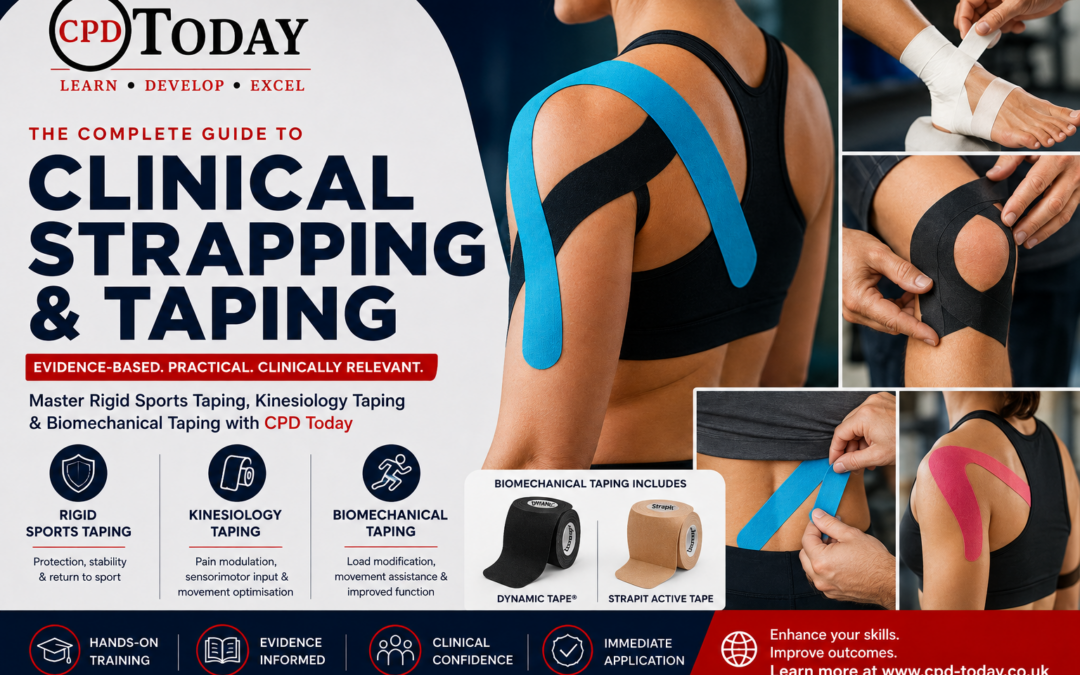
Unlike many taping courses that focus on a single method, our course covers the three principal taping approaches used in contemporary MSK practice:
- Rigid Sports Taping
- Kinesiology Taping
- Biomechanical Taping (including Dynamic Tape® and Strapit Active Tape)
By understanding the strengths, limitations and evidence behind each approach, you’ll be able to integrate taping confidently into your everyday clinical practice.
Why Learn Clinical Strapping & Taping?
Clinical taping is far more than simply applying tape to an injured body part. Effective taping requires an understanding of anatomy, biomechanics, tissue healing, movement analysis, pathology and patient goals.
When used appropriately, taping can help:
- Reduce pain during movement
- Improve function and confidence
- Modify mechanical loading
- Support injured tissues
- Assist return to work, exercise and sport
- Enhance rehabilitation outcomes
- Complement manual therapy and exercise prescription
- Improve patient adherence to rehabilitation
Taping should not be viewed as a stand-alone treatment, but as one component of an evidence-informed, patient-centred management plan.
The Three Clinical Taping Systems
Rigid Sports Taping
Rigid sports taping is designed to restrict excessive movement, improve joint stability and protect injured tissues during activity.
It is commonly used for:
- Lateral ankle sprains
- Thumb injuries
- Wrist injuries
- Patellofemoral disorders
- Shoulder instability
- Return-to-play support
Rigid taping is particularly valuable during the acute and subacute stages of rehabilitation, helping patients remain active while protecting healing tissues.
Kinesiology Taping
Kinesiology tape is an elastic therapeutic tape designed to move with the body rather than restrict movement.
Current research suggests kinesiology taping can provide clinically meaningful short-term improvements in pain and function for several chronic musculoskeletal conditions, particularly when combined with active rehabilitation, manual therapy and exercise.
It may assist with:
- Pain modulation
- Movement awareness
- Sensorimotor feedback
- Functional movement
- Patient confidence during rehabilitation
Common clinical applications include:
- Chronic low back pain
- Neck pain
- Shoulder pain
- Patellofemoral pain
- Achilles tendinopathy
- Plantar heel pain
- Tennis elbow
- Pregnancy-related pelvic girdle pain
Throughout the course, we critically evaluate the latest systematic reviews and meta-analyses, helping clinicians understand where the evidence is strongest and how to apply it effectively in practice.
Biomechanical Taping
Biomechanical taping focuses on modifying movement and reducing mechanical stress placed on painful or overloaded tissues.
On the CPD Today course, we teach the principles of biomechanical taping using:
- Dynamic Tape®
- Strapit Active Tape
These highly elastic tapes are designed to:
- Reduce tissue load
- Assist movement
- Improve movement efficiency
- Redistribute mechanical forces
- Support functional rehabilitation
Biomechanical taping is increasingly used for conditions such as:
- Achilles tendinopathy
- Plantar fasciitis
- Running injuries
- Knee pain
- Hip pain
- Shoulder disorders
- Tendinopathies
- Load-sensitive musculoskeletal conditions
Importantly, our course focuses on clinical reasoning, helping you determine when biomechanical taping is the most appropriate option and when another taping strategy may be more suitable.
An Evidence-Based Approach
At CPD Today, evidence-based practice underpins everything we teach.
Our course explores:
- Current systematic reviews
- Meta-analyses
- Clinical practice guidelines
- Biomechanical principles
- Clinical reasoning
- Patient-centred care
- Practical application of research
We also discuss where evidence remains limited, ensuring clinicians develop realistic expectations and apply taping appropriately within modern MSK rehabilitation.
Integrating Taping into Clinical Practice
Taping should enhance—not replace—good clinical care.
During the course, you’ll learn how to integrate taping with:
- Manual therapy
- Exercise rehabilitation
- Strength and conditioning
- Load management
- Patient education
- Return-to-sport planning
- Functional rehabilitation
This integrated approach reflects current best practice and helps maximise patient outcomes.
Conditions Covered
The principles taught throughout the course can be applied to a wide range of musculoskeletal presentations, including:
- Ankle sprains
- Achilles tendinopathy
- Plantar fasciitis
- Patellofemoral pain syndrome
- Knee osteoarthritis
- Rotator cuff-related shoulder pain
- Tennis elbow
- Golfer’s elbow
- Neck pain
- Low back pain
- Sacroiliac joint pain
- Hip pain
- Running injuries
- Sports injuries
- Muscle strains
- Tendinopathies
- Pregnancy-related pelvic girdle pain
Why Choose CPD Today?
Our courses are delivered by experienced clinicians who use these techniques daily in clinical practice.
You’ll benefit from:
- Extensive hands-on practical sessions
- Small group teaching
- Individual feedback
- Evidence-informed education
- Clinical reasoning throughout
- Techniques you can apply immediately in practice
Rather than simply teaching tape applications, we teach you how to think clinically, enabling you to adapt techniques to individual patients rather than memorising recipes.
Frequently Asked Questions
Who is this course suitable for?
The course is designed for physiotherapists, osteopaths, chiropractors, sports therapists and other appropriately qualified healthcare professionals managing musculoskeletal conditions.
Do I need previous taping experience?
No. The course is suitable for beginners as well as experienced clinicians looking to refine and expand their taping skills.
Will I learn more than kinesiology taping?
Yes. Unlike many CPD courses, we cover rigid sports taping, kinesiology taping and biomechanical taping, giving you a comprehensive toolkit for clinical practice.
Is the course evidence based?
Absolutely. Every technique is taught alongside the current evidence, biomechanical principles and clinical reasoning to support informed decision-making.
Can I use these techniques immediately in clinic?
Yes. The course is highly practical, allowing you to implement what you’ve learned straight away with appropriate clinical reasoning.
Develop Your Clinical Taping Skills with CPD Today
Whether you’re looking to improve patient outcomes, expand your treatment options or build greater confidence in managing musculoskeletal conditions, the CPD Today Strapping & Taping Course provides the practical skills, evidence base and clinical reasoning needed to integrate taping effectively into everyday practice.
Join us to master rigid sports taping, kinesiology taping and biomechanical taping through hands-on, evidence-based training designed for today’s MSK clinician.
Related Articles
As part of this series, explore our in-depth guides on:
- What Is Sports Strapping?
- Kinesiology Taping: The Evidence Explained
- What Is Biomechanical Taping?
- Dynamic Tape® and Strapit Active Tape in Clinical Practice
- Choosing the Right Tape for the Right Patient
- Common Taping Mistakes
- Taping for Achilles Tendinopathy
- Taping for Plantar Fasciitis
- Taping for Knee Pain
- Taping for Shoulder Pain
- Pregnancy Taping
- Combining Taping with Manual Therapy and Exercise