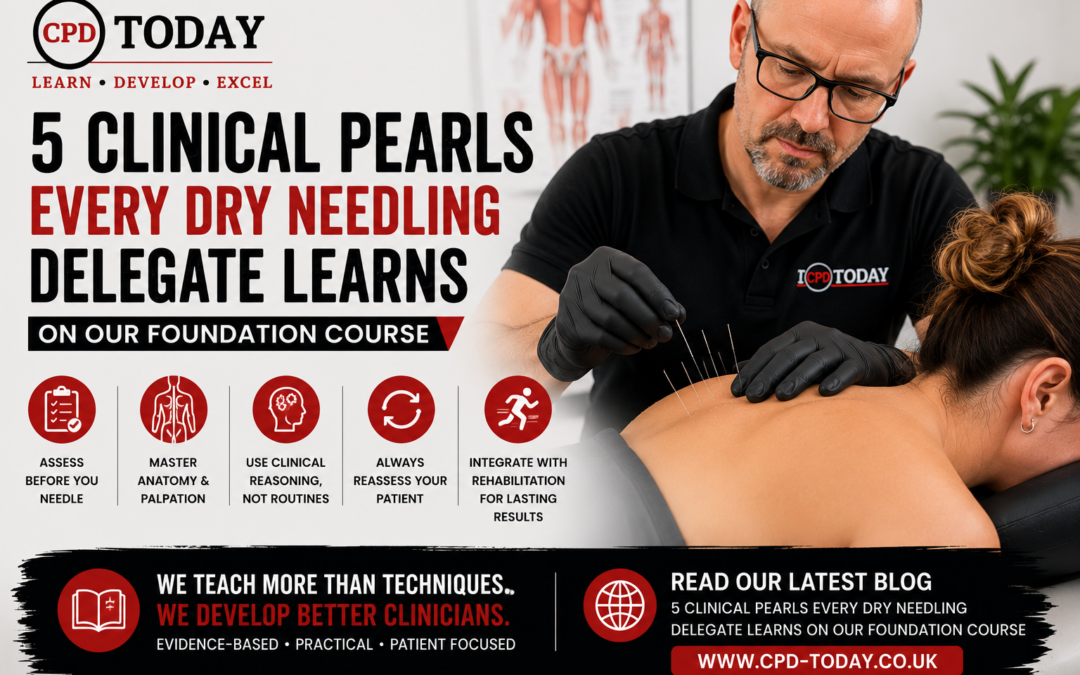
5 Clinical Pearls Every Dry Needling Delegate Learns on Our Foundation Course
Meta Description: Discover five essential clinical pearls taught on CPD Today’s Foundation Dry Needling Course. Learn how clinical reasoning, anatomy and rehabilitation help build confident, evidence-based practitioners.
5 Clinical Pearls Every Dry Needling Delegate Learns on Our Foundation Course
When healthcare professionals book a dry needling course, they often expect to learn one thing:
Where to put the needle.
While practical techniques are an important part of training, they are only one piece of the puzzle.
At CPD Today, our Foundation Dry Needling Course is designed to develop confident, evidence-based clinicians—not technicians who simply memorise muscles and needle locations.
Over the years, we’ve found that the delegates who become the most successful practitioners all develop the same core principles. Here are five of the most important clinical pearls you’ll learn on our Foundation Course.
Clinical Pearl 1: Assessment Comes Before Needles
One of the biggest mistakes new clinicians make is deciding on treatment before fully understanding the patient’s presentation.
Dry needling should never be a routine intervention.
Instead, every treatment should begin with a comprehensive assessment, including:
- Detailed history
- Functional limitations
- Movement assessment
- Clinical diagnosis
- Patient goals
- Identification of contributing factors
Only then can you decide whether dry needling is the most appropriate intervention.
How We Teach This at CPD Today
Before delegates perform any practical needling, we teach structured assessment and clinical reasoning. We want clinicians to understand why they’re treating—not simply where they’re treating.
Clinical Pearl 2: Anatomy Is Your Greatest Safety Tool
Dry needling relies on a detailed understanding of anatomy.
Knowing where muscles attach is only the beginning.
Safe and effective practice requires an understanding of:
- Surface anatomy
- Muscle function
- Neurovascular structures
- Safe needle angles
- Appropriate needle depth
- Anatomical variations
The stronger your anatomical knowledge, the greater your confidence and the safer your clinical practice.
How We Teach This at CPD Today
Throughout the course, anatomy is taught alongside practical sessions. Delegates develop palpation skills, identify anatomical landmarks and practise safe techniques under close supervision.
Clinical Pearl 3: Less Is Often More
Many beginners believe that more needles equal better results.
In reality, successful treatment is rarely about the number of muscles treated.
Targeted, clinically reasoned dry needling often produces better outcomes than treating every area of discomfort.
Quality always outweighs quantity.
How We Teach This at CPD Today
We encourage delegates to justify every treatment decision. If you can’t explain why you’re needling a muscle, you probably shouldn’t be treating it.
Clinical Pearl 4: Always Reassess
Treatment doesn’t end when the needles are removed.
One of the most valuable habits a clinician can develop is reassessing the patient after treatment.
Ask yourself:
- Has pain changed?
- Has movement improved?
- Is function better?
- Has the patient’s confidence increased?
Reassessment helps determine whether your intervention achieved its intended goal and guides your next clinical decision.
How We Teach This at CPD Today
Every practical session reinforces reassessment. Delegates learn to measure outcomes, reflect on treatment effectiveness and adapt their management plans accordingly.
Clinical Pearl 5: Dry Needling Is Part of Rehabilitation—Not a Replacement for It
Perhaps the most important lesson we teach is that dry needling is one tool within a much broader rehabilitation programme.
While dry needling can reduce pain and improve movement, long-term success depends on helping patients restore function through:
- Exercise therapy
- Manual therapy
- Movement retraining
- Load management
- Patient education
- Self-management strategies
Dry needling creates an opportunity for rehabilitation—it should never replace it.
How We Teach This at CPD Today
Delegates learn how to integrate dry needling with evidence-based rehabilitation, ensuring treatment supports meaningful, long-term patient outcomes rather than providing short-term symptom relief alone.
Why These Clinical Pearls Matter
These five principles underpin everything we teach.
Rather than focusing solely on practical techniques, our Foundation Course develops clinicians who can:
- Assess confidently
- Think critically
- Practise safely
- Communicate effectively
- Integrate dry needling into modern musculoskeletal care
This is what transforms a newly trained delegate into a confident practitioner.
Why Choose CPD Today?
At CPD Today, we believe education should be practical, evidence-based and immediately applicable to clinical practice.
Our Foundation Dry Needling Course offers:
- Small-group practical teaching
- Extensive supervised hands-on training
- Evidence-based content
- Functional anatomy
- Clinical reasoning
- Safety and best practice
- Rehabilitation-focused management
- Experienced instructors with decades of clinical and teaching experience
We don’t just teach techniques—we help clinicians develop the confidence to make better clinical decisions.
Clinical Takeaway
The best dry needling clinicians aren’t those who know the most muscles—they’re the ones who make the best clinical decisions. By focusing on assessment, anatomy, clinical reasoning, reassessment and rehabilitation, you’ll develop the confidence to integrate dry needling safely and effectively into everyday musculoskeletal practice. These five clinical pearls form the foundation of everything we teach at CPD Today and continue to guide our delegates long after they complete the course.
Frequently Asked Questions
Are these pearls only useful for beginners?
No. While they’re introduced on our Foundation Course, experienced clinicians often tell us these principles have transformed the way they approach patient assessment and treatment.
Is the course mostly practical?
Yes. Our Foundation Course combines extensive hands-on practical teaching with anatomy, safety, clinical reasoning and evidence-based learning.
Will I learn more than just needling techniques?
Absolutely. Our goal is to help delegates become better clinicians, not just better at inserting needles.
Who is the Foundation Course designed for?
The course is suitable for appropriately qualified healthcare professionals, including physiotherapists, osteopaths, chiropractors, sports therapists and other manual therapists working within their professional scope of practice.
Ready to Take the Next Step?
If you’re looking for a Foundation Dry Needling Course that goes beyond teaching techniques and focuses on developing safe, confident and evidence-based clinicians, we’d love to welcome you to CPD Today.
Join us to build your practical skills, deepen your clinical reasoning and learn how to integrate dry needling into modern musculoskeletal practice with confidence.
Explore our upcoming Foundation Dry Needling courses at www.cpd-today.co.uk.