
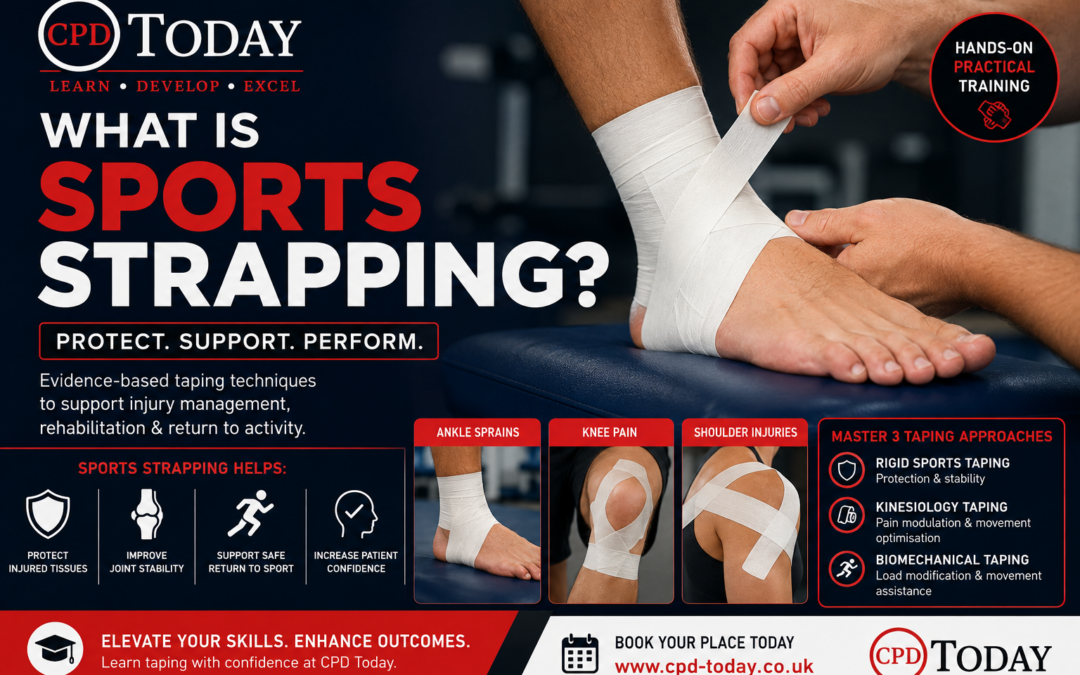
What Is Sports Strapping? A Complete Guide for Healthcare Professionals
Keywords: Sports strapping, sports taping, rigid sports taping, sports taping course, strapping and taping course UK, ankle strapping, athletic taping, sports injury taping, CPD Today
Meta Description (155 characters):
Discover what sports strapping is, how it works, when to use it, and the latest evidence. Learn how CPD Today’s Sports Strapping & Taping Course develops practical clinical skills.
What Is Sports Strapping? A Complete Guide for Healthcare Professionals
Sports strapping has been a cornerstone of musculoskeletal and sports injury management for decades. From elite athletes to recreational runners and everyday patients, rigid sports taping remains one of the most effective methods of providing external support, protecting injured tissues and facilitating a safe return to activity.
Despite advances in rehabilitation and sports medicine, sports strapping continues to play an important role when used appropriately and combined with evidence-based rehabilitation.
In this guide, we’ll explain what sports strapping is, how it works, when it should be used, what the research tells us, and why healthcare professionals should develop this valuable clinical skill.
What Is Sports Strapping?
Sports strapping, also known as rigid sports taping or athletic taping, involves applying non-elastic adhesive tape to support joints, ligaments, muscles or tendons.
Unlike kinesiology tape, which stretches with movement, rigid sports tape is designed to:
- Restrict excessive or potentially harmful movement
- Improve joint stability
- Protect healing tissues
- Reduce mechanical stress
- Support safe return to activity
- Increase confidence during rehabilitation
Sports taping is commonly used in physiotherapy clinics, osteopathic practice, chiropractic care, sports medicine, pitch-side environments and orthopaedic rehabilitation.
Why Do Clinicians Use Sports Strapping?
The purpose of sports strapping is rarely to “fix” an injury.
Instead, it forms part of a comprehensive rehabilitation programme by helping patients remain active while protecting healing tissues.
Potential benefits include:
- Improved joint stability
- Reduced pain during movement
- Protection of injured ligaments
- Controlled range of movement
- Improved confidence
- Earlier return to exercise
- Enhanced sporting performance following rehabilitation
- Reduced risk of re-injury in selected patients
Importantly, taping should complement exercise therapy, manual therapy and patient education rather than replace them.
How Does Sports Strapping Work?
Sports strapping works through several mechanisms.
1. Mechanical Support
Rigid tape physically limits excessive joint movement, reducing stress placed on injured structures.
This is particularly useful following ligament injuries where excessive movement may delay healing.
2. Improved Proprioception
The pressure created by the tape stimulates skin receptors, increasing sensory feedback and improving movement awareness.
This enhanced proprioception may improve joint position sense and movement control during functional activities.
3. Increased Patient Confidence
Many patients report feeling more secure when taped.
This psychological benefit can encourage earlier movement and greater confidence during rehabilitation, although clinicians should avoid creating long-term dependence on taping.
4. Load Modification
By influencing movement patterns, sports taping may reduce excessive loading through painful structures, allowing patients to tolerate rehabilitation exercises more comfortably.
Common Conditions Treated with Sports Strapping
Sports strapping can be applied to numerous musculoskeletal presentations, including:
Lower Limb
- Lateral ankle sprains
- Syndesmosis injuries
- Achilles tendinopathy
- Plantar fasciitis
- Medial tibial stress syndrome
- Patellofemoral pain syndrome
- Knee ligament injuries
- Hamstring strains
Upper Limb
- Thumb collateral ligament injuries
- Wrist sprains
- Tennis elbow
- Shoulder instability
- Acromioclavicular joint injuries
- Finger injuries
Sports Applications
- Rugby
- Football
- Athletics
- Running
- Tennis
- Cricket
- Gymnastics
- Netball
Sports Strapping vs Kinesiology Taping
One of the most common misconceptions is that all tape serves the same purpose.
In reality, different taping systems are designed to achieve different clinical goals.
| Sports Strapping | Kinesiology Taping |
|---|---|
| Rigid tape | Elastic tape |
| Restricts movement | Allows movement |
| Joint protection | Pain modulation |
| Mechanical support | Sensorimotor input |
| Return to sport | Functional rehabilitation |
Choosing the correct taping system depends on the patient’s presentation, goals and stage of rehabilitation.
What Does the Research Say?
Rigid sports taping has a well-established role in sports medicine, particularly for preventing recurrent ankle sprains and supporting injured joints during rehabilitation.
Research suggests sports taping may:
- Reduce recurrent ankle sprain risk in previously injured athletes
- Improve perceived joint stability
- Support earlier return to activity
- Improve confidence during rehabilitation
- Enhance functional performance in selected patients
However, taping is not a substitute for rehabilitation.
Current clinical guidelines consistently recommend combining taping with:
- Progressive strengthening
- Balance training
- Neuromuscular rehabilitation
- Load management
- Patient education
- Sport-specific conditioning
The greatest clinical outcomes occur when taping is integrated into a comprehensive rehabilitation programme rather than used in isolation.
Common Sports Strapping Mistakes
Even experienced clinicians can make errors when learning sports taping.
Common mistakes include:
- Applying excessive tension
- Incorrect anchor placement
- Poor anatomical positioning
- Using inappropriate tape selection
- Attempting to tape without clear clinical reasoning
- Over-reliance on taping
- Failing to reassess movement following application
These mistakes may reduce effectiveness or create unnecessary discomfort.
Why Hands-On Training Matters
Watching online videos is useful, but it cannot replace supervised practical education.
Successful sports strapping requires:
- Accurate anatomical knowledge
- Correct tape tension
- Patient positioning
- Clinical reasoning
- Functional assessment
- Practical repetition
Receiving immediate feedback from experienced instructors significantly improves confidence and technique.
Learn Sports Strapping with CPD Today
At CPD Today, our Clinical Strapping & Taping Course teaches far more than tape applications.
You’ll develop a structured clinical reasoning process, enabling you to decide:
- Which taping system to use
- When to use it
- Why it is appropriate
- How to integrate it with rehabilitation
- How to maximise patient outcomes
Our evidence-based course includes:
- Rigid Sports Taping
- Kinesiology Taping
- Biomechanical Taping (including Dynamic Tape® and Strapit Active Tape)
- Practical workshops
- Current research
- Clinical case discussions
- Immediate clinical application
Whether you’re a physiotherapist, osteopath, chiropractor or sports therapist, you’ll leave with practical skills that can be implemented in clinic immediately.
Frequently Asked Questions
Is sports strapping the same as kinesiology taping?
No. Sports strapping uses rigid tape to provide mechanical support and limit excessive movement, whereas kinesiology taping uses elastic tape to support movement, pain modulation and sensorimotor feedback.
Can sports taping prevent injuries?
Research supports sports taping as one strategy for reducing recurrent injuries, particularly ankle sprains, when combined with rehabilitation and appropriate conditioning. It should not be considered a guarantee against injury.
Can patients exercise while wearing sports tape?
Yes. One of the primary aims of sports strapping is to support patients during rehabilitation, exercise and return to sport, provided this is clinically appropriate.
Is sports taping suitable for all injuries?
No. Tape selection should be based on a thorough clinical assessment. Some injuries require immobilisation, bracing or medical referral instead.
Who should attend a sports strapping course?
Healthcare professionals involved in musculoskeletal care, including physiotherapists, osteopaths, chiropractors, sports therapists and rehabilitation practitioners, can benefit from developing sports strapping skills.
Conclusion
Rigid sports strapping remains one of the most valuable practical skills for clinicians managing musculoskeletal injuries. When used alongside evidence-based rehabilitation, it can improve joint stability, support injured tissues, increase patient confidence and facilitate a safe return to activity.
Understanding when to use sports strapping—and when another taping approach may be more appropriate—is just as important as mastering the application itself.
At CPD Today, our evidence-based Clinical Strapping & Taping Course combines hands-on practical teaching with current research and clinical reasoning, helping healthcare professionals develop the confidence and competence to integrate sports strapping into everyday clinical practice.
Further Reading
Continue your learning with the next articles in our series:
- Kinesiology Taping vs Sports Strapping: What’s the Difference?
- The Evidence Behind Kinesiology Taping
- What Is Biomechanical Taping?
- Choosing the Right Tape for the Right Patient
- Common Taping Mistakes and How to Avoid Them
SEO Keywords Targeted
- Sports strapping
- Sports taping
- Rigid sports taping
- Sports taping course
- Strapping and taping course
- Clinical taping
- Sports injury taping
- Ankle strapping
- Athletic taping
- MSK CPD
- Physiotherapy CPD
- Osteopathy CPD
- Manual therapy CPD
- Sports therapist CPD
- CPD Today