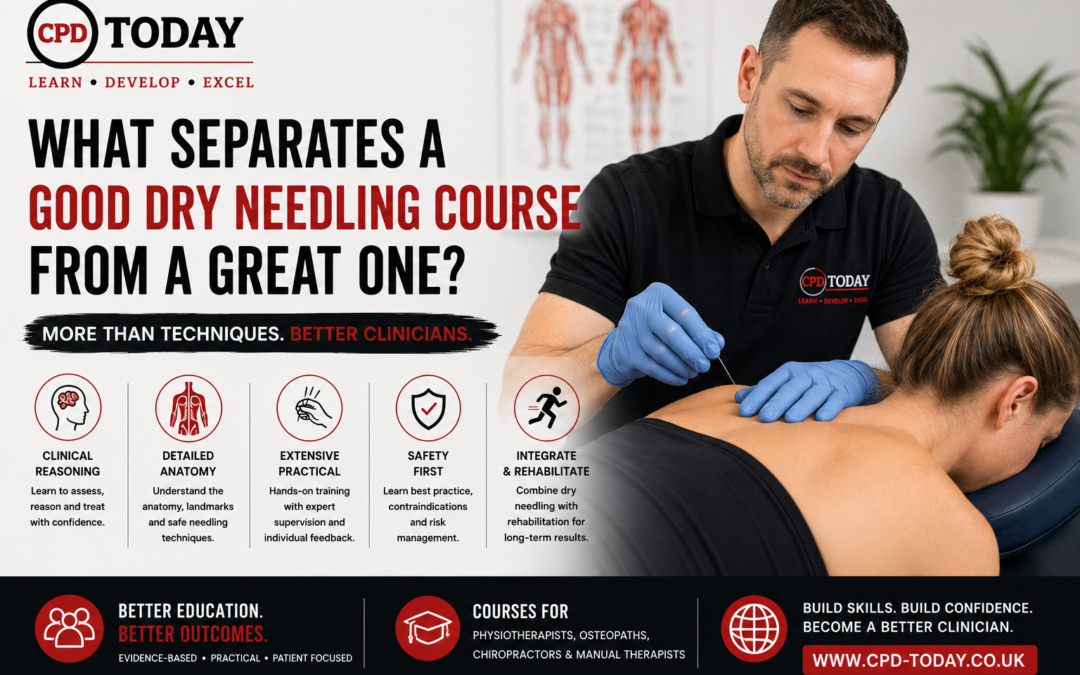
What Separates a Good Dry Needling Course from a Great One?
Meta Description: Discover what to look for when choosing a dry needling course. Learn why clinical reasoning, anatomy, practical training and ongoing support are essential for becoming a confident, evidence-based clinician.
What Separates a Good Dry Needling Course from a Great One?
If you’re considering learning dry needling, you’ll quickly discover there are many courses available. They all promise practical skills, increased confidence and improved patient outcomes—but are they all the same?
The simple answer is no.
A good dry needling course will teach you how to insert a needle safely.
A great dry needling course will teach you how to think like a clinician, make evidence-based decisions and integrate dry needling into modern musculoskeletal practice.
At CPD Today, we believe the difference isn’t measured by how many muscles are covered—it’s measured by the quality of education, the confidence it builds and how well delegates can apply their learning in everyday clinical practice.
So, what should you look for when choosing a dry needling course?
1. Clinical Reasoning Comes Before Needle Placement
One of the biggest misconceptions about dry needling is that success depends on knowing where to insert a needle.
In reality, success depends on understanding:
- Is dry needling appropriate?
- Why am I choosing this treatment?
- What am I trying to achieve?
- What should I do after treatment?
The best courses develop clinical decision-making, not just technical ability.
How We Teach This at CPD Today
Clinical reasoning underpins every practical session. Before delegates perform dry needling, they learn how to assess patients, interpret findings and justify every treatment decision.
2. Strong Anatomy Teaching
Dry needling is impossible to perform safely without a detailed understanding of anatomy.
A high-quality course should teach more than muscle names. It should include:
- Functional anatomy
- Surface anatomy
- Palpation
- Neurovascular structures
- Safe needle angles
- Needle depth
- Anatomical variations
Understanding anatomy builds confidence and improves patient safety.
How We Teach This at CPD Today
Delegates spend significant time developing palpation skills and identifying anatomical landmarks before practical needling begins.
3. Plenty of Supervised Practical Experience
Watching demonstrations is useful.
Actually practising under expert supervision is where confidence develops.
Look for courses that provide:
- Small teaching groups
- Individual feedback
- Repeated practice
- Real clinical scenarios
- Time to ask questions
The more supervised practice you receive, the more confident you’ll feel returning to clinic.
How We Teach This at CPD Today
Our courses maximise hands-on learning, with experienced instructors providing continuous feedback throughout practical sessions.
4. Safety Is Never an Afterthought
Patient safety should be embedded into every aspect of a dry needling course.
A quality programme should cover:
- Contraindications
- Precautions
- Infection prevention
- Adverse event management
- Consent
- Safe disposal of needles
- High-risk anatomical regions
Learning when not to needle is just as important as learning how to needle.
5. Evidence-Based Teaching
The field of musculoskeletal healthcare continues to evolve.
Great educators continually review current evidence and update their teaching accordingly.
Look for courses that discuss:
- Current research
- Clinical guidelines
- Realistic treatment expectations
- Benefits and limitations
- Multimodal rehabilitation
Evidence should support teaching—not simply confirm existing habits.
6. Rehabilitation Is Part of the Course
Dry needling is not a stand-alone treatment.
Research consistently supports combining dry needling with:
- Exercise therapy
- Manual therapy
- Patient education
- Load management
- Rehabilitation
The best courses teach delegates how to integrate dry needling into a complete management programme.
How We Teach This at CPD Today
Every practical technique is linked to rehabilitation strategies, ensuring delegates understand how to turn short-term symptom relief into meaningful functional improvement.
7. Experienced Educators Matter
The quality of a course often reflects the experience of those delivering it.
When choosing a provider, ask:
- Are the instructors experienced clinicians?
- Do they teach regularly?
- Do they continue to practise?
- Can they relate theory to real patient cases?
Learning from clinicians who actively manage musculoskeletal patients every day provides valuable practical insights that go beyond textbooks.
8. Ongoing Support After the Course
Learning doesn’t end when the course finishes.
The best education providers continue to support delegates through:
- Follow-up guidance
- Educational resources
- Advanced courses
- Refresher training
- Access to experienced instructors
Confidence grows through continued learning.
Why Clinicians Choose CPD Today
At CPD Today, our goal is simple:
To develop confident, safe and evidence-based clinicians.
Our Foundation and Advanced Dry Needling Courses combine:
- Evidence-based education
- Extensive practical training
- Functional anatomy
- Clinical reasoning
- Rehabilitation principles
- Small-group teaching
- Experienced instructors
- Ongoing professional development
We don’t believe in teaching techniques in isolation. We teach clinicians how to make better decisions, communicate effectively with patients and integrate dry needling into high-quality musculoskeletal care.
What Our Delegates Tell Us
One of the most common pieces of feedback we receive is:
“I expected to learn dry needling techniques—I didn’t expect to improve my overall clinical reasoning.”
That reflects exactly what we aim to achieve.
Our delegates leave with more than a new skill; they leave with greater confidence in assessment, diagnosis and patient management.
Clinical Pearl
A great dry needling course doesn’t just teach you where to put a needle—it teaches you why, when and whether to use one at all.
That difference shapes every treatment decision you make.
Clinical Takeaway
Choosing a dry needling course is an investment in your professional development. While many courses teach practical techniques, the best programmes also develop clinical reasoning, anatomical knowledge, patient communication and rehabilitation planning. These skills not only improve confidence but also help clinicians deliver safer, more effective and more evidence-based patient care. At CPD Today, we believe that developing better clinicians—not just better technicians—is what truly separates a good dry needling course from a great one.
Frequently Asked Questions
What should I look for in a dry needling course?
Choose a course that combines evidence-based teaching, detailed anatomy, extensive practical training, clinical reasoning, safety and rehabilitation—not just needling techniques.
Is hands-on practice important?
Absolutely. Supervised practical sessions with experienced instructors are essential for developing confidence and competence.
Why is clinical reasoning emphasised so much?
Because successful dry needling depends on selecting the right treatment for the right patient at the right time—not simply inserting a needle.
Does CPD Today provide advanced training?
Yes. After completing our Foundation Course, delegates can progress to our Advanced Dry Needling & Electroacupuncture Course to develop more advanced techniques and clinical skills.
Ready to Learn with Confidence?
If you’re looking for a dry needling course that goes beyond teaching techniques, CPD Today offers evidence-based, hands-on education designed to help healthcare professionals become safer, more confident and more effective clinicians.
Whether you’re starting your dry needling journey or looking to refine your skills, our courses provide the practical experience, clinical reasoning and ongoing support needed to apply dry needling with confidence.
Explore our upcoming Foundation and Advanced Dry Needling Courses at www.cpd-today.co.uk.
Internal Links (SEO)
Link this article to:
- What Is Dry Needling?
- Which Dry Needling Course Should I Take?
- 5 Clinical Pearls Every Dry Needling Delegate Learns
- Why Clinical Reasoning Is More Important Than Needle Placement
- How We Teach Dry Needling for Shoulder Pain on Our Foundation Course
- Common Mistakes Beginners Make with Dry Needling
- Safety Guidelines for Dry Needling
- Contraindications for Dry Needling
- The Evidence for Dry Needling