
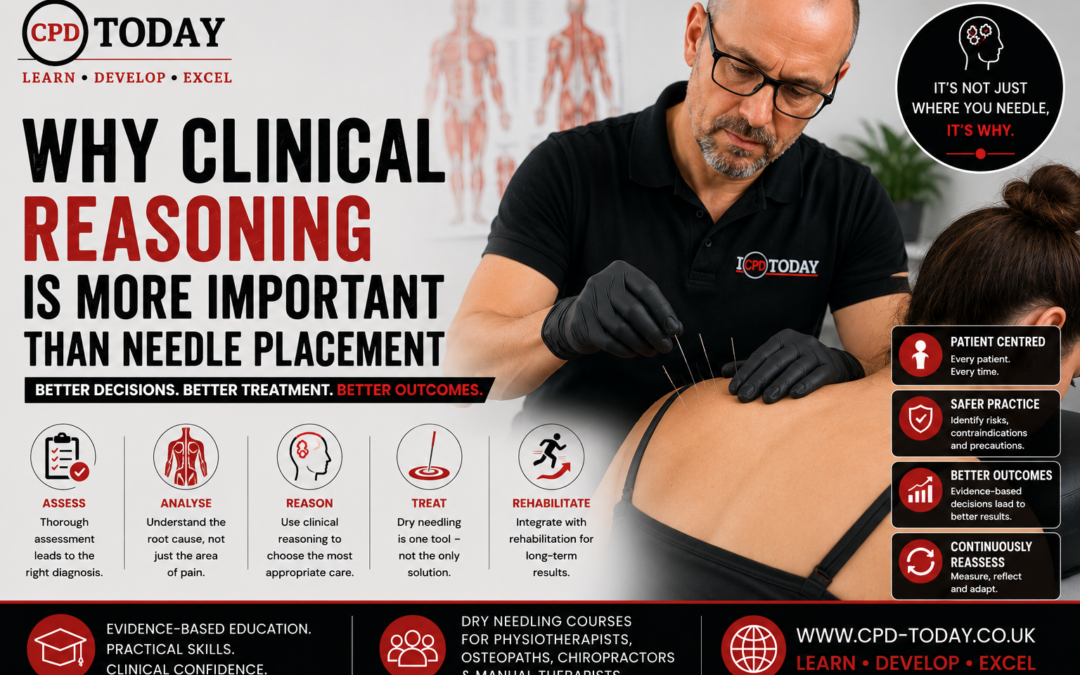
Why Clinical Reasoning Is More Important Than Needle Placement
Meta Description: Learn why clinical reasoning is the foundation of safe, effective dry needling. Discover how CPD Today teaches healthcare professionals to make better treatment decisions through evidence-based assessment and rehabilitation.
Why Clinical Reasoning Is More Important Than Needle Placement
Ask a group of clinicians what they hope to learn on a dry needling course, and many will answer:
“I want to know where to put the needle.”
It’s a reasonable expectation. After all, dry needling is a practical skill.
However, at CPD Today, we believe this is only part of the picture.
Knowing where to place a needle is important—but knowing whether you should needle, why you’re choosing that treatment and what you hope to achieve is far more important.
That is why clinical reasoning sits at the heart of everything we teach.
What Is Clinical Reasoning?
Clinical reasoning is the process of gathering information, interpreting findings and making informed treatment decisions based on the individual patient—not simply following a protocol.
It involves asking questions such as:
- What is the patient’s primary problem?
- Which tissues are contributing to their symptoms?
- Is dry needling appropriate?
- Are there any contraindications or precautions?
- Will dry needling help the patient reach their goals?
- What should follow the treatment?
Every patient is different, and every treatment should reflect that.
The Difference Between Technique and Decision-Making
Two clinicians can use exactly the same dry needling technique but achieve very different outcomes.
The difference often lies in the decision that came before the needle was inserted.
One clinician may:
- Complete a thorough assessment.
- Identify the underlying impairment.
- Explain the treatment clearly.
- Integrate dry needling with rehabilitation.
- Reassess the patient afterwards.
Another may simply needle the painful area because “that’s where it hurts.”
The technique may look identical—but the quality of care is very different.
There Is No “One Muscle Fits All”
A common misconception is that every condition has a single muscle that should be treated.
For example:
- Shoulder pain = supraspinatus
- Tennis elbow = extensor muscles
- Neck pain = upper trapezius
- Low back pain = lumbar multifidus
Clinical practice is rarely that simple.
Shoulder pain may involve the rotator cuff, cervical spine, thoracic spine, scapular control, neural sensitivity or movement dysfunction.
Dry needling should always be guided by assessment rather than assumptions.
Assessment Always Comes First
Before considering dry needling, clinicians should evaluate:
- Patient history
- Symptom behaviour
- Functional limitations
- Movement quality
- Strength
- Joint mobility
- Neural involvement
- Psychosocial factors
- Patient goals
Only then can an informed decision be made about treatment.
This is why we teach assessment before practical needling on every CPD Today course.
The Right Treatment at the Right Time
Dry needling is not always the best option.
Sometimes patients benefit more from:
- Education
- Exercise therapy
- Manual therapy
- Load modification
- Advice and reassurance
One of the signs of an experienced clinician is recognising when not to needle.
Knowing when to choose another intervention is just as important as mastering needling techniques.
Clinical Reasoning Improves Safety
Good clinical reasoning also helps clinicians identify:
- Contraindications
- Precautions
- Red flags
- Relevant anatomy
- Risk factors
- Appropriate needle selection
This leads to safer practice and better patient care.
Clinical Reasoning Improves Outcomes
Research supports multimodal management for many musculoskeletal conditions.
Dry needling is often most effective when it is used to:
- Reduce pain
- Improve movement
- Facilitate rehabilitation
- Increase patient confidence
- Support functional recovery
Without a rehabilitation plan, the benefits of dry needling may be short-lived.
Clinical reasoning ensures treatment fits into a broader management strategy.
How We Teach Clinical Reasoning at CPD Today
Our Foundation Dry Needling Course is built around one core principle:
Every needle should have a reason.
Before delegates begin practical needling, we teach them how to:
- Conduct structured assessments.
- Interpret examination findings.
- Identify appropriate patients.
- Recognise contraindications.
- Select suitable treatment strategies.
- Integrate dry needling with rehabilitation.
- Measure outcomes and reassess.
By the end of the course, delegates understand that dry needling is not simply a practical skill—it’s a clinical decision.
Why This Makes a Better Clinician
Learning techniques is relatively straightforward.
Developing sound clinical reasoning takes time, reflection and quality education.
Clinicians who consistently ask:
- Why?
- When?
- How?
- What next?
are more likely to deliver safe, effective and patient-centred care.
That’s the standard we strive to develop at CPD Today.
Clinical Pearl
The best clinicians don’t ask, “Where do I put the needle?” They ask, “Is dry needling the right intervention for this patient today?”
That single question changes everything.
Clinical Takeaway
Technical skill is only one part of becoming a confident dry needling practitioner. Clinical reasoning underpins every safe and effective treatment decision—from assessment and patient selection to rehabilitation and reassessment. At CPD Today, we teach delegates to think critically, make evidence-based decisions and integrate dry needling into modern musculoskeletal practice, ensuring they leave with more than just a new technique—they leave with a stronger clinical framework.
Frequently Asked Questions
Why is clinical reasoning so important in dry needling?
Because it helps clinicians determine whether dry needling is appropriate, safe and likely to benefit the patient, rather than simply applying a technique based on symptoms alone.
Does the Foundation Course teach assessment?
Yes. Assessment and clinical reasoning are taught before practical needling, ensuring delegates understand when and why to use dry needling.
Is dry needling suitable for every patient?
No. Treatment decisions should always be based on a thorough assessment, patient goals, contraindications and current evidence.
What makes CPD Today’s teaching different?
We focus on developing clinical decision-making alongside practical skills. Our aim is to produce confident clinicians who understand how to integrate dry needling safely and effectively into evidence-based musculoskeletal care.
Next recommended article in the series
What Separates a Good Dry Needling Course from a Great One?