
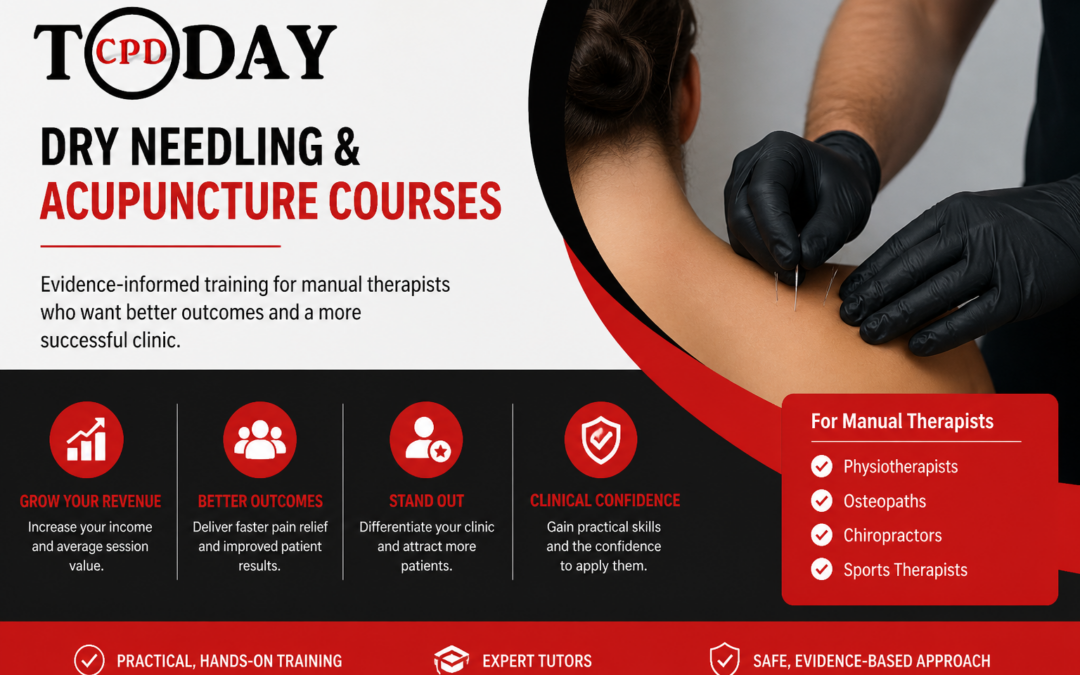
Frequently Asked Questions Before Booking a Dry Needling Course
SEO Title: Dry Needling Course FAQs: Everything You Need to Know Before Booking | CPD Today
Suggested URL: /dry-needling-course-faq
Meta Description: Thinking about booking a dry needling course in the UK? Get answers about eligibility, safety, practical training, qualifications, insurance and choosing the best dry needling course.
If you’re considering learning dry needling, you probably have questions before committing to a course.
Who can learn dry needling? Do you need previous experience? Is it difficult? How much practical training should you receive? And how do you choose a good dry needling course?
At CPD Today, we teach dry needling to healthcare professionals who want practical, clinically relevant training that they can integrate into musculoskeletal practice.
We’ve brought together some of the most common questions clinicians ask before booking a Foundation Dry Needling Course in the UK.
Quick Answer: What Should I Look for in a Dry Needling Course?
A good dry needling course should combine anatomy, safety, clinical reasoning, evidence-informed teaching and extensive supervised practical training.
You shouldn’t simply learn where to insert needles.
You should understand:
- Why you’re selecting dry needling
- When it may be appropriate
- When it isn’t appropriate
- Relevant anatomy
- Contraindications and precautions
- Safe needling principles
- How to reassess the patient
- How to integrate dry needling with rehabilitation
This approach forms the basis of our teaching at CPD Today.
Dry Needling Course FAQs
1. What Is Dry Needling?
Dry needling is a clinical technique involving the insertion of fine, solid filament needles into selected tissues as part of the management of some musculoskeletal presentations.
Unlike an injection, nothing is injected into the tissue—hence the term “dry” needling.
Modern dry needling should not simply involve needling wherever a patient reports pain. Treatment selection should be based on assessment, anatomy, clinical reasoning, patient goals and an understanding of the available evidence.
2. Who Can Learn Dry Needling?
Eligibility depends on your professional background, scope of practice, insurer requirements and the entry criteria of the training provider.
CPD Today courses are aimed at appropriately qualified healthcare and manual therapy professionals. Depending on the course and relevant requirements, this may include professionals such as:
- Physiotherapists
- Osteopaths
- Chiropractors
- Sports therapists
- Other appropriately qualified musculoskeletal practitioners
Before booking any dry needling training, clinicians should check that the technique falls within their professional scope and that their insurer will provide appropriate cover.
3. Can Physiotherapists Learn Dry Needling?
Dry needling is used by many physiotherapists as one component of musculoskeletal practice, subject to appropriate education, competence, professional requirements and insurance.
A physiotherapist learning dry needling should receive training that covers more than needle insertion.
At CPD Today, our approach emphasises anatomy, assessment, safety, clinical reasoning and rehabilitation alongside practical needling skills.
4. Can Osteopaths Learn Dry Needling?
Appropriately trained osteopaths may incorporate dry needling within their clinical practice where this is consistent with their professional responsibilities, competence and insurance arrangements.
Dry needling can complement an osteopathic approach particularly well when it is integrated with assessment, manual therapy, exercise and rehabilitation rather than viewed as an isolated technique.
5. Can Sports Therapists Learn Dry Needling?
Eligibility can depend on the therapist’s qualification level, professional membership, insurer and course entry requirements.
Sports therapists considering dry needling should therefore check their individual eligibility before booking.
At CPD Today, we encourage clinicians to contact us if they’re uncertain whether their qualification meets the entry requirements for a particular course.
6. Do I Need Previous Dry Needling Experience?
For a Foundation Dry Needling Course, previous dry needling experience is generally not expected.
Foundation training should introduce the technique progressively.
At CPD Today, we build from core principles including:
Evidence → Safety → Anatomy → Palpation → Technique → Clinical Reasoning → Reassessment → Rehabilitation
This helps delegates understand the reasoning behind the intervention rather than simply memorising needle placements.
7. Do I Need to Be Confident with Needles Before Attending?
No.
It’s common for delegates to feel apprehensive about performing their first dry needling technique.
Confidence should develop gradually through good teaching, anatomical understanding, demonstration, supervised practice and instructor feedback.
You shouldn’t be expected to walk into a Foundation Course already confident with needles.
Developing that confidence is part of the learning process.
8. Is Dry Needling Difficult to Learn?
The basic handling of a needle can be learned relatively quickly.
Becoming a good dry needling clinician involves considerably more.
You need to understand:
- Anatomy
- Palpation
- Patient positioning
- Contraindications
- Precautions
- Infection control
- Clinical reasoning
- Patient communication
- Treatment selection
- Rehabilitation
That’s why we believe dry needling education should focus on developing the clinician, rather than simply teaching a collection of techniques.
9. Is Dry Needling Safe?
Dry needling is an invasive clinical technique and therefore requires appropriate training, anatomical knowledge, hygiene procedures, patient consent and risk management.
Clinicians should understand both common minor responses and the potential for more significant adverse events associated with inappropriate technique or particular anatomical regions.
A high-quality dry needling course should therefore make safety a core component of practical teaching, not simply a short theoretical section.
10. Why Is Anatomy So Important for Dry Needling?
Because the needle passes through the skin and into underlying tissues.
Clinicians need to understand not only the target muscle but also the structures surrounding it.
This may include:
- Nerves
- Blood vessels
- Bone
- Joints
- Thoracic structures
- Other vulnerable anatomical structures
Detailed surface anatomy and palpation therefore form an important part of safe dry needling practice.
At CPD Today, we believe:
Anatomical knowledge is one of your most important safety tools.
11. Will I Actually Practise Dry Needling on the Course?
Practical training should form a substantial part of a Foundation Dry Needling Course.
Watching demonstrations or completing online theory cannot replicate supervised hands-on skill development.
Our CPD Today Foundation Course places strong emphasis on practical learning, allowing delegates to develop palpation, positioning, needle handling and treatment skills with instructor guidance.
12. Why Is Supervised Practical Training Important?
Because dry needling is a practical clinical skill.
An experienced instructor can observe details such as:
- Your positioning
- Hand placement
- Palpation
- Needle handling
- Communication
- Technique selection
and provide immediate feedback.
That feedback is often what turns theoretical understanding into practical confidence.
13. What Should a Good Foundation Dry Needling Course Teach?
We believe a comprehensive Foundation Course should cover several interconnected areas:
- Principles and evidence
- Relevant anatomy
- Palpation
- Patient assessment
- Contraindications and precautions
- Infection prevention and safe practice
- Needle handling
- Practical techniques
- Clinical reasoning
- Reassessment
- Integration with rehabilitation
If a course concentrates almost entirely on where to put needles, it’s worth asking what is missing.
14. Should Dry Needling Be Used as a Stand-Alone Treatment?
Not routinely.
Dry needling is better considered as one potential component of a broader management strategy.
Depending on the patient’s presentation, this might also include:
- Exercise
- Progressive loading
- Manual therapy
- Patient education
- Movement retraining
- Activity modification
- Self-management
The question shouldn’t simply be:
“Where should I needle?”
It should be:
“What does this patient need?”
15. How Important Is Clinical Reasoning?
Extremely important.
Knowing how to perform a technique doesn’t automatically tell you when to use it.
Before needling, clinicians should consider questions such as:
- What is the clinical presentation?
- What am I trying to change?
- Why have I selected this tissue?
- Is dry needling appropriate?
- Are there contraindications or precautions?
- How will I measure the response?
- What happens after needling?
At CPD Today, one of our core teaching principles is:
Every needle should have a reason.
16. Can I Use Dry Needling Immediately After Completing a Course?
Completing a course is only one component of professional competence.
Before incorporating dry needling into practice, clinicians should ensure that they meet the requirements of their profession, employer where relevant, insurer and individual scope of practice.
You should also only use techniques for which you feel appropriately trained and competent.
Professional development doesn’t stop when the course finishes.
17. Do I Need Insurance for Dry Needling?
You should confirm appropriate professional indemnity arrangements before providing dry needling clinically.
Requirements can vary depending on profession, insurer, qualification and workplace.
If you’re unsure, contact your insurer directly and confirm what training or certification they require.
Don’t assume that completing any particular course automatically guarantees insurance cover.
18. How Long Does It Take to Become Confident at Dry Needling?
There isn’t a single answer.
Confidence depends on factors including previous clinical experience, anatomical knowledge, practical exposure and continued use of the technique.
A good Foundation Course should give you the framework and supervised practical experience needed to begin developing competence.
Confidence then continues to grow through appropriate clinical experience, reflection and further professional development.
19. What Is the Difference Between Foundation and Advanced Dry Needling?
A Foundation Dry Needling Course is designed to establish the core knowledge and practical skills required for safe clinical practice.
Advanced training builds upon those foundations.
Depending on the programme, advanced education may explore more complex anatomical areas, additional techniques, more detailed clinical applications and other approaches such as electroacupuncture/electrical needling techniques.
At CPD Today, our training pathway allows clinicians to establish strong foundations before progressing their skills further.
20. Should I Take a Foundation or Advanced Dry Needling Course?
If you haven’t previously completed appropriate dry needling training, the Foundation Course is usually the appropriate starting point.
If you’re already trained and regularly using dry needling clinically, advanced education may be more suitable.
The important thing is not to rush progression.
Strong advanced skills require strong foundations.
21. Can You Learn Dry Needling Online?
Online education can be valuable for theory, anatomy revision, evidence and continuing professional development.
However, dry needling itself is a practical invasive skill.
We believe initial practical training benefits considerably from face-to-face demonstration, supervised practice and immediate instructor feedback.
For clinicians learning dry needling for the first time, practical education should be a major consideration when comparing courses.
22. How Do I Choose the Best Dry Needling Course in the UK?
Don’t choose solely on price or the number of muscles listed in the course description.
Ask:
- Who teaches the course?
- What are their clinical and teaching backgrounds?
- How much supervised practical training is included?
- Is anatomy taught?
- Is safety embedded throughout?
- Does the course teach contraindications and precautions?
- Is current evidence discussed?
- Is clinical reasoning included?
- Is rehabilitation discussed?
- What happens after the course?
A course should help you become a better clinician, not simply add another certificate to your portfolio.
Why Choose CPD Today for Dry Needling Training?
At CPD Today, our philosophy is simple:
Learn. Develop. Excel.
Our dry needling education is designed around the realities of clinical practice.
We combine:
- Evidence-informed teaching
- Functional and surface anatomy
- Safety
- Clinical reasoning
- Extensive supervised practical learning
- Individual feedback
- Patient assessment
- Rehabilitation
- Real-world clinical discussion
Our aim isn’t to teach delegates to needle every patient.
It’s to help healthcare professionals develop the confidence to understand when dry needling may be useful, how to apply the techniques they’ve learned safely and when another approach may be more appropriate.
Looking for a Foundation Dry Needling Course in the UK?
If you’re a physiotherapist, osteopath, chiropractor, sports therapist or another eligible healthcare professional considering learning dry needling, choosing the right education matters.
The CPD Today Foundation Dry Needling Course combines practical training with anatomy, evidence, safety and clinical reasoning to help clinicians develop skills they can integrate into modern musculoskeletal practice.
If you’ve never used a needle before, that’s exactly what Foundation training is designed for.
Start with the foundations. Build your confidence. Develop your clinical skills.
Explore upcoming CPD Today Dry Needling Courses at www.cpd-today.co.uk.
Learn. Develop. Excel.