
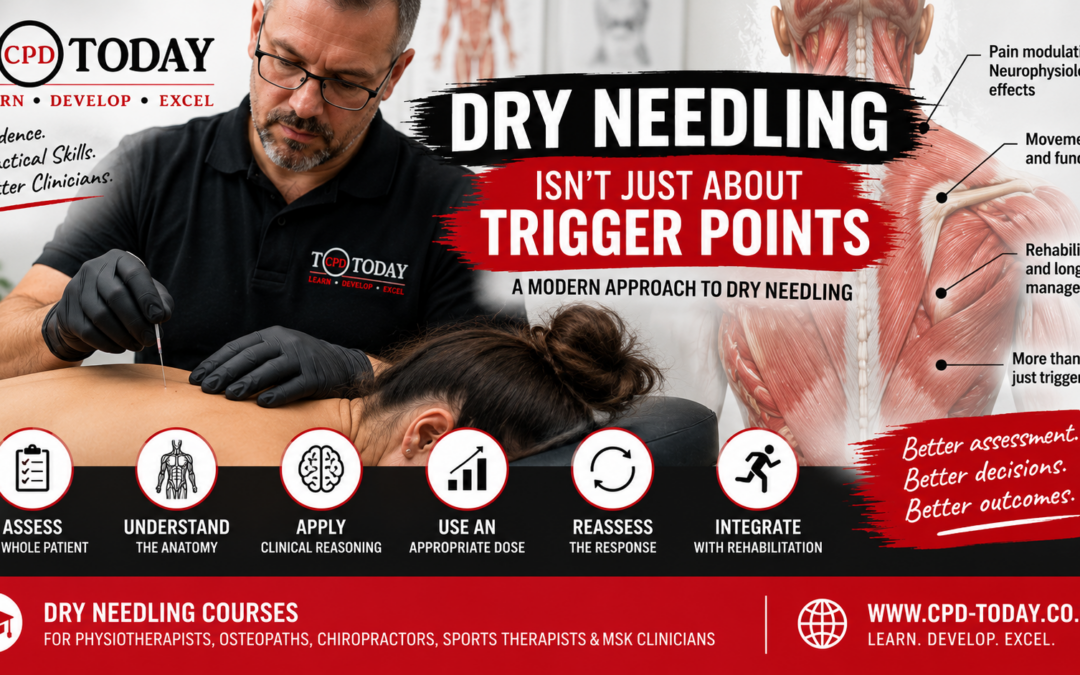
SEO Title: Dry Needling Isn’t Just About Trigger Points | Modern Dry Needling Explained
Meta Description: Is dry needling only for trigger points? Explore modern dry needling practice, pain modulation, clinical reasoning and rehabilitation, and discover how CPD Today teaches clinicians to go beyond trigger-point treatment.
Suggested URL: /dry-needling-trigger-points-modern-practice
Primary keyword: dry needling trigger points
Supporting searches: how does dry needling work, modern dry needling, dry needling course UK, myofascial trigger points, dry needling training, dry needling pain relief
Dry Needling Isn’t Just About Trigger Points
Mention dry needling to many clinicians and one phrase immediately comes to mind:
Trigger points.
For many years, dry needling education centred heavily around identifying a tender or taut area within a muscle, inserting a needle and attempting to produce a local twitch response.
But is that all dry needling is?
No.
Our understanding of musculoskeletal pain has developed considerably, and contemporary dry needling practice is increasingly viewed within a broader framework involving pain modulation, neuromuscular responses, patient expectations, movement and rehabilitation.
At CPD Today, this is an important part of how we teach dry needling.
We don’t want clinicians simply searching for “knots” and needling them.
We want them asking:
Why am I using dry needling? What am I trying to change? And what am I going to do afterwards?
What Is a Trigger Point?
A myofascial trigger point has traditionally been described as a hypersensitive area associated with a taut band of skeletal muscle that may produce local tenderness and sometimes referred symptoms.
Clinically, patients may describe these areas as:
- Knots
- Tight spots
- Tender points
- Muscle tension
- Areas that reproduce their familiar symptoms
Trigger points have played an important role in the historical development of dry needling.
However, the exact mechanisms and biological nature of trigger points remain debated, and their identification between clinicians is not always consistent.
That doesn’t mean a patient’s tenderness isn’t real.
It means we should be cautious about presenting one explanatory model as the complete explanation for their pain.
The Traditional Trigger-Point Model of Dry Needling
A traditional approach might look something like this:
Find a trigger point → insert a needle → obtain a twitch response → reduce the trigger point.
This model has influenced dry needling teaching for decades.
The local twitch response—a brief involuntary contraction of muscle fibres following stimulation—has consequently sometimes been regarded as evidence that the clinician has successfully treated the target.
But modern clinical reasoning asks a more important question:
Does producing a twitch response actually matter to the outcome we’re trying to achieve?
The answer is more complicated than simply “yes” or “no”.
Do You Need a Local Twitch Response?
Not necessarily.
A twitch response can occur during some dry needling techniques, particularly when stimulating sensitive areas within muscle.
However, obtaining a twitch response shouldn’t automatically become the objective of treatment.
Repeatedly manipulating a needle simply to chase increasingly large twitch responses may increase post-treatment soreness without necessarily producing a proportionally better clinical outcome.
The objective should remain centred on the patient.
For example:
Has pain changed?
Has movement improved?
Has function changed?
Can the patient now engage more effectively with rehabilitation?
These questions are more clinically meaningful than simply asking whether the muscle twitched.
So How Might Dry Needling Work?
This is where modern dry needling becomes particularly interesting.
There probably isn’t a single mechanism explaining every clinical response.
Several peripheral and central neurophysiological mechanisms have been proposed.
Needle stimulation may influence sensory input from the treated area and contribute to changes in pain processing.
Potential mechanisms discussed within the literature include:
- Peripheral sensory stimulation
- Changes in nociceptive input
- Spinal pain-modulating mechanisms
- Descending pain modulation
- Changes in local tissue sensitivity
- Altered motor responses
- Contextual and expectation-related effects
Importantly, these mechanisms shouldn’t be presented as proof that dry needling “fixes” damaged tissue.
A change in pain doesn’t necessarily mean a structure has physically changed.
Pain Reduction Can Create an Opportunity
Imagine a patient with shoulder pain who finds reaching overhead painful.
Following an appropriate assessment, dry needling is selected as one component of treatment.
Afterwards, their movement is reassessed.
Their pain has reduced and they can move more comfortably.
What happens next?
This is where the clinician has an opportunity.
Rather than simply telling the patient to return next week for more needling, you might use that temporary improvement to introduce:
- Strengthening
- Movement retraining
- Progressive loading
- Mobility exercises
- Functional rehabilitation
Dry needling hasn’t necessarily “fixed” the shoulder.
It may have helped create a window in which rehabilitation becomes easier.
That’s a very different clinical philosophy.
Dry Needling Shouldn’t Become “Find the Pain and Needle It”
Another problem with an overly simplistic trigger-point model is the temptation to needle wherever a patient reports tenderness.
But tenderness doesn’t automatically identify the cause of someone’s symptoms.
Consider someone with neck and shoulder pain.
Tenderness in the upper trapezius might be present.
But the wider assessment may reveal:
- Cervical involvement
- Neural sensitivity
- Reduced shoulder capacity
- Load-related symptoms
- Sleep-related factors
- Work-related aggravation
- Psychosocial influences
Needling a tender muscle without considering the broader presentation risks reducing clinical care to:
“It hurts here, so I’ll needle here.”
Modern musculoskeletal practice should be more sophisticated than that.
Assessment Comes Before Needling
At CPD Today, we repeatedly return to one principle:
Assessment before intervention.
Before selecting dry needling, clinicians should consider:
- What is the patient’s main problem?
- What activities are limited?
- What does the assessment demonstrate?
- What are the patient’s goals?
- Are there relevant contraindications or precautions?
- Why might dry needling help?
- What outcome are we hoping to influence?
- How will we measure whether it helped?
Only then should the needle enter the conversation.
Every Needle Should Have a Reason
This has become one of the central principles behind our teaching.
Before inserting a needle, you should be able to explain why you’re doing it.
Not simply:
“Because that muscle is tight.”
Instead:
“Based on my assessment, I think this intervention may help modify the patient’s symptoms sufficiently to allow us to progress their rehabilitation.”
That represents a much stronger clinical rationale.
What About “Muscle Knots”?
Patients frequently use the term “knot”, and clinicians often use it too.
It’s a useful everyday description of how an area feels.
However, we should be careful about explaining pain as though muscles literally develop knots that need to be physically broken apart by a needle.
Musculoskeletal pain is influenced by numerous biological, psychological and contextual factors.
A tender area can be clinically relevant without needing an overly structural explanation.
Good communication helps patients understand treatment without creating unnecessary fear about their body.
Dry Needling Doesn’t Have to Be Painful to Work
Another misconception associated with trigger-point treatment is that treatment needs to be painful or aggressive to be effective.
It doesn’t.
Treatment dosage should consider:
- Patient sensitivity
- Treatment goals
- Area being treated
- Previous response
- Patient preference
- Clinical presentation
More stimulation isn’t automatically better stimulation.
Sometimes a relatively conservative technique may be entirely appropriate.
Clinical Pearl
Don’t judge treatment quality by how much the patient feels during needling. Judge it by what changes afterwards.
Reassessment Is More Important Than the Twitch
If you’re using dry needling to influence a particular clinical finding, reassess that finding.
For example, you might measure:
- Pain during movement
- Range of motion
- Functional task
- Strength
- Movement confidence
- Exercise tolerance
Then treat.
Then repeat the measure.
This gives you clinically useful information.
If nothing changes, that matters too.
It may suggest that the intervention isn’t particularly useful for that patient at that time.
Dry Needling Should Support Rehabilitation
One of the most important principles we teach is:
The needle is rarely the end of treatment.
If dry needling helps modify symptoms, ask:
What can the patient do now that they couldn’t do before?
Perhaps they can:
- Load the tendon more comfortably
- Move the shoulder further
- Perform an exercise with less pain
- Turn their neck more easily
- Walk more comfortably
- Return gradually to sport
Use the change.
That’s where dry needling becomes integrated into rehabilitation rather than becoming a passive treatment that patients feel dependent upon.
What Does the Evidence Say About Dry Needling?
Research into dry needling has reported potential improvements in pain and some measures of function across a range of musculoskeletal presentations, particularly in the short term.
However, findings vary considerably between conditions, techniques, comparison treatments and study designs.
The evidence does not justify presenting dry needling as a cure-all.
Nor does it mean dry needling must be included in every treatment programme.
A more reasonable interpretation is that dry needling may be a useful adjunct for selected patients when supported by appropriate assessment and incorporated within broader evidence-informed management.
That’s the approach we encourage at CPD Today.
Modern Dry Needling Is About Clinical Reasoning
The evolution of dry needling isn’t necessarily about abandoning trigger points.
It’s about recognising that trigger points represent one part of a much broader clinical picture.
A modern approach asks:
Why am I needling?
What response am I trying to achieve?
Is there a safer or simpler alternative?
How much stimulation is appropriate?
How will I measure the response?
What happens afterwards?
Those questions turn dry needling from a technique into a clinically reasoned intervention.
How We Teach Modern Dry Needling at CPD Today
On our Foundation Dry Needling Course, we teach practical needling techniques alongside the clinical reasoning required to use them appropriately.
Our training incorporates:
- Relevant anatomy
- Surface anatomy and palpation
- Current evidence
- Safety
- Contraindications and precautions
- Patient selection
- Needle handling
- Practical techniques
- Clinical reasoning
- Reassessment
- Exercise and rehabilitation
We discuss trigger points, but we don’t want delegates leaving with the impression that every painful patient is simply a collection of trigger points waiting to be needled.
We teach the clinician—not just the technique.
What Changes at Advanced Level?
Once clinicians have established good foundational skills, advanced training can explore more complex applications and treatment approaches.
This may include more advanced clinical reasoning, additional anatomical areas and electrical stimulation techniques such as electroacupuncture.
But the fundamental principle doesn’t change.
Whether you’re inserting one needle or using a more advanced technique:
Every intervention should have a clinical reason.
Advanced practice isn’t about using increasingly complicated techniques.
It’s about making increasingly thoughtful decisions.
Common Dry Needling Myths
“Dry needling works by breaking up muscle knots.”
This is an oversimplification. Clinical responses are likely to involve several mechanisms, including neurophysiological and contextual effects.
“You need a twitch response for dry needling to work.”
A twitch may occur, but it shouldn’t automatically be considered necessary for a successful clinical outcome.
“The more needles you use, the better the treatment.”
There is no simple relationship between the number of needles and treatment quality.
“If dry needling hurts more, it’s working better.”
Treatment discomfort isn’t a measure of effectiveness.
“Dry needling fixes the underlying problem.”
Sometimes dry needling may help modify symptoms, but long-term management often requires rehabilitation, education, load management and addressing relevant contributing factors.
Clinical Takeaway
Dry needling has historically been strongly associated with myofascial trigger points and local twitch responses.
Those concepts remain part of the conversation, but they shouldn’t define the whole of modern dry needling practice.
Today’s clinician should think more broadly.
Assess the patient.
Understand the anatomy.
Choose the intervention for a reason.
Use an appropriate dose.
Reassess the response.
Then progress rehabilitation.
At CPD Today, that’s what we mean by teaching dry needling as a clinical skill rather than simply a needling technique.
Frequently Asked Questions
Is dry needling the same as trigger-point therapy?
No. Trigger-point needling is one approach associated with dry needling, but contemporary dry needling practice can be considered within a broader clinical and neurophysiological framework.
Does dry needling remove muscle knots?
It’s more accurate to describe potential changes in symptoms, sensitivity or function rather than suggesting a needle physically removes a “knot”.
Does a muscle have to twitch for dry needling to work?
Not necessarily. A local twitch response can occur, but producing one shouldn’t automatically be the primary objective of treatment.
How does dry needling reduce pain?
The exact mechanisms remain under investigation. Proposed explanations include peripheral and central neurophysiological processes affecting nociceptive input and pain modulation, alongside contextual factors.
Is more needling better?
No. Treatment should be appropriately dosed according to the patient, clinical presentation and intended outcome.
Should dry needling be combined with exercise?
Often, yes. Where dry needling produces a useful change in symptoms or movement, that change can provide an opportunity to progress appropriate exercise and rehabilitation.
Do CPD Today courses teach trigger-point dry needling?
Trigger-point concepts can form part of dry needling education, but our teaching places them within a broader framework of anatomy, evidence, safety, clinical reasoning, reassessment and rehabilitation.
Learn Modern Dry Needling with CPD Today
If you’re looking for a Dry Needling Course in the UK, don’t just learn where to put the needle.
Learn why you’re putting it there.
Our Foundation Dry Needling Course helps clinicians develop the anatomy, safety, practical skills and clinical reasoning required to introduce dry needling appropriately into musculoskeletal practice.
Already trained?
Our Advanced Dry Needling & Electroacupuncture Course provides the opportunity to develop your existing skills further.
Learn. Develop. Excel.
Explore CPD Today courses at www.cpd-today.co.uk.