
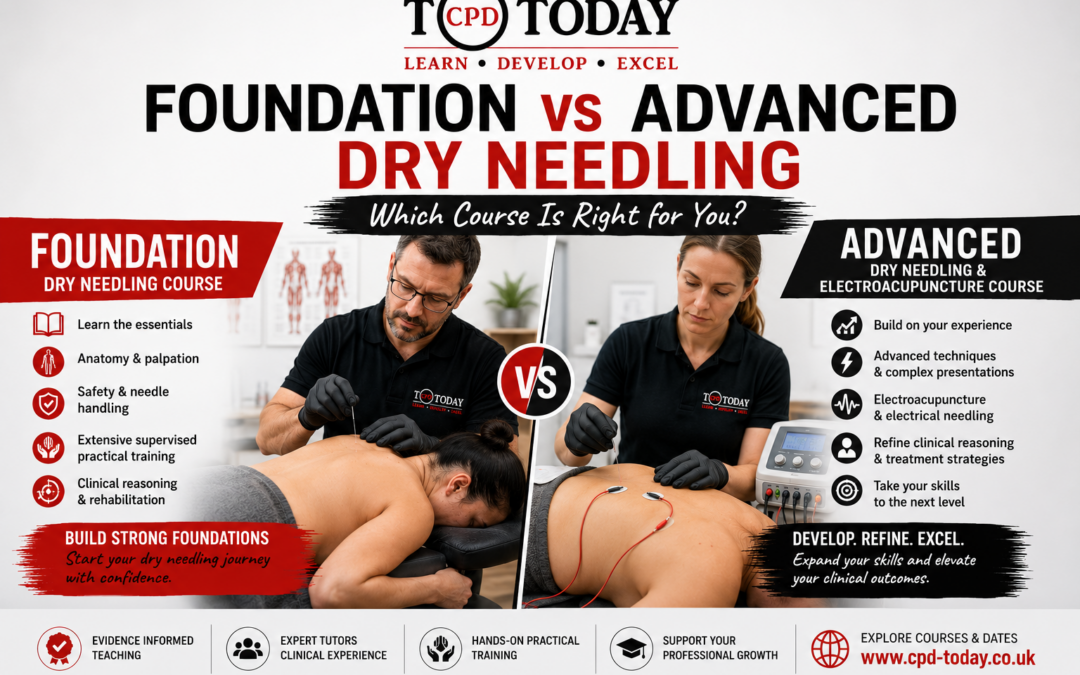
SEO Title: Foundation vs Advanced Dry Needling Course: Which Should You Choose? | CPD Today
Meta Description: Foundation or Advanced Dry Needling Course? Compare the two levels of CPD Today dry needling training and discover which course is right for your clinical experience and professional development.
Suggested URL: /foundation-vs-advanced-dry-needling-course
If you’re looking for a dry needling course in the UK, one of the first decisions you’ll need to make is:
Should I take a Foundation or Advanced Dry Needling Course?
For clinicians completely new to dry needling, the answer is usually straightforward: start with the foundations.
But what if you’ve previously completed some dry needling training? What if you already use needling regularly in clinic? Or perhaps you’re confident treating common musculoskeletal presentations but want to develop your techniques further?
At CPD Today, our Foundation and Advanced Dry Needling training are designed to form a progression.
The Foundation Course develops the essential knowledge, safety, clinical reasoning and practical skills required to begin using dry needling appropriately.
Advanced training builds on those foundations, allowing experienced practitioners to expand their clinical toolkit and explore more advanced applications.
Here’s how to decide which course is right for you.
Quick Answer: Foundation or Advanced Dry Needling?
Choose a Foundation Dry Needling Course if you’re new to dry needling or haven’t previously completed suitable practical training.
Consider an Advanced Dry Needling Course if you already have appropriate foundation-level training, understand safe needling principles and regularly use dry needling within your clinical practice.
The important principle is:
Don’t rush to advanced techniques before you’ve developed strong foundations.
What Is a Foundation Dry Needling Course?
A Foundation Dry Needling Course introduces appropriately qualified healthcare professionals to the principles and practical skills required to begin developing competence in dry needling.
It shouldn’t simply teach you a list of muscles and needle positions.
Good Foundation training should help you understand:
- What dry needling is
- Current evidence and proposed mechanisms
- Patient assessment
- Clinical reasoning
- Relevant anatomy
- Surface anatomy and palpation
- Contraindications and precautions
- Infection prevention
- Safe needle handling
- Practical needling techniques
- Patient communication and consent
- Reassessment
- Integration with rehabilitation
At CPD Today, these principles underpin our Foundation training.
Who Is the Foundation Dry Needling Course For?
Foundation training is designed for appropriately qualified clinicians who are new to dry needling.
Depending on eligibility, this may include:
- Physiotherapists
- Osteopaths
- Chiropractors
- Sports therapists
- Other appropriately qualified musculoskeletal practitioners
You don’t need previous dry needling experience.
In fact, many delegates arrive having never inserted a needle before.
The purpose of Foundation training is to build confidence progressively rather than expecting you to arrive with practical needling skills.
What Will I Learn on a Foundation Course?
The focus is on building strong fundamentals.
We want delegates to progress through a logical sequence:
Assess → Reason → Identify → Palpate → Position → Needle → Reassess → Rehabilitate
This is deliberately different from simply memorising:
Condition X = Needle Y.
Patients don’t always fit neat protocols.
Developing clinical reasoning gives you the ability to adapt what you’ve learned to the individual patient.
Why Anatomy Is So Important at Foundation Level
Anatomy is one of the most important foundations of safe dry needling.
Before inserting a needle, you need to understand:
- What tissue you’re targeting
- Where it is located
- What structures surround it
- What lies beneath it
- How patient positioning changes the anatomy
- Relevant safety considerations
That’s why we spend considerable time combining surface anatomy, palpation and practical technique.
The goal isn’t simply to remember where your instructor put the needle.
It’s to understand why it was placed there.
What Is an Advanced Dry Needling Course?
Advanced dry needling training is intended for clinicians who have already established appropriate foundation-level knowledge and practical experience.
Rather than repeating the basics, advanced training allows clinicians to develop their existing skills further.
Depending on the programme, advanced training may include:
- More advanced clinical applications
- Additional anatomical regions
- More complex techniques
- Refined clinical reasoning
- Challenging patient presentations
- Advanced treatment strategies
- Electrical needling/electroacupuncture approaches
- Integration with wider rehabilitation strategies
The emphasis shifts from learning the fundamental skill towards refining and expanding how you use it clinically.
Who Should Consider Advanced Dry Needling Training?
Advanced training may be appropriate if you:
- Have completed recognised Foundation-level dry needling training
- Already use dry needling clinically
- Are confident with basic needle handling
- Understand contraindications and precautions
- Have good surface anatomy and palpation skills
- Want to expand your range of techniques
- Want to develop your clinical reasoning further
- Are interested in electroacupuncture or electrical needling applications
Advanced shouldn’t mean simply using more needles.
It should mean developing a deeper understanding of how and why you’re using the technique.
Foundation vs Advanced Dry Needling: At a Glance
| Foundation Dry Needling | Advanced Dry Needling | |
|---|---|---|
| Previous experience | Usually not required | Foundation training expected |
| Main goal | Build core skills | Develop existing skills |
| Anatomy | Fundamental anatomy and palpation | Builds on existing anatomical knowledge |
| Safety | Core safe-practice principles | Applied to more advanced techniques |
| Needle handling | Introduced and developed | Refined |
| Clinical reasoning | Fundamental principles | More complex application |
| Practical training | Extensive supervised practice | Advanced practical application |
| Electrical techniques | Course dependent | May include electroacupuncture/electrical needling |
| Best suited to | Beginners | Previously trained clinicians |
What If I’ve Done Some Dry Needling Before?
This is where the decision can become less obvious.
Perhaps you attended a short course several years ago.
Maybe you’ve learned some techniques but haven’t used them regularly.
Or perhaps your previous training covered only a small number of areas.
In these circumstances, don’t choose a course purely based on the certificate you already hold.
Consider your current competence and confidence.
Ask yourself:
- When did I last perform dry needling?
- How frequently do I use it?
- Am I confident with relevant anatomy?
- Do I understand current safety principles?
- Can I recognise contraindications and precautions?
- Can I justify why I’m selecting dry needling?
- Do I routinely reassess afterwards?
If several of those questions make you uncertain, revisiting Foundation-level training may be more useful than jumping straight into advanced techniques.
Is Repeating Foundation Training a Step Backwards?
Absolutely not.
Experienced clinicians regularly revisit foundational skills.
That’s true across healthcare.
Returning to Foundation training can help refresh:
- Anatomy
- Safety
- Palpation
- Needle handling
- Clinical reasoning
- Evidence
- Practical confidence
Sometimes improving the fundamentals has a greater impact on clinical practice than simply learning another technique.
What Makes Advanced Training “Advanced”?
It’s easy to assume that advanced means:
More muscles + more needles = more advanced.
We don’t think that’s a particularly useful definition.
Advanced practice should involve more sophisticated decision-making.
An advanced clinician should increasingly be asking:
Why am I choosing this intervention?
What outcome am I trying to achieve?
What does the evidence suggest?
How does this fit into rehabilitation?
What will I do if the patient doesn’t respond?
Technique matters.
But clinical reasoning determines how that technique is used.
Where Does Electroacupuncture Fit?
For clinicians who already have appropriate needling experience, advanced training can provide an opportunity to explore electrical stimulation alongside needling techniques, where appropriate.
This adds another dimension to needling practice and requires clinicians to understand areas such as:
- Appropriate patient selection
- Equipment
- Safety
- Treatment parameters
- Clinical reasoning
- Contraindications and precautions
It shouldn’t simply be viewed as connecting a machine to needles.
As with conventional dry needling, the important question remains:
Why are you choosing this intervention for this patient?
Do I Need Advanced Training to Be a Good Dry Needling Practitioner?
No.
Being a good clinician isn’t determined by how many courses you’ve completed.
A practitioner with excellent anatomy, assessment skills and clinical reasoning who uses a relatively small number of techniques appropriately may provide much better care than somebody who knows dozens of advanced techniques but applies them indiscriminately.
Advanced CPD should develop your clinical practice, not simply increase your collection of techniques.
Should I Take Advanced Training Immediately After Foundation?
Not necessarily.
There can be considerable value in spending time applying your Foundation learning clinically before progressing.
This allows you to discover:
- Which techniques you use regularly
- Which areas you find challenging
- Where your confidence needs developing
- What clinical questions arise
- Which additional skills would genuinely benefit your patients
Advanced training then becomes much more meaningful because you can relate new learning to genuine clinical experience.
Choosing the Right Dry Needling Course
Before booking, consider three questions.
1. What training have I already completed?
If none, Foundation training is the logical starting point.
2. How confident am I currently?
A previous certificate doesn’t necessarily equal current competence.
3. What do I actually want to learn?
If you need core needling skills, choose Foundation.
If you already have those foundations and want to expand your clinical application, Advanced may be more appropriate.
The CPD Today Dry Needling Training Pathway
At CPD Today, we want professional development to follow a logical progression.
Foundation Dry Needling
Learn the fundamentals.
Develop anatomy, safety, palpation, needle handling, clinical reasoning and practical confidence.
↓
Clinical Practice
Apply and consolidate.
Use your skills appropriately, reassess your patients and continue developing clinical experience.
↓
Advanced Dry Needling & Electroacupuncture
Develop your skills further.
Expand your techniques, clinical reasoning and understanding of more advanced applications.
This creates progression rather than simply collecting disconnected CPD courses.
Why Choose CPD Today?
Our philosophy is reflected in three words:
Learn. Develop. Excel.
Our dry needling training combines:
- Evidence-informed education
- Functional anatomy
- Surface anatomy and palpation
- Clinical reasoning
- Safety
- Extensive practical training
- Rehabilitation
- Real-world clinical application
Whether you’re attending Foundation or Advanced training, the aim isn’t simply to teach you another technique.
It’s to help you become a more knowledgeable, confident and thoughtful clinician.
Clinical Takeaway
Choosing between Foundation and Advanced Dry Needling shouldn’t be about selecting the course with the most impressive list of techniques.
Choose the course that matches where you are clinically now.
If you’re new to dry needling, build strong foundations.
If you’ve already established those foundations and have clinical experience, advanced training can help you develop further.
And if you’re unsure?
There’s nothing wrong with strengthening the basics.
Advanced clinical practice is built on excellent fundamentals.
Frequently Asked Questions
Which dry needling course should a beginner take?
Clinicians without previous appropriate dry needling training should generally begin with a Foundation Dry Needling Course.
Do I need Foundation training before an Advanced Dry Needling Course?
Advanced courses normally expect previous appropriate needling education. Check the individual course entry requirements before booking.
Can I attend Advanced training if I completed Foundation training several years ago?
Potentially, but consider your current competence and how regularly you’ve used dry needling. A refresher may be valuable if your practical experience has been limited.
Is Advanced Dry Needling better than Foundation?
No. They serve different purposes. Foundation training develops essential skills; advanced training builds upon them.
Does Advanced Dry Needling include electroacupuncture?
This depends on the individual course. CPD Today’s advanced training pathway includes Advanced Dry Needling & Electroacupuncture content where specified.
How do I know which CPD Today course to book?
If you’re completely new to dry needling, start with Foundation. If you’re already appropriately trained and want to develop your skills further, consider Advanced training. If you’re uncertain about your eligibility, contact CPD Today before booking.
Which Course Is Right for You?
New to dry needling?
Start with the CPD Today Foundation Dry Needling Course.
Build your anatomy, safety, clinical reasoning and hands-on practical skills from the foundations upwards.
Already trained?
Explore our Advanced Dry Needling & Electroacupuncture training and take the next step in your professional development.
Learn. Develop. Excel.
Explore upcoming courses at www.cpd-today.co.uk.