
Absolutely. The logical next article in the series is:
Target keywords: kinesiology taping vs sports taping, rigid sports tape, kinesiology tape, sports taping course, kinesiology taping course, strapping and taping course UK.
Meta description: Learn the differences between kinesiology taping and rigid sports taping, when to use each, and how evidence-based clinical reasoning improves patient outcomes.
Kinesiology Taping vs Rigid Sports Taping: What’s the Difference?
One of the most common questions clinicians ask when learning taping techniques is:
“Should I use rigid sports tape or kinesiology tape?”
The answer is simple—it depends on your clinical objective.
Although both taping systems are valuable tools within musculoskeletal practice, they have very different mechanical properties, clinical applications and treatment goals.
Understanding these differences allows clinicians to choose the most appropriate taping approach for each patient rather than relying on a single technique for every presentation.
At CPD Today, clinical reasoning is central to our Strapping & Taping Course. We teach clinicians not just how to apply tape, but why they are selecting a particular taping method.
What Is Rigid Sports Taping?
Rigid sports taping uses non-elastic adhesive tape to provide external support to joints and soft tissues.
Its primary aim is to:
- Restrict excessive movement
- Protect healing tissues
- Improve joint stability
- Support return to activity
- Reduce stress on injured ligaments
Rigid taping has been used successfully in sports medicine for decades and remains one of the most effective methods of supporting unstable joints during rehabilitation.
Common examples include:
- Lateral ankle sprains
- Thumb UCL injuries
- Patellar taping
- Shoulder support
- Wrist injuries
- Return-to-play strapping
What Is Kinesiology Taping?
Kinesiology tape is a highly elastic therapeutic tape designed to move with the body.
Rather than restricting movement, kinesiology tape aims to:
- Support natural movement
- Reduce pain
- Improve sensorimotor feedback
- Increase movement awareness
- Complement rehabilitation
It has become increasingly popular within musculoskeletal practice because it allows patients to remain active while receiving continuous therapeutic input.
The Key Differences
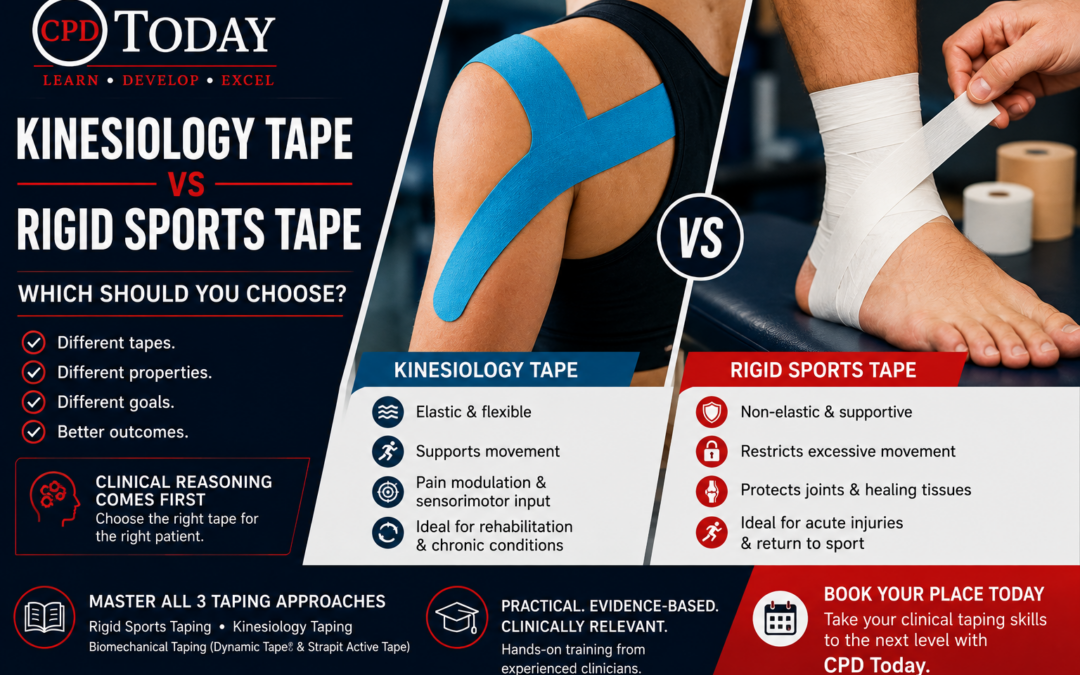
| Rigid Sports Taping | Kinesiology Taping |
|---|---|
| Non-elastic | Elastic |
| Restricts movement | Allows movement |
| Provides external support | Supports comfortable movement |
| Protects healing tissues | Pain modulation and movement awareness |
| Often used acutely | Frequently used throughout rehabilitation |
Neither system is “better.” Each has different indications depending on the patient’s presentation and rehabilitation goals.
When Should You Choose Rigid Sports Taping?
Rigid taping is often the preferred option when the primary goal is protecting injured tissues.
Examples include:
- Acute ligament injuries
- Joint instability
- Early return to sport
- Functional support during activity
- Preventing excessive movement
For example, following a lateral ankle sprain, rigid taping may help control inversion while allowing progressive return to walking, running and sport.
When Should You Choose Kinesiology Taping?
Kinesiology tape is generally chosen when the aim is to optimise movement rather than restrict it.
It may be appropriate for:
- Chronic musculoskeletal pain
- Tendinopathies
- Shoulder pain
- Neck pain
- Chronic low back pain
- Patellofemoral pain
- Plantar heel pain
- Pregnancy-related pelvic girdle pain
Many clinicians also use kinesiology taping to improve confidence during movement while patients complete an active rehabilitation programme.
What Does the Research Say?
Rigid sports taping has strong evidence supporting its role in protecting joints and reducing the risk of recurrent ankle sprains, particularly in athletes with previous injury.
Research into kinesiology taping has also developed considerably. Systematic reviews suggest that kinesiology taping can provide short-term improvements in pain and function for several chronic musculoskeletal conditions, particularly when used alongside exercise, manual therapy and rehabilitation rather than as a stand-alone treatment.
This reinforces an important clinical principle:
The tape itself is rarely the treatment. It is an adjunct that supports high-quality rehabilitation.
Common Mistakes
Many clinicians make the mistake of using the same tape for every patient.
Instead, ask yourself:
- What am I trying to achieve?
- Does this patient need support or movement assistance?
- Is protection more important than freedom of movement?
- What does the current evidence suggest?
- How does taping integrate with my rehabilitation plan?
Answering these questions leads to more effective and individualised care.
Clinical Reasoning Comes First
At CPD Today, we encourage clinicians to move beyond simply memorising taping techniques.
Every application should begin with:
- A thorough assessment
- Identification of the patient’s goals
- Understanding tissue healing
- Appreciating biomechanics
- Reviewing the available evidence
- Selecting the most appropriate taping strategy
This clinical reasoning process is what separates experienced practitioners from technicians.
Learn Both Techniques with CPD Today
Our Clinical Strapping & Taping Course teaches:
- Rigid Sports Taping
- Kinesiology Taping
- Biomechanical Taping (including Dynamic Tape® and Strapit Active Tape)
You’ll learn:
- When to use each taping system
- Practical application techniques
- Current evidence
- Clinical reasoning
- Integration with exercise rehabilitation and manual therapy
- Immediate clinical application
By the end of the course, you’ll have the confidence to choose the right taping approach for the right patient—not simply apply tape because it’s familiar.
Frequently Asked Questions
Is kinesiology tape better than rigid sports tape?
Neither is universally better. Each has different indications and should be selected according to the patient’s condition, rehabilitation stage and clinical goals.
Can they be used together?
Yes. In some cases, clinicians may combine taping strategies as part of a comprehensive management plan where clinically appropriate.
Which tape should beginners learn first?
Healthcare professionals should understand the principles behind all three major taping approaches—rigid sports taping, kinesiology taping and biomechanical taping—to make informed clinical decisions.
Conclusion
Rigid sports taping and kinesiology taping are complementary, not competing, techniques. One provides mechanical support and protection; the other facilitates movement and may help reduce pain and improve function when integrated into evidence-based rehabilitation.
Developing the knowledge to choose the right technique at the right time is one of the most valuable skills an MSK clinician can acquire.
At CPD Today, our Clinical Strapping & Taping Course equips clinicians with the practical skills, clinical reasoning and evidence base needed to use taping confidently and effectively in everyday practice.