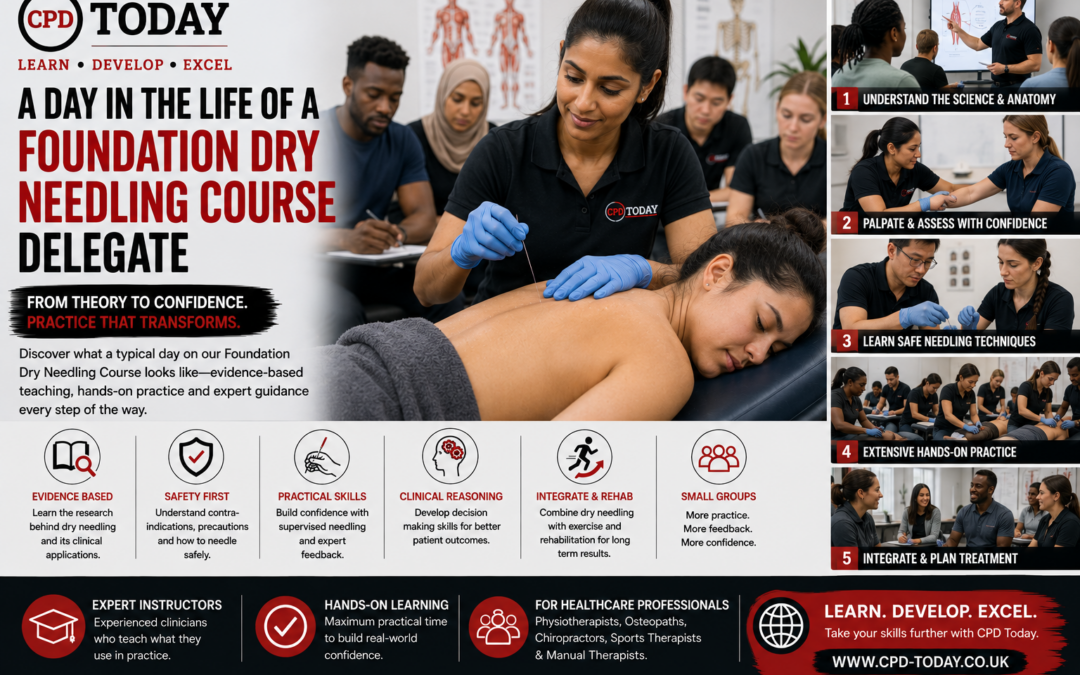
A Day in the Life of a Foundation Dry Needling Course Delegate
Thinking of learning dry needling? Discover what a typical day on a CPD Today Foundation Dry Needling Course looks like, from anatomy and safety to supervised hands-on practical training.
A Day in the Life of a Foundation Dry Needling Course Delegate
You’ve decided you’d like to learn dry needling.
You’ve looked at different courses, read about the evidence and perhaps spoken to colleagues who already use dry needling in practice.
But there’s probably still one question:
What is actually going to happen when I walk through the door?
For clinicians who have never used needles before, attending a Foundation Dry Needling Course can understandably feel a little daunting.
At CPD Today, our aim is to make the learning environment practical, supportive and enjoyable while giving you the knowledge and hands-on experience required to start developing confidence with dry needling.
Here’s what a typical day might look like.
Arriving at the Course
You’ll meet your instructors and the other healthcare professionals attending the course.
Delegates come from a range of clinical backgrounds, which may include:
- Physiotherapy
- Osteopathy
- Chiropractic
- Sports therapy
- Other appropriate musculoskeletal and manual therapy professions
Some delegates have years of clinical experience. Others are relatively early in their careers.
What they have in common is a desire to add another evidence-informed treatment option to their clinical toolkit.
And importantly, you don’t need previous dry needling experience to attend our Foundation Course.
First Things First: Understanding Dry Needling
Before anyone picks up a needle, we establish the foundations.
We explore what dry needling is, how it differs from other needling approaches and where it may fit within modern musculoskeletal practice.
This includes discussion around:
- Current evidence
- Proposed physiological mechanisms
- Pain modulation
- Clinical indications
- Limitations of dry needling
- Patient selection
We don’t want delegates simply memorising techniques.
We want them to understand why they might use them.
Safety Before Technique
One of the most important parts of learning dry needling is understanding how to practise safely.
Before practical needling begins, we discuss areas including:
- Infection control
- Needle handling
- Sharps disposal
- Patient positioning
- Consent
- Contraindications
- Precautions
- Potential adverse events
- Relevant anatomy
Safety isn’t something we teach once and forget.
It runs through the entire course.
Then Comes Anatomy
Ask an experienced dry needling practitioner what makes them confident and they’ll often give a similar answer:
Anatomy.
Knowing the name of a muscle isn’t enough.
You need to understand what lies underneath, beside and around it.
Our teaching therefore incorporates:
- Surface anatomy
- Palpation
- Muscle borders
- Bony landmarks
- Neurovascular structures
- Relevant underlying structures
- Safe approaches
Delegates palpate structures before progressing to needle placement.
This is an important part of developing safe clinical practice.
Time to Pick Up a Needle
For many delegates, this is the moment they’ve been waiting for—and sometimes the moment they’ve been slightly nervous about.
The first practical session is carefully supervised.
We demonstrate techniques before delegates practise them themselves.
You’ll work through:
Identify → Palpate → Position → Needle → Reassess
Rather than rushing through large numbers of muscles, we focus on understanding each technique properly.
Learning by Doing
Dry needling is a practical clinical skill.
You cannot learn it properly by watching videos alone.
As the course progresses, delegates spend increasing amounts of time practising under supervision.
Your instructors can observe:
- Your patient positioning
- Palpation
- Needle handling
- Technique
- Communication
- Clinical reasoning
and provide immediate feedback.
This is where confidence really starts to develop.
Questions Are Encouraged
One of the advantages of face-to-face practical education is being able to ask questions as they arise.
And there are usually plenty.
For example:
“Would you needle this patient?”
“Which muscle would you consider here?”
“What if the patient doesn’t respond?”
“Would you combine this with exercise?”
These discussions are often some of the most valuable parts of the course because they connect practical techniques with real clinical situations.
It’s Not About Needling Everything
As delegates become more comfortable with the technique, another important lesson emerges:
More needles don’t necessarily mean better treatment.
We encourage delegates to think about what they are trying to achieve.
Instead of asking:
“What else can I needle?”
we want you asking:
“What does this patient actually need?”
Sometimes the answer may be dry needling.
Sometimes it may be exercise, education, manual therapy, load modification—or simply reassurance.
Clinical reasoning determines the treatment.
Reassess, Reassess, Reassess
One of the habits we encourage throughout the course is reassessment.
After treatment, consider:
- Has movement changed?
- Has pain changed?
- Has function improved?
- Did the intervention achieve what you expected?
If you don’t reassess, how do you know whether your intervention helped?
This simple principle can significantly improve clinical decision-making.
Integrating Dry Needling with Rehabilitation
As the day progresses, the focus begins shifting from simply performing a technique to understanding how it fits within a complete treatment plan.
Dry needling might help reduce pain or improve movement.
But what happens next?
That could involve:
- Strengthening
- Mobility exercises
- Movement retraining
- Progressive loading
- Patient education
- Self-management
At CPD Today, we see dry needling as a potential gateway into rehabilitation, rather than the end of treatment.
Learning from Other Clinicians
One of the often-overlooked benefits of attending a practical CPD course is learning from the other delegates.
Physiotherapists, osteopaths, chiropractors and sports therapists may approach the same clinical presentation slightly differently.
Discussing cases and treatment approaches can generate valuable conversations and new ideas.
Good CPD isn’t simply about listening to the lecturer.
It’s about clinicians learning from each other too.
From Nervous to Confident
At the beginning of the course, some delegates are understandably cautious about inserting their first needle.
As their understanding of anatomy improves and they gain supervised practical experience, that apprehension often begins to reduce.
By the end of the training, the aim isn’t for delegates to think:
“I can needle everything.”
It’s for them to think:
“I understand how to decide when dry needling is appropriate and how to perform the techniques I’ve learned safely.”
That’s a very different kind of confidence.
What Makes the CPD Today Approach Different?
Our philosophy is straightforward:
Don’t just teach the technique. Teach the clinician.
Our Foundation Dry Needling Course therefore brings together:
- Evidence-informed education
- Detailed anatomy
- Clinical reasoning
- Safety
- Extensive hands-on practice
- Individual feedback
- Rehabilitation
- Real-world clinical discussion
We want delegates to understand not only how to use dry needling, but why, when and when not to use it.
Clinical Pearl
Confidence doesn’t come from memorising where to put a needle. It comes from understanding the anatomy, knowing why you’re treating and practising the technique properly.
That’s why supervised practical learning is such an important part of our Foundation Course.
Clinical Takeaway
Your first dry needling course should give you more than a collection of techniques.
It should provide a framework for safe assessment, clinical reasoning, anatomy, treatment and rehabilitation.
At CPD Today, we want delegates to leave understanding that dry needling is not the treatment plan—it’s one potential part of a much broader approach to musculoskeletal care.
The aim is simple: better knowledge, better clinical decisions and greater confidence in practice.
Frequently Asked Questions
Will I actually practise dry needling on the course?
Yes. The Foundation Course includes extensive supervised practical training. Practical experience is a central part of learning the technique.
I’ve never used a needle before. Is that a problem?
No. The course is designed as Foundation-level training and builds progressively from the fundamentals.
Is the course mostly theory?
No. Theory, evidence, anatomy and safety provide the foundations, but hands-on practical learning forms a major part of the course.
Do you teach clinical reasoning?
Yes. This is one of the most important aspects of our teaching. We want delegates to understand why they’re selecting an intervention rather than simply following predetermined protocols.
Will I learn how to combine dry needling with other treatments?
Yes. We discuss how dry needling can be incorporated alongside exercise, rehabilitation, education and other appropriate approaches to musculoskeletal management.
Thinking About Learning Dry Needling?
If you’re a healthcare professional considering adding dry needling to your clinical practice, choosing the right training is important.
The CPD Today Foundation Dry Needling Course combines evidence-informed teaching with extensive hands-on practical experience, anatomy, safety and clinical reasoning.
Whether you’re a physiotherapist, osteopath, chiropractor, sports therapist or another appropriately qualified clinician, our aim is to help you develop the knowledge and confidence to integrate dry needling appropriately into your clinical practice.
Explore upcoming CPD Today Dry Needling Courses at www.cpd-today.co.uk.