SEO Title: Why Anatomy Matters in Dry Needling | CPD Today Dry Needling Course UK
Meta Description: Discover why anatomy is essential for safe dry needling and how CPD Today teaches surface anatomy, palpation and clinical reasoning on our Foundation Dry Needling Course.
Suggested URL: /why-anatomy-matters-dry-needling-course
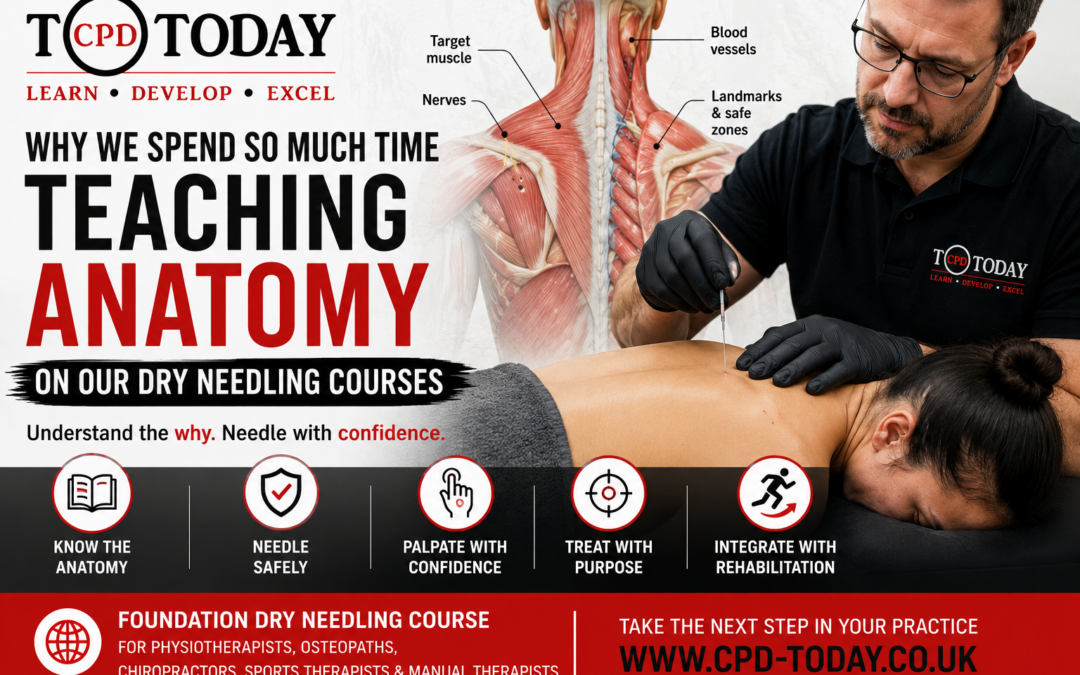
Why We Spend So Much Time Teaching Anatomy on Our Dry Needling Courses
When clinicians first attend a dry needling course, there’s understandably one thing they’re particularly keen to do:
Pick up a needle and start needling.
But at CPD Today, we deliberately spend considerable time on something that comes before the needle:
Anatomy.
Why?
Because knowing a technique isn’t enough.
If you’re going to insert a needle through the skin and into underlying tissues, you need to understand exactly what you’re aiming for, what surrounds it and what structures you need to avoid.
That’s why anatomy isn’t simply a theory session at the beginning of our Foundation Dry Needling Course.
It’s embedded throughout our practical teaching.
Anatomy Is One of Your Most Important Safety Tools
Dry needling is an invasive technique.
A clinician therefore needs more than a general understanding of where a muscle is located.
You need to consider structures such as:
- Nerves
- Blood vessels
- Bone
- Joints
- Thoracic structures
- Adjacent muscles
- Other vulnerable anatomical structures
The relationship between the target tissue and these surrounding structures influences how—and whether—you approach a particular area.
For us, anatomy and safety cannot be separated.
Clinical Pearl
The needle doesn’t know what’s underneath the skin. You need to.
Knowing the Muscle Isn’t Enough
Most healthcare professionals attending a dry needling course already have substantial anatomical knowledge.
But remembering an illustration from an anatomy textbook is very different from locating a structure accurately on a real person.
A textbook might show a muscle clearly separated from everything around it.
Real patients aren’t like that.
Body shape varies. Muscle bulk varies. Position changes anatomical relationships. Landmarks may be easier or harder to identify.
That’s why practical anatomy matters.
Surface Anatomy Comes Before Needle Placement
Before needling a structure, we want delegates to be able to identify it confidently.
That means developing surface anatomy skills.
During practical teaching we consider:
- Bony landmarks
- Muscle borders
- Muscle direction
- Adjacent structures
- Patient positioning
- Tissue depth
- Individual anatomical differences
This provides a much stronger foundation than simply copying where an instructor placed a needle.
Palpation Is a Clinical Skill
Palpation is sometimes underestimated.
In dry needling, it can be an important bridge between anatomical knowledge and practical technique.
Delegates learn to combine what they know from anatomy with what they can identify clinically.
The process becomes:
Understand → Identify → Palpate → Position → Needle → Reassess
Every stage matters.
If you aren’t confident about the structure you’re identifying, the answer shouldn’t be to insert a needle and hope.
The answer is to return to the anatomy.
Anatomy Helps Determine Needle Direction
Learning that a particular muscle can be needled doesn’t automatically tell you how it should be approached.
Clinicians may need to consider:
- Patient position
- Needle direction
- Appropriate depth
- Structures beneath the target
- Structures adjacent to the target
- Whether an alternative approach would be safer
This is one reason we don’t believe dry needling should be taught simply as a collection of photographs showing needle positions.
We want delegates to understand why a particular approach is being used.
Anatomy Isn’t Identical in Every Patient
Human anatomy follows recognisable patterns, but people aren’t identical.
There can be differences in:
- Body composition
- Muscle size
- Tissue depth
- Skeletal landmarks
- Previous surgery
- Injury
- Individual anatomical variation
This means clinicians need to assess the person in front of them rather than relying solely on memorised measurements or standardised diagrams.
Good anatomy teaching develops adaptable clinicians.
Anatomy and Clinical Reasoning Work Together
Even perfect anatomical knowledge doesn’t tell you whether a patient actually needs dry needling.
That’s where clinical reasoning comes in.
Before reaching for a needle, ask:
What is the patient’s problem?
What am I trying to change?
Why have I selected this tissue?
Is needling appropriate?
Are there relevant precautions or contraindications?
How will I assess whether it worked?
Anatomy helps you perform a technique safely.
Clinical reasoning helps determine whether you should perform it in the first place.
Both are essential.
Why We Don’t Just Teach “Needle Here”
It’s tempting when learning a new technique to want a simple recipe:
For condition X → needle muscle Y.
Clinical practice isn’t that straightforward.
Take shoulder pain.
Two patients may both report pain in a similar area but have very different presentations.
One might demonstrate rotator cuff-related symptoms.
Another may have cervical involvement.
Another may have restricted shoulder movement.
Another may have symptoms where dry needling isn’t particularly relevant at all.
Automatically selecting the same muscle for all four patients wouldn’t represent good clinical reasoning.
We therefore teach anatomy within the context of assessment and patient presentation, rather than as isolated needle locations.
Anatomy Helps You Know When NOT to Needle
One of the most important skills in dry needling isn’t inserting a needle.
It’s deciding not to.
If you can’t confidently identify the anatomy or establish an appropriate approach, don’t needle the area.
The same applies where relevant contraindications, precautions or other clinical concerns exist.
Confidence shouldn’t mean believing you can needle everything.
Confidence means recognising the boundaries of your knowledge and competence.
Why Practical Anatomy Matters More Than Memorisation
You can learn a great deal from books, apps and anatomical models.
They’re valuable educational resources.
But dry needling is a hands-on clinical skill.
You ultimately need to translate theoretical anatomy onto a real person.
That’s why our courses combine anatomical discussion with:
- Demonstration
- Palpation
- Positioning
- Supervised practical work
- Instructor feedback
- Clinical discussion
The anatomy becomes something you apply, rather than simply something you remember.
Why Supervised Learning Matters
When learning dry needling, small changes can matter.
An instructor may help a delegate adjust:
- Patient positioning
- Palpation
- Hand position
- Needle direction
- Technique
- Clinical reasoning
Immediate feedback allows delegates to understand not only what needs changing, but why.
This is difficult to replicate through videos or diagrams alone.
It’s one reason extensive supervised practical teaching forms an important part of our Foundation Dry Needling Course.
Does Better Anatomy Knowledge Improve Confidence?
In our teaching experience, one of the biggest drivers of confidence is understanding what lies beneath your fingers.
Uncertainty creates hesitation.
Understanding creates informed decision-making.
When a clinician can confidently identify the target tissue, surrounding anatomy and appropriate approach, practical needling becomes far less intimidating.
This is why we don’t rush anatomy simply to increase the number of muscles covered during a course.
More techniques don’t necessarily mean better training.
We would rather delegates understand the techniques they’re learning properly.
How We Teach Anatomy at CPD Today
Our approach combines anatomy with practical clinical application.
Rather than separating anatomy into one isolated lecture, we revisit it throughout practical sessions.
Depending on the technique being taught, delegates consider:
- What structure are we treating?
- Why might we treat it?
- How do we identify it?
- What structures surround it?
- How should the patient be positioned?
- What are the relevant safety considerations?
- How does this technique fit into the overall treatment plan?
This means anatomy, safety and clinical reasoning develop together.
Anatomy, Dry Needling and Rehabilitation
Knowing anatomy isn’t only useful for inserting needles.
It also helps clinicians understand movement, loading and rehabilitation.
If dry needling is used to modify pain or movement temporarily, the next question should be:
What are we going to do with that change?
Treatment may progress into:
- Strengthening
- Mobility work
- Progressive loading
- Movement retraining
- Functional rehabilitation
- Return to sport or activity
Understanding anatomy therefore supports the entire clinical process—not simply the needling technique.
What Should You Look for in a Dry Needling Course?
If you’re comparing dry needling courses in the UK, don’t simply compare how many muscles each provider promises to cover.
Ask:
- How is anatomy taught?
- Is surface anatomy included?
- Will I practise palpation?
- Is safety integrated into practical sessions?
- How much supervised hands-on training is provided?
- Are instructors available to correct technique?
- Is clinical reasoning taught?
- Does the course discuss rehabilitation?
- Will I understand why I’m using each technique?
A long list of muscles may look impressive.
But understanding what you’re doing is far more valuable than simply collecting techniques.
Why Choose CPD Today for Foundation Dry Needling Training?
At CPD Today, our goal isn’t to produce clinicians who simply know where to insert needles.
We want to develop clinicians who can assess, reason and practise safely.
Our Foundation Dry Needling training combines:
- Functional anatomy
- Surface anatomy
- Palpation
- Evidence-informed teaching
- Contraindications and precautions
- Clinical reasoning
- Extensive supervised practical training
- Rehabilitation principles
- Real-world clinical discussion
We believe that combination is fundamental to developing confidence.
Clinical Takeaway
If you remember one principle from this article, make it this:
Don’t memorise where the needle goes. Understand why it goes there.
Strong anatomical knowledge allows clinicians to identify structures more confidently, understand relevant risks and adapt techniques to the individual patient.
Combine that with clinical reasoning and supervised practical experience, and you have the foundations for safer dry needling practice.
That’s why we spend so much time teaching anatomy on our CPD Today Foundation Dry Needling Course.
It’s not something we need to get through before the practical work begins.
It is part of the practical work.
Frequently Asked Questions
How much anatomy do I need to know before learning dry needling?
Clinicians should already have an appropriate anatomical background for their profession. A good Foundation Dry Needling Course should then revisit relevant anatomy and apply it directly to practical techniques.
Why is surface anatomy important in dry needling?
Surface anatomy helps clinicians translate textbook knowledge onto an individual patient by identifying relevant landmarks, muscles and surrounding structures.
Do CPD Today courses include practical anatomy?
Yes. Anatomy, palpation and relevant safety considerations are incorporated into practical teaching rather than treated purely as theoretical subjects.
Is dry needling just about learning muscle locations?
No. Safe dry needling requires appropriate assessment, anatomical knowledge, clinical reasoning, patient selection and an understanding of contraindications and precautions.
Should I choose the dry needling course that teaches the most muscles?
Not necessarily. The number of techniques taught doesn’t automatically indicate the quality of training. Consider the depth of anatomy, supervised practice, safety education, clinical reasoning and instructor support.
Can anatomy make me more confident with dry needling?
A strong understanding of relevant anatomy can help reduce uncertainty and allow clinicians to make more informed decisions about palpation, positioning and practical technique.
Learn Dry Needling with CPD Today
If you’re looking for a Foundation Dry Needling Course in the UK, choose training that goes beyond simply showing you where to place needles.
At CPD Today, we combine anatomy, clinical reasoning, evidence, safety and extensive hands-on practical training to help healthcare professionals develop confidence in dry needling.
Learn the anatomy. Understand the reasoning. Develop the practical skills.
Learn. Develop. Excel.
Explore upcoming CPD Today Dry Needling Courses at www.cpd-today.co.uk.
Primary search phrase:
Dry Needling Course UK
Secondary topics:
dry needling anatomy, dry needling training UK, foundation dry needling course, learn dry needling, dry needling course for physiotherapists, dry needling course for osteopaths, dry needling safety, dry needling palpation.