
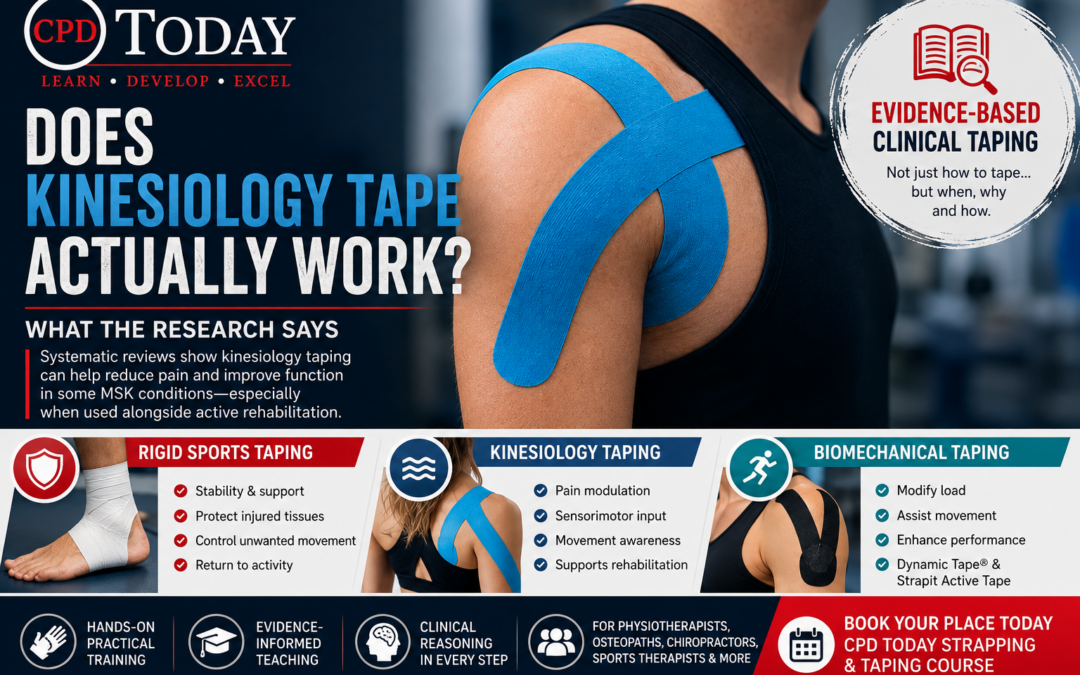
An Evidence-Based Guide for Healthcare Professionals
Kinesiology tape is probably one of the most recognisable—and debated—treatment tools in modern musculoskeletal practice.
You’ve probably seen brightly coloured tape across the shoulders of Olympic athletes, around runners’ knees or along the backs of patients attending physiotherapy and rehabilitation clinics.
But an important question remains:
Does kinesiology tape actually work?
The answer is more nuanced than either “yes” or “no”.
Research suggests kinesiology taping can provide benefits for pain and disability in some musculoskeletal conditions, particularly in the short term. However, results vary between conditions, studies and outcomes, and kinesiology tape should generally be considered an adjunct to rehabilitation rather than a stand-alone treatment. (PubMed)
At CPD Today, this is exactly how we teach kinesiology taping: not as a miracle treatment, but as another clinical tool that can be selected appropriately following assessment and integrated with exercise, rehabilitation and manual therapy.
What Is Kinesiology Tape?
Kinesiology tape is an elastic adhesive therapeutic tape.
Unlike traditional rigid sports tape, which is primarily used to restrict or control movement, kinesiology tape stretches and moves with the patient.
Depending on the application and clinical objective, clinicians may use kinesiology taping to help with:
- Pain modulation
- Sensorimotor input
- Movement awareness
- Functional movement
- Swelling management
- Patient confidence
- Supporting activity during rehabilitation
This distinction is important.
Kinesiology tape isn’t simply a more colourful version of rigid sports tape.
The two taping systems have different properties and are selected for different clinical objectives.
What Does the Research Say About Kinesiology Taping?
This is where the discussion becomes particularly interesting.
Earlier reviews were often sceptical. A 2014 systematic review concluded that kinesiology taping generally performed no better than sham or other interventions and that reported benefits were often small or based on lower-quality trials. (PubMed)
However, the evidence base has continued to develop.
A later systematic review and meta-analysis involving 36 studies reported improvements in both pain and disability across musculoskeletal disorders. The authors reported significant reductions in pain within the first five days and at four to six weeks, although results varied between conditions and comparisons. (PubMed)
Most importantly, a 2026 overview of systematic reviews has now examined the effectiveness and clinical relevance of kinesiology taping across musculoskeletal disorders, reflecting just how substantial the evidence base has become. It also reinforces the need to consider follow-up period, clinical relevance and certainty of evidence rather than simply asking whether individual trials produced statistically significant results. (PubMed)
So instead of asking:
“Does kinesiology tape work?”
A better clinical question is:
“For which patients, conditions and outcomes might kinesiology taping be useful?”
Kinesiology Taping for Chronic Musculoskeletal Conditions
One particularly interesting area is the use of kinesiology tape for chronic musculoskeletal pain.
A systematic review examining chronic musculoskeletal pain lasting more than four weeks found kinesiology taping produced greater pain relief than minimal intervention, although improvements in disability were less certain. (PubMed)
This distinction between pain and function is important.
A patient feeling less pain does not automatically mean their underlying strength, capacity or movement tolerance has improved.
This is one reason kinesiology taping may be most valuable when used to facilitate active rehabilitation.
If reducing pain allows someone to walk further, exercise more comfortably or participate more confidently in rehabilitation, the tape may have served a useful clinical purpose.
Kinesiology Taping for Chronic Low Back Pain
Chronic low back pain is one of the most extensively researched applications.
A 2023 systematic review and meta-analysis of nine randomised controlled trials found kinesiology taping produced significant immediate and short-term reductions in pain. However, it wasn’t superior for outcomes including disability, range of movement, fear of movement and trunk endurance. (PubMed)
Other research has produced slightly different findings.
A systematic review of 12 randomised trials involving 676 patients found that adding kinesiology taping to physical therapy resulted in greater improvements in both pain and disability than physical therapy alone. The authors nevertheless highlighted limitations including relatively small studies, moderate evidence levels and heterogeneity. (PubMed)
An earlier meta-analysis also found improvements in disability compared with placebo taping, while pain outcomes were less convincing. (PubMed)
Rather than seeing these results as contradictory, clinicians should recognise that they demonstrate the complexity of rehabilitation research.
Different:
- Application methods
- Treatment durations
- Comparison interventions
- Patient populations
- Outcome measures
can all influence results.
The evidence therefore doesn’t support telling every patient with back pain that kinesiology tape will help.
Equally, it doesn’t justify saying kinesiology taping has no evidence behind it.
What About Shoulder Pain?
Shoulder research provides another useful example of why evidence needs to be interpreted carefully.
A systematic review and meta-analysis involving 14 studies and 680 participants found kinesiology taping wasn’t superior to sham taping, exercise or passive treatments for pain. (PubMed)
Another systematic review and meta-analysis found significant improvements in shoulder pain and disability when kinesiology taping was combined with exercise, but not when compared with placebo or steroid treatment. The authors concluded that evidence was insufficient to recommend kinesiology taping as an independent treatment but identified limited evidence supporting its use as a complementary intervention. (PubMed)
Again, this fits well with modern MSK practice:
Tape may support rehabilitation. It shouldn’t replace rehabilitation.
Does Kinesiology Tape Need to Produce a Long-Term Effect to Be Useful?
Not necessarily.
This is an important concept when teaching clinical taping.
Imagine a patient with knee pain who struggles to perform their rehabilitation exercises because squatting is uncomfortable.
If an appropriate taping application temporarily reduces their symptoms enough for them to exercise more confidently, the tape may have achieved its clinical objective.
The long-term adaptation comes from progressive rehabilitation.
The tape may simply help the patient participate in that process.
This is similar to many other interventions used in MSK practice.
The question isn’t always:
“Did the tape cure the condition?”
Sometimes the more useful question is:
“Did the intervention help the patient progress with rehabilitation?”
Is It Just a Placebo Effect?
This question is often raised when discussing kinesiology tape.
Placebo and contextual effects undoubtedly form part of many healthcare interventions. However, reducing kinesiology taping to “just placebo” oversimplifies the evidence.
Potential mechanisms discussed within rehabilitation include:
- Cutaneous sensory stimulation
- Changes in sensorimotor feedback
- Altered perception of movement
- Pain modulation
- Increased confidence during activity
Some proposed mechanisms have stronger evidence than others, and clinicians should be cautious about making claims that aren’t supported by research.
We therefore teach clinicians to explain taping realistically rather than promising that tape will “switch muscles on”, permanently correct posture or structurally reposition tissues.
Kinesiology Taping vs Rigid Sports Taping
The two approaches shouldn’t be confused.
Rigid sports tape is primarily used when the clinical objective involves protection, stability or restriction of unwanted movement.
Kinesiology tape is elastic and permits movement, making it more appropriate when the objective involves pain modulation, sensory input or supporting movement during rehabilitation.
There is also a third important category:
Biomechanical taping.
Biomechanical tapes such as Dynamic Tape® and Strapit Active Tape use different elastic and mechanical properties to assist movement and modify load.
Understanding these distinctions is a central part of good taping practice.
Why Clinical Reasoning Matters More Than the Colour of the Tape
Simply learning a collection of taping recipes isn’t enough.
Before applying kinesiology tape, clinicians should consider:
- What is the patient’s diagnosis or clinical presentation?
- What am I trying to achieve with the tape?
- Is pain preventing the patient from participating in rehabilitation?
- Would rigid, kinesiology or biomechanical tape better achieve my objective?
- How will I assess whether the application has worked?
- What happens next in the rehabilitation programme?
Most importantly:
Reassess after applying the tape.
If the movement, symptom or functional task you’re trying to influence hasn’t changed, reconsider the application rather than assuming it must be helping.
Kinesiology Tape Shouldn’t Replace Exercise
This is perhaps the most important message.
For many persistent musculoskeletal conditions, longer-term management involves restoring:
- Strength
- Capacity
- Movement confidence
- Load tolerance
- Function
Tape alone cannot achieve these adaptations.
Instead, kinesiology tape can sometimes be used as a short-term adjunct that helps patients participate in the rehabilitation needed to produce longer-term change.
That distinction is fundamental to evidence-based clinical practice.
Learn Evidence-Based Kinesiology Taping with CPD Today
Our CPD Today Clinical Strapping & Taping Course doesn’t teach kinesiology taping in isolation.
Healthcare professionals learn how to select between:
Rigid Sports Taping
For protection, stability and controlling unwanted movement.
Kinesiology Taping
For pain modulation, sensorimotor input and supporting movement during rehabilitation.
Biomechanical Taping
Including Dynamic Tape® and Strapit Active Tape, for modifying mechanical load and assisting movement.
The emphasis throughout is on:
- Hands-on practical training
- Current research
- Clinical reasoning
- Patient selection
- Appropriate tape selection
- Reassessment
- Integration with rehabilitation
The aim isn’t simply to leave knowing how to put tape on.
It’s to understand why you’re putting it on in the first place.
Frequently Asked Questions
Does kinesiology tape really work?
Research suggests kinesiology taping can improve pain and disability in some musculoskeletal presentations, particularly over the short term, but effects vary between conditions and studies. It shouldn’t be presented as a stand-alone cure. (PubMed)
Does kinesiology tape help chronic pain?
There is systematic-review evidence of pain reduction in chronic musculoskeletal conditions, although effects on disability and longer-term function are less consistent. (PubMed)
Does kinesiology tape help chronic low back pain?
Several systematic reviews have reported short-term improvements in pain, and some have found benefits when kinesiology taping is added to physical therapy. Evidence for improvements in disability and other functional outcomes is more mixed. (PubMed)
Is kinesiology taping better than exercise?
Generally, this is the wrong comparison. Exercise produces adaptations that tape cannot. Kinesiology taping is better considered a potential adjunct that may help some patients participate more comfortably in active rehabilitation.
Is kinesiology tape the same as biomechanical tape?
No. Although both are elastic, biomechanical tapes such as Dynamic Tape® and Strapit Active Tape are used with a different mechanical rationale, particularly around load modification and movement assistance.
The Bottom Line
So, does kinesiology tape actually work?
For some patients and some outcomes, the evidence suggests it can.
Systematic reviews and meta-analyses report benefits for pain and, in some circumstances, disability. However, results vary considerably between conditions, and evidence doesn’t support presenting kinesiology taping as a stand-alone solution for musculoskeletal problems. (PubMed)
The more clinically useful position lies between the two extremes.
Kinesiology tape isn’t a miracle treatment.
But neither should it automatically be dismissed as colourful placebo tape.
Used selectively, reassessed appropriately and integrated with active rehabilitation, it can be a useful addition to the MSK clinician’s toolkit.
At CPD Today, that’s exactly what we teach: evidence, practical skills and clinical reasoning—so you know not only how to tape, but when and why to use it.