
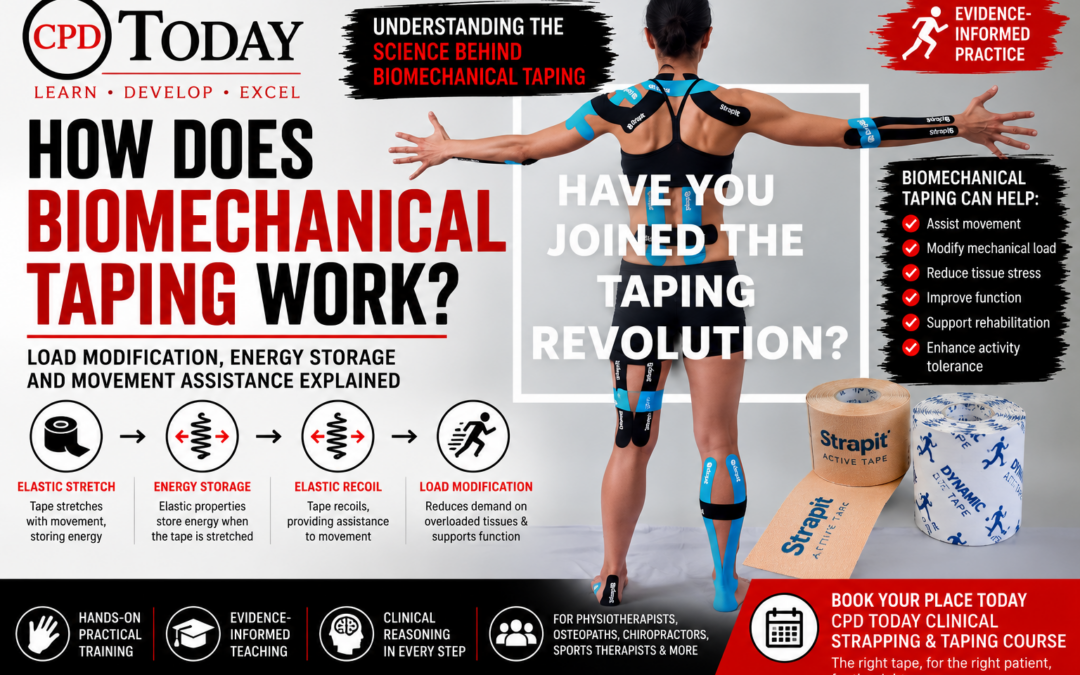
How Does Biomechanical Taping Work? Load Modification, Energy Storage and Movement Assistance
A Guide for Physiotherapists, Osteopaths and MSK Healthcare Professionals
Biomechanical taping is increasingly used by healthcare professionals looking for ways to influence movement and mechanical loading while allowing patients to remain active.
Unlike rigid sports taping, which is commonly used to restrict or control unwanted movement, biomechanical taping uses highly elastic tape to interact with movement.
Tapes such as Dynamic Tape® and Strapit Active Tape can be applied with the aim of assisting movement, modifying load and reducing mechanical demand on selected tissues.
But how does this actually work?
To use biomechanical tape effectively, clinicians need to understand more than where to place a strip of tape.
We need to think about:
Force. Load. Movement. Elasticity. Energy storage. Recoil.
These principles form an important part of the CPD Today Clinical Strapping & Taping Course, where we teach clinicians how to move beyond simply copying taping applications and instead understand the reasoning behind them.
What Is Biomechanical Taping?
Biomechanical taping uses highly elastic tape to create an external mechanical influence on the body.
Depending on the application, the clinician may be attempting to:
- Assist a movement
- Modify mechanical load
- Reduce demand on a particular tissue
- Influence movement mechanics
- Support functional activity
- Improve tolerance to rehabilitation
- Assist return to sport
The key word is mechanical.
Rather than simply applying tape over the location of pain, the clinician considers the forces associated with a particular movement.
Biomechanical Tape Works Differently from Rigid Sports Tape
Rigid sports tape has very little stretch.
This makes it useful when the clinical objective is to:
- Restrict unwanted movement
- Protect an injured ligament
- Provide joint support
- Improve perceived stability
- Support return to sport
Biomechanical tape behaves differently.
Its high elasticity means that it can lengthen as the patient moves.
Rather than simply preventing movement, the objective can therefore be to interact with that movement.
This distinction is fundamental.
The External Spring Concept
One useful way of understanding biomechanical tape is to think of it as an external elastic spring.
Imagine stretching an elastic band.
As you pull it:
The elastic material lengthens → energy is stored → the material attempts to return towards its original length.
Biomechanical tapes can demonstrate similar elastic behaviour.
When positioned appropriately, movement stretches the tape.
The tape’s elastic resistance and recoil can then contribute an external force to the movement.
The aim isn’t for the tape to perform the movement for the patient.
Instead, it may reduce some of the mechanical demand required from the patient’s tissues.
What Is Energy Storage and Recoil?
Our bodies already use elastic energy constantly.
Tendons are a good example.
During running, the Achilles tendon undergoes loading and deformation before contributing to the storage and return of elastic energy during movement.
Biomechanical tape introduces an additional external elastic component.
As the tape stretches, energy can be stored within the material.
As it recoils, some of that energy can be returned.
This creates the potential for the tape to assist movement depending on:
- Direction of application
- Amount of stretch
- Patient positioning
- Tape properties
- Movement being performed
This is why biomechanical taping needs to be considered in relation to movement, not simply anatomy.
What Does Load Modification Mean?
“Reducing load” is frequently used when discussing rehabilitation, but the term can easily be misunderstood.
Load isn’t inherently harmful.
In fact, appropriate loading is essential for maintaining and developing:
- Muscle strength
- Tendon capacity
- Bone density
- Physical resilience
- Sporting performance
Problems can occur when the mechanical demand being placed upon a tissue exceeds its current capacity.
A simplified way of thinking about this is:
Demand > Capacity = Potential Symptoms
The rehabilitation goal is therefore rarely to eliminate load completely.
Instead, we often want to temporarily modify load while progressively increasing capacity.
Biomechanical taping may provide one method of doing this.
A Clinical Example: Achilles Tendinopathy
Consider a runner with Achilles tendinopathy.
The runner may experience symptoms during:
- Walking
- Heel raises
- Running
- Hills
- Jumping
The long-term solution isn’t to permanently unload the Achilles tendon.
Successful rehabilitation will usually involve progressively increasing the tendon’s ability to tolerate load.
However, during certain stages of rehabilitation, the runner may struggle to tolerate their normal activity.
A biomechanical taping application might therefore be considered as a temporary strategy to modify mechanical demand.
The clinical pathway becomes:
Modify symptoms/load → maintain appropriate activity → progressively rehabilitate → increase capacity → reduce reliance on tape.
The tape supports the rehabilitation process rather than replacing it.
Movement Assistance
Another important principle is movement assistance.
Suppose a patient finds a particular movement painful or difficult.
A biomechanical application may be positioned so that the elastic recoil of the tape assists that movement.
Potential examples might include:
- Ankle plantarflexion
- Knee movement
- Hip movement
- Shoulder elevation
- Running mechanics
- Functional sporting movements
The clinician isn’t simply asking:
“Where does the patient hurt?”
They’re asking:
“Which movement am I trying to influence?”
That is a very different clinical thought process.
Direction Matters
Biomechanical taping isn’t simply about applying lots of tension.
The direction in which the tape is applied is crucial because this determines how the tape interacts with movement.
Clinicians therefore need to consider:
- What movement is occurring?
- Which direction do I want to assist?
- Where should the tape begin?
- Where should it finish?
- How should the patient be positioned?
- How much stretch is appropriate?
- What happens when the patient performs the movement?
This is one reason biomechanical taping is particularly suited to hands-on practical training.
Why Patient Positioning Matters
Patient positioning determines the relationship between the tape and the body when the application is applied.
If the patient is positioned differently, the tape may behave differently when they return to their functional movement.
Small changes can influence:
- Tape stretch
- Direction of recoil
- Mechanical assistance
- Comfort
- Functional effect
Learning this from a photograph or short social media video can be difficult.
During practical training, clinicians can physically experience how changing positioning alters the behaviour of the tape.
Is More Tension Better?
Not necessarily.
A common mistake when clinicians first encounter biomechanical taping is assuming that greater stretch must produce a greater effect.
But clinical taping isn’t simply about pulling the tape as hard as possible.
Excessive tension may:
- Cause discomfort
- Irritate the skin
- Alter the intended application
- Reduce tolerance
- Produce an inappropriate mechanical effect
The amount of tension should be determined by the properties of the tape, the application and the intended clinical objective.
Dynamic Tape® and Strapit Active Tape
Dynamic Tape® and Strapit Active Tape are both examples of tapes that can be used within a biomechanical taping approach.
Rather than treating them as completely separate taping systems, it is more useful clinically to understand the underlying biomechanical principles.
The practitioner needs to understand:
- Elastic properties
- Direction of force
- Movement being assisted
- Load being modified
- Appropriate tension
- Patient positioning
- Reassessment
Once clinicians understand these principles, they can make better decisions about how biomechanical tape may be incorporated into rehabilitation.
Biomechanical Tape vs Kinesiology Tape
Because both are elastic, biomechanical tape and kinesiology tape are sometimes incorrectly treated as interchangeable.
The intended clinical rationale can be quite different.
Kinesiology Taping
Common objectives may include:
- Pain modulation
- Cutaneous sensory input
- Sensorimotor feedback
- Movement awareness
- Supporting rehabilitation
Biomechanical Taping
The emphasis is more specifically on:
- Mechanical assistance
- Load modification
- Energy storage and recoil
- Force redistribution
- Influencing movement demands
This doesn’t make one superior to the other.
They simply provide clinicians with different tools.
Why Reassessment Is Essential
A beautifully applied piece of tape isn’t necessarily an effective application.
Clinicians need to determine whether the intervention has actually influenced the outcome they were targeting.
At CPD Today, we encourage a simple approach:
Assess → Apply → Reassess
For example, before applying tape you might assess:
- Pain during a squat
- Heel-raise tolerance
- Stair climbing
- Shoulder elevation
- Running
- Jumping
- A sport-specific movement
Apply the tape.
Then repeat the same test.
Ask:
Has anything meaningfully changed?
If not, reconsider the application.
Clinical reasoning should always take priority over simply following a taping recipe.
Biomechanical Taping for Tendinopathy
Biomechanical taping may be particularly interesting in conditions where load management is central to rehabilitation.
Potential examples include:
- Achilles tendinopathy
- Patellar tendinopathy
- Rotator cuff-related shoulder pain
- Lateral elbow tendinopathy
However, tape should never be presented as a method of “healing” a tendon.
The long-term objective remains improving the patient’s ability to tolerate appropriate mechanical load.
That generally requires progressive rehabilitation.
Tape may simply help some patients navigate part of that journey.
Biomechanical Taping for Running Injuries
Running creates repeated loading cycles.
Even relatively small changes in mechanical demand may become relevant when repeated over thousands of steps.
Biomechanical taping may therefore be considered within the management of selected running-related presentations.
But again, the tape should form part of a broader assessment.
Clinicians should also consider:
- Training load
- Strength
- Recovery
- Running volume
- Recent changes in training
- Previous injury
- Tissue capacity
- Rehabilitation
The tape is one tool—not the entire solution.
The Biggest Mistake: Learning Recipes Instead of Principles
Online taping videos often present applications according to diagnosis:
“Tape for Achilles pain.”
“Tape for knee pain.”
“Tape for shoulder pain.”
The problem is that two people with the same diagnosis may have very different rehabilitation requirements.
A better approach is:
Identify the problem → establish the objective → choose the taping system → design the application → reassess.
This is precisely why we place so much emphasis on clinical reasoning within CPD Today courses.
Learn Biomechanical Taping Practically with CPD Today
Reading about biomechanical taping is useful.
Actually feeling how the tape behaves is much more valuable.
On the CPD Today Clinical Strapping & Taping Course, you’ll have the opportunity to work practically with different taping approaches and understand how changes in tension, direction and positioning influence an application.
Our course brings together three important areas:
Rigid Sports Taping
For protection, support, stability and control of unwanted movement.
Kinesiology Taping
For pain modulation, sensorimotor input, movement awareness and rehabilitation.
Biomechanical Taping
Including Dynamic Tape® and Strapit Active Tape, with a focus on mechanical load modification and movement assistance.
More Than a Collection of Taping Techniques
Our goal isn’t to send you home with 30 applications to memorise.
We want you to develop a framework that allows you to create and adapt taping strategies according to the patient in front of you.
You’ll learn to ask:
What am I trying to achieve?
Which taping approach is most appropriate?
What direction should the tape work in?
How should I position the patient?
How much tension should I use?
How will I reassess the result?
Those skills are far more transferable than memorising individual applications.
Who Is the Course For?
The CPD Today Clinical Strapping & Taping Course is designed for healthcare professionals working within musculoskeletal care and rehabilitation, including:
- Physiotherapists
- Osteopaths
- Chiropractors
- Sports therapists
- Rehabilitation professionals
- Other appropriately qualified MSK practitioners
Whether you are new to taping or already use rigid or kinesiology tape, biomechanical taping can add another dimension to your clinical reasoning.
Why Choose CPD Today?
Our teaching philosophy is:
Learn • Develop • Excel
We combine:
- Extensive hands-on practice
- Evidence-informed teaching
- Clinical reasoning
- Practical MSK applications
- Multiple taping approaches
- Functional assessment
- Reassessment
- Skills designed for immediate clinical use
You’ll practise the techniques rather than simply watch them demonstrated.
You’ll also experience being taped yourself, helping you understand how different tensions and applications feel from the patient’s perspective.
Frequently Asked Questions
How does biomechanical taping work?
Biomechanical taping uses highly elastic tape to create an external mechanical influence. Depending on the application, the elastic resistance and recoil of the tape may be used to assist movement or modify mechanical demand.
What does load modification mean?
Load modification means changing some of the mechanical demand being placed upon a tissue or movement rather than necessarily eliminating load altogether.
Does biomechanical tape store energy?
Elastic materials can store energy when stretched and return some of that energy during recoil. Biomechanical taping attempts to use these properties as part of a clinically designed application.
Are Dynamic Tape® and Strapit Active Tape biomechanical tapes?
Yes. Both can be used according to biomechanical taping principles involving load modification and movement assistance.
Is biomechanical tape better than kinesiology tape?
Not necessarily. They can be selected for different clinical objectives. Good taping practice is about choosing the appropriate approach for the individual patient.
Does biomechanical taping replace rehabilitation?
No. It should be considered an adjunct. Progressive exercise, appropriate loading and rehabilitation remain central to developing long-term physical capacity.
Develop Your Clinical Taping Skills
Biomechanical taping becomes much easier to understand when we stop thinking about tape simply as something placed over an injured structure.
Instead, think:
What movement is occurring?
What forces are involved?
What load is the patient struggling to tolerate?
Can an elastic external force meaningfully influence that task?
And crucially:
Does the patient actually improve when I apply it?
Understanding these principles transforms biomechanical taping from a collection of applications into a genuine clinical skill.
The CPD Today Clinical Strapping & Taping Course teaches you how to use rigid sports taping, kinesiology taping and biomechanical taping, including Dynamic Tape® and Strapit Active Tape, within a practical clinical reasoning framework.
Don’t just learn where to put the tape. Understand what you’re trying to achieve.
Book Your CPD Today Clinical Strapping & Taping Course
Hands-on practical training.
Evidence-informed teaching.
Clinical reasoning.
Skills you can use immediately in practice.
The right tape. For the right patient. For the right reason.
Next in the Series
Rigid, Kinesiology or Biomechanical Tape: Which Tape Should You Choose?