
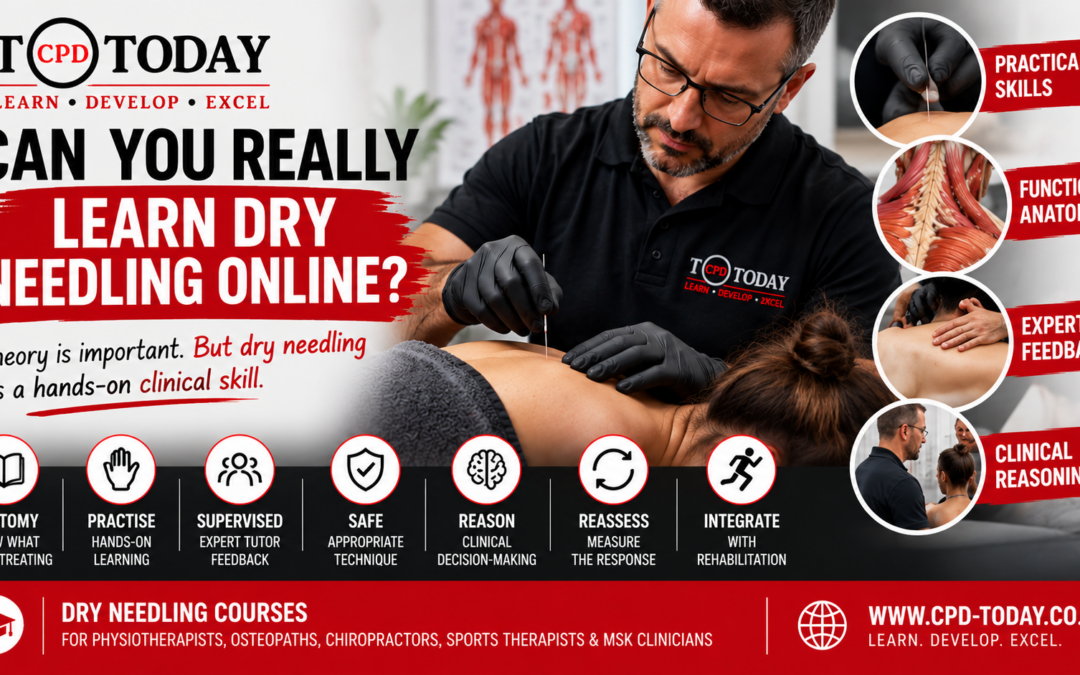
Why Hands-On Training Matters When Learning Dry Needling
Meta Description: Looking for a dry needling course in the UK? Discover why supervised hands-on training, anatomy, clinical reasoning and instructor feedback matter when learning dry needling.
Suggested URL: /hands-on-dry-needling-training-course-uk
Primary keyword: Dry Needling Course UK
Secondary phrases: dry needling training UK, learn dry needling, Foundation Dry Needling Course, practical dry needling course, dry needling course for physiotherapists, dry needling course for osteopaths
Can You Really Learn Dry Needling Online?
There has never been more clinical education available online.
You can watch videos, study anatomy, read research papers, attend webinars and complete online CPD without leaving home.
For many areas of professional development, that’s incredibly useful.
But dry needling is different.
Dry needling is a practical, invasive clinical skill. Learning the theory is important, but eventually you have to translate that knowledge into what happens when you’re standing next to a real patient with a needle in your hand.
That’s why at CPD Today, our Foundation Dry Needling Course places such a strong emphasis on face-to-face, supervised practical training.
We don’t just want you to know about dry needling.
We want you to develop the practical skills and clinical reasoning required to use it appropriately.
Watching Dry Needling Isn’t the Same as Performing It
Watching an experienced clinician perform dry needling can make the technique appear relatively straightforward.
Identify the muscle.
Position the patient.
Insert the needle.
But when you perform the technique yourself for the first time, you quickly realise there’s considerably more involved.
You need to think about:
- Anatomy
- Palpation
- Patient positioning
- Needle handling
- Needle direction
- Tissue depth
- Surrounding structures
- Patient communication
- Consent
- Treatment dosage
- Your own hand position
And you need to consider all of those things while communicating confidently with the patient.
That requires practice.
Why Supervised Practice Matters
Imagine you’re learning a dry needling technique.
You identify the anatomical landmarks, palpate the target tissue and position your needle.
You think everything looks correct.
But an experienced instructor notices that changing your hand position slightly would improve your technique.
That correction might take ten seconds.
But it could fundamentally change how you perform that technique in future.
That’s the value of supervised practical education.
An instructor can observe things you may not recognise yourself.
Immediate Feedback Develops Better Technique
During practical training, our tutors can help delegates refine areas such as:
- Palpation
- Patient positioning
- Hand position
- Needle handling
- Needle direction
- Communication
- Treatment selection
- Clinical reasoning
That immediate feedback is difficult to replicate through online learning alone.
A video can demonstrate a technique.
It can’t watch you perform it.
Anatomy Comes Alive When You Apply It
Most clinicians attending our courses already have considerable anatomical knowledge.
But there’s an important difference between identifying a muscle in an anatomy book and confidently identifying it on a real person.
Patients vary.
Muscle bulk varies.
Body composition varies.
Landmarks vary.
Position changes anatomical relationships.
That’s why our practical sessions combine:
Anatomy → Palpation → Positioning → Technique
rather than teaching them as completely separate subjects.
It’s Not About Memorising Needle Positions
One of the easiest ways to teach dry needling would be to show delegates photographs and say:
“Put the needle here.”
We deliberately don’t want our training to work like that.
Because what happens when the patient in front of you doesn’t look like the person in the photograph?
Instead, we want you to understand:
What structure am I targeting?
How do I identify it?
What surrounds it?
Why am I treating it?
Is dry needling appropriate?
Understanding the anatomy and reasoning allows you to adapt.
Memorising a photograph doesn’t.
Practical Training Builds Confidence
Many delegates attending their first dry needling course understandably feel nervous.
Some have never held an acupuncture needle before.
That’s perfectly normal.
We don’t expect you to arrive confident.
Building that confidence is part of the course.
Skills are introduced progressively, allowing delegates to develop familiarity with needle handling before progressing through practical techniques.
With demonstration, supervised practice and tutor feedback, something that initially feels unfamiliar can gradually become much more comfortable.
Learn in an Environment Where You Can Ask Questions
Clinical learning rarely follows a perfectly straight line.
During practical training, questions naturally appear:
“Am I definitely on the right muscle?”
“Could I change the patient’s position?”
“How deep should I be thinking here?”
“What would you do with a larger patient?”
“Would you use this technique in this presentation?”
These discussions are extremely valuable.
They’re also difficult to predict when designing prerecorded educational material.
Face-to-face learning allows the teaching to respond to what delegates actually need.
We Teach the Reasoning, Not Just the Needle
Being able to perform a technique doesn’t automatically mean you should use it.
That’s why our Foundation Course places considerable emphasis on clinical reasoning.
Before dry needling, we encourage clinicians to ask:
- What is the patient’s presentation?
- What does my assessment demonstrate?
- Why am I considering dry needling?
- What am I trying to change?
- Are there contraindications or precautions?
- How will I assess the response?
- What will I do afterwards?
This changes the thought process from:
“Which muscle should I needle?”
to:
“What does this patient actually need?”
Safety Needs More Than a PowerPoint Slide
Safety is fundamental to dry needling.
But learning safety shouldn’t simply mean sitting through a presentation about contraindications.
Safety needs to be integrated into practical teaching.
When learning a technique, delegates should consider:
- Relevant anatomy
- Nearby structures
- Patient positioning
- Needle direction
- Appropriate technique
- Contraindications
- Precautions
- Hygiene
- Patient communication
This makes safety part of how you perform the technique, rather than something you learned several hours earlier in a lecture.
Why Small Teaching Groups and Tutor Access Matter
When comparing dry needling courses, don’t only look at the number of techniques listed.
Ask yourself:
How much actual supervision will I receive?
Practical education works best when tutors can observe delegates, answer questions and provide individual feedback.
A long list of muscles on a course programme might look impressive.
But we’d rather you leave understanding the techniques you’ve learned than rush through an enormous checklist.
Quality of learning matters more than quantity of techniques.
What Should You Expect From a Foundation Dry Needling Course?
If you’re considering learning dry needling, we’d recommend looking for a course that includes:
Strong anatomy teaching
You should understand the structures you’re treating and those around them.
Extensive practical training
Dry needling is a practical skill. You need time to practise.
Instructor feedback
Someone should observe and help refine your technique.
Safety education
Contraindications, precautions and anatomical safety should be embedded throughout the course.
Clinical reasoning
You should understand when and why you might use dry needling.
Reassessment
You should learn how to evaluate whether your intervention actually produced a useful change.
Rehabilitation
Dry needling should fit within wider patient management rather than becoming an isolated treatment.
These principles form the foundation of how we teach at CPD Today.
What Makes the CPD Today Foundation Dry Needling Course Different?
Our aim isn’t to produce clinicians who can simply say:
“I know how to put a needle into a muscle.”
We want delegates to leave understanding the entire clinical process.
Assess
Understand the patient and their presentation.
Reason
Decide whether dry needling is appropriate.
Identify
Use anatomy and palpation to identify the relevant structures.
Needle
Apply an appropriate technique safely.
Reassess
Determine whether something clinically useful changed.
Rehabilitate
Use that change to progress the patient’s management.
This creates a much more clinically useful framework than simply memorising needling locations.
Who Is Our Foundation Dry Needling Course For?
Our Foundation training is designed for appropriately qualified healthcare and musculoskeletal professionals who want to develop dry needling skills.
Depending on eligibility, this may include:
- Physiotherapists
- Osteopaths
- Chiropractors
- Sports therapists
- Other appropriately qualified MSK practitioners
Previous dry needling experience isn’t normally the point of Foundation training.
The course is designed to develop those foundations.
Clinicians should confirm their individual professional scope and insurance requirements before incorporating dry needling into practice.
What If I’m Nervous About Learning Dry Needling?
You’re unlikely to be the only person in the room.
Learning an invasive technique can initially feel very different from learning another manual therapy technique.
That’s why the progression of teaching matters.
We want delegates to move from:
Understanding
↓
Watching
↓
Practising
↓
Receiving feedback
↓
Practising again
↓
Developing confidence
You aren’t simply given a needle and expected to get on with it.
What Happens After the Foundation Course?
Your learning shouldn’t stop when the course finishes.
The next stage is consolidating your skills appropriately in clinical practice.
Over time you’ll discover:
- Which techniques you use most
- Which presentations you find most appropriate
- Where you need more practice
- Which clinical questions arise
- Where you want to develop further
For clinicians who already have appropriate Foundation training and clinical experience, our Advanced Dry Needling & Electroacupuncture training provides a natural next stage of professional development.
This creates a training pathway:
Foundation → Clinical Experience → Advanced Development
rather than a collection of unrelated CPD courses.
Foundation or Advanced Dry Needling?
If you’ve never received appropriate dry needling training, Foundation Dry Needling is generally the logical starting point.
If you’re already trained, confident with fundamental techniques and regularly using dry needling clinically, Advanced Dry Needling & Electroacupuncture may be more appropriate.
Don’t choose Advanced simply because the word sounds better.
Advanced practice requires strong foundations.
Why Choose CPD Today for Dry Needling Training?
We believe good CPD should change what happens when you return to clinic.
That’s why our dry needling education focuses on:
✔ Evidence-informed teaching
✔ Functional and surface anatomy
✔ Palpation
✔ Safety
✔ Clinical reasoning
✔ Extensive hands-on learning
✔ Supervised practice
✔ Tutor feedback
✔ Reassessment
✔ Rehabilitation
✔ Real-world clinical application
We aren’t interested in simply helping you collect another certificate.
We want you to become a better clinician.
Frequently Asked Questions
Can I learn dry needling online?
Online education can be valuable for theoretical learning, anatomy revision and evidence. However, initial dry needling training benefits significantly from supervised practical education because it is a hands-on invasive clinical skill.
Do I need previous dry needling experience?
A Foundation Dry Needling Course is intended to establish fundamental knowledge and practical skills, so previous dry needling experience isn’t generally expected.
Will I practise dry needling during the course?
Practical training is a major component of CPD Today’s approach, allowing delegates to develop skills under supervision and receive tutor feedback.
Is dry needling difficult to learn?
Needle handling itself can be developed relatively quickly, but good dry needling practice also requires anatomy, palpation, safety, clinical reasoning and appropriate patient selection.
Who can attend a dry needling course?
Eligibility depends on professional qualifications, scope of practice, insurance and the individual course requirements. Check your eligibility before booking.
What should I look for when choosing a dry needling course?
Look beyond price and the number of muscles advertised. Consider practical teaching time, instructor experience, anatomy, safety, clinical reasoning, tutor access and how the training integrates dry needling into wider patient management.
Ready to Learn Dry Needling?
If you’re searching for a practical Dry Needling Course in the UK, choose training that gives you more than a collection of techniques.
The CPD Today Foundation Dry Needling Course is designed to help eligible clinicians develop the anatomy, practical skills, safety awareness and clinical reasoning required to begin integrating dry needling into MSK practice.
New to dry needling?
Start with our Foundation Dry Needling Course.
Already appropriately trained?
Develop your skills with Advanced Dry Needling & Electroacupuncture.
Don’t just watch dry needling. Learn it. Practise it. Understand it.
CPD Today
Learn. Develop. Excel.