Why Choose CPD Today for Your Foundation Dry Needling Training?
Meta Title: Foundation Dry Needling Course UK | CPD Today
Meta Description: Looking for a Foundation Dry Needling Course in the UK? Discover CPD Today’s practical, evidence-informed approach to anatomy, safety, clinical reasoning, assessment and hands-on dry needling training.
Suggested URL: /why-choose-cpd-today-foundation-dry-needling-course
Primary keyword: Foundation Dry Needling Course UK
Supporting keywords: dry needling course UK, dry needling training UK, learn dry needling UK, dry needling CPD course, dry needling course for physiotherapists, dry needling course for osteopaths, practical dry needling training
Looking for a Foundation Dry Needling Course in the UK?
If you’re considering learning dry needling, you’ll probably have already discovered that there are plenty of courses available.
So why choose CPD Today?
Our answer isn’t that we simply teach more muscles or more needling techniques.
We believe a good Foundation Dry Needling Course should develop something more important:
The clinician using the needle.
Dry needling isn’t simply about learning where to insert a needle.
You need to understand the anatomy, identify the tissue, recognise potential risks, select appropriate patients, communicate effectively, apply the technique safely, assess the response and decide what happens next.
That’s why our Foundation training follows a simple clinical framework:
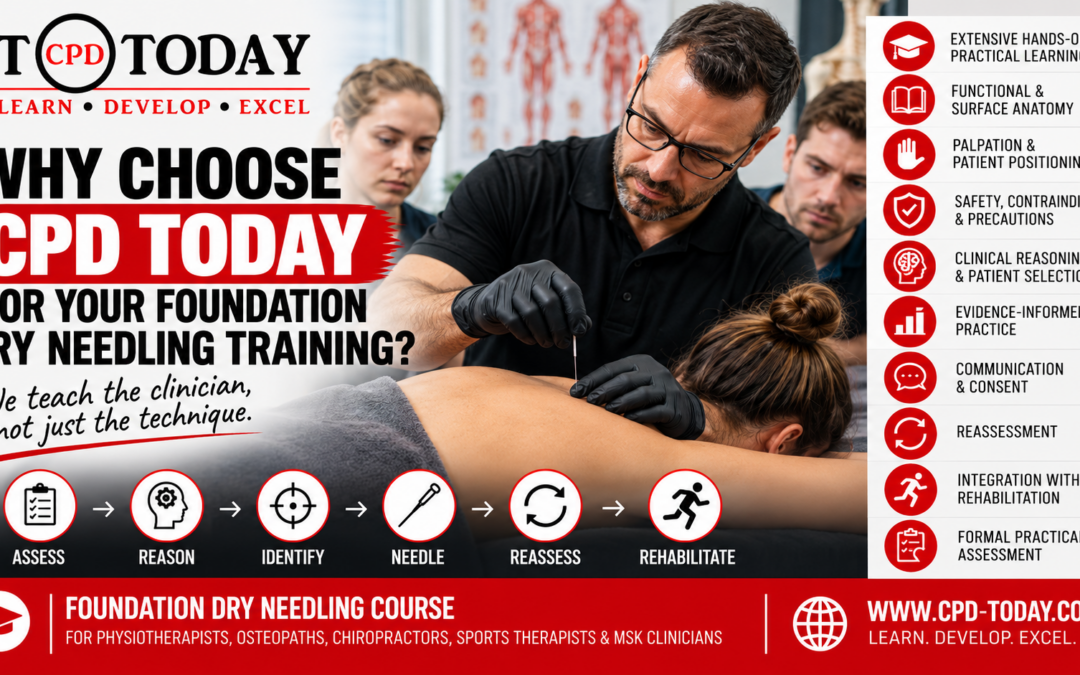
ASSESS → REASON → IDENTIFY → NEEDLE → REASSESS → REHABILITATE
Here’s what that means when you train with CPD Today.
1. We Teach More Than Needle Placement
It would be relatively easy to structure a dry needling course around:
Muscle → needle position → practise → next muscle.
But we don’t believe that’s enough.
Instead, we want delegates asking:
Why am I treating this tissue?
What am I hoping to achieve?
Is dry needling appropriate for this patient?
Are there relevant risks or precautions?
How will I know whether it helped?
What will I do afterwards?
That means clinical reasoning isn’t an additional topic on the course.
It’s part of how we teach the technique.
2. Extensive Hands-On Practical Training
Dry needling is a practical skill.
You can learn anatomy online.
You can read research papers.
You can watch needling videos.
But eventually you need to develop the ability to perform the technique yourself.
Our Foundation Course therefore places a strong emphasis on supervised hands-on learning.
Delegates have opportunities to:
Watch the technique
↓
Practise it
↓
Receive tutor feedback
↓
Refine their technique
↓
Practise again
A video can show you what an experienced clinician does.
It can’t watch what you are doing.
That’s where face-to-face practical education becomes particularly valuable.
3. Anatomy Is Central to Our Teaching
Anatomy matters whenever a needle passes through the skin.
But we don’t want delegates simply remembering diagrams.
You need to translate anatomical knowledge onto a real person.
That means understanding:
- Anatomical landmarks
- Muscle orientation
- Tissue depth
- Adjacent structures
- Relevant nerves and blood vessels
- Anatomical risk
- Patient positioning
Our practical teaching therefore brings together:
Anatomy → Palpation → Positioning → Safety → Needling
Rather than:
“Put the needle here because that’s where the tutor put it.”
4. We Teach You to Palpate, Not Just Look at Pictures
Patients don’t arrive with anatomy diagrams printed on their skin.
Body composition differs.
Muscle bulk differs.
Landmarks vary.
Positioning changes anatomical relationships.
That’s why palpation and surface anatomy form an important part of Foundation training.
You need to develop confidence identifying the structure you’re intending to treat.
This is another reason we believe practical teaching matters.
5. Safety Runs Throughout the Course
Dry needling is an invasive clinical technique.
Safety therefore isn’t something we discuss briefly before moving on to the interesting part.
Safety is the interesting part.
Our teaching considers areas including:
- Relevant anatomy
- Contraindications
- Precautions
- Hygiene
- Safe needle handling
- Patient positioning
- Appropriate technique
- Communication
- Consent
- Recognition of adverse events
- Appropriate responses when something unexpected occurs
One principle underpins all of this:
Knowing when and where not to needle is just as important as knowing how to needle.
6. We Teach Clinical Reasoning
Learning 30 techniques doesn’t necessarily make somebody a better dry needling practitioner.
Knowing when to use them matters more.
Before reaching for a needle, we encourage delegates to consider:
What is the clinical presentation?
What does my assessment tell me?
Why am I considering dry needling?
What outcome am I trying to influence?
What are the alternatives?
How will I reassess the patient?
This prevents dry needling becoming:
“Find something tender and needle it.”
Instead:
Every needle should have a clinical reason.
7. Evidence-Informed Rather Than Technique-Led
Dry needling is sometimes promoted as though it can fix almost any musculoskeletal problem.
That’s not how we teach it.
Research suggests dry needling may have a role in the management of some musculoskeletal presentations, particularly as part of broader management.
But the evidence varies between conditions, techniques and outcomes.
We therefore encourage clinicians to understand both:
What the evidence suggests
and
What the evidence doesn’t establish.
Good CPD should improve critical thinking—not replace it with another treatment philosophy.
8. We Don’t Teach That More Needles Mean Better Treatment
Dry needling has a treatment dose.
That might involve:
- Number of needles
- Technique
- Treatment duration
- Amount of stimulation
- Number of tissues treated
- Patient sensitivity
- Previous response
- Clinical objective
More isn’t automatically better.
Likewise:
More pain ≠ better treatment
More twitch responses ≠ better treatment
More muscles ≠ better treatment
Good clinical practice involves choosing an appropriate intervention for the patient in front of you.
9. We Teach Reassessment
One of the most useful habits clinicians can develop is remarkably simple:
Check whether your treatment actually changed anything.
If a patient has painful shoulder elevation, assess it.
If dry needling is selected appropriately, treat.
Then repeat the movement.
The process becomes:
ASSESS → TREAT → REASSESS
Did pain change?
Did movement change?
Did function change?
Can the patient now tolerate an exercise more comfortably?
If nothing changes, that’s useful clinical information too.
10. We Connect Dry Needling to Rehabilitation
This is fundamental to our teaching philosophy.
Dry needling shouldn’t automatically become a stand-alone treatment that patients repeatedly return to receive.
Imagine treatment reduces someone’s shoulder symptoms.
Great.
Now ask:
What can they do now that they couldn’t do before?
Perhaps you can progress:
- Strengthening
- Mobility
- Progressive loading
- Functional movement
- Exercise
- Sports rehabilitation
Dry needling may sometimes provide a useful window of opportunity.
Rehabilitation allows you to use it.
That’s why our framework ends with:
REASSESS → REHABILITATE
11. You’ll Receive Tutor Feedback
There’s an important difference between:
Watching someone perform dry needling
and
Having someone watch you perform dry needling.
During practical learning, tutor feedback can help refine:
- Palpation
- Positioning
- Hand placement
- Needle handling
- Technique
- Communication
- Clinical reasoning
Sometimes a relatively small correction can make a significant difference to how confident a technique feels.
That’s one of the major advantages of supervised practical education.
12. Our Tutors Understand Clinical Practice and Education
When choosing a dry needling course, we believe you should look at who will actually teach you.
Our teaching team brings together extensive experience in clinical MSK practice and professional education.
This matters because teaching isn’t simply demonstrating how we perform a technique.
It’s helping you learn how to perform it.
That requires observation, communication, feedback and an understanding of how clinicians learn practical skills.
13. Your Practical Ability Matters
Dry needling is a practical clinical skill.
We therefore believe course completion should represent more than simply sitting in the room for the required number of hours.
Our Foundation programme incorporates formal practical assessment.
The purpose isn’t to make delegates nervous or catch people out.
It’s to ensure the qualification has meaning.
Attendance tells us you were there.
Assessment helps demonstrate what you’ve learned.
14. We Want You to Leave With a Clinical Framework
When the course finishes, we don’t expect you to remember every sentence your tutors said.
What we do want you to remember is the process:
ASSESS
Understand the patient.
↓
REASON
Decide whether dry needling is appropriate.
↓
IDENTIFY
Use anatomy and palpation.
↓
NEEDLE
Apply an appropriate technique.
↓
REASSESS
Determine whether something changed.
↓
REHABILITATE
Use that change clinically.
That’s something you can take back into practice.
15. Foundation Training Is Part of a Development Pathway
Foundation shouldn’t be the end of your learning.
It should give you the fundamentals required to begin developing experience.
Our training pathway follows:
Foundation Dry Needling
Learn the fundamentals.
↓
Clinical Experience
Apply, practise and consolidate.
↓
Advanced Dry Needling & Electroacupuncture
Develop your skills further.
This is why we don’t try to cram every possible technique into Foundation training.
Advanced practice needs strong foundations.
Who Is the CPD Today Foundation Dry Needling Course For?
Our Foundation training is aimed at appropriately qualified healthcare and MSK professionals who want to develop dry needling skills.
Depending on eligibility, this may include:
- Physiotherapists
- Osteopaths
- Chiropractors
- Sports therapists
- Other appropriately qualified MSK clinicians
Individual practitioners should ensure training and subsequent practice are appropriate to their professional scope, insurance and workplace requirements.
Do I Need Previous Dry Needling Experience?
The Foundation Course is designed to develop the fundamentals, so you don’t need to arrive already confident with dry needling.
Some delegates understandably feel apprehensive about their first practical needling session.
That’s why learning progresses gradually:
Understand → Observe → Practise → Feedback → Refine
Confidence comes through supported practice rather than simply being expected.
What Will I Learn?
Our Foundation Dry Needling training brings together:
✔ Functional and surface anatomy
✔ Palpation
✔ Evidence-informed practice
✔ Contraindications and precautions
✔ Anatomical safety
✔ Needle handling
✔ Patient positioning
✔ Clinical reasoning
✔ Patient selection
✔ Communication and consent
✔ Treatment dosage
✔ Extensive supervised practical training
✔ Reassessment
✔ Rehabilitation
✔ Tutor feedback
✔ Practical assessment
The important point is that these aren’t isolated subjects.
They work together.
Why Not Simply Take the Cheapest Dry Needling Course?
Cost understandably matters.
But price alone tells you very little about the quality of clinical education.
When comparing courses, look at:
- Practical teaching time
- Tutor experience
- Tutor access
- Anatomy teaching
- Safety
- Clinical reasoning
- Assessment
- Course structure
- Progression opportunities
A cheap course can be excellent.
An expensive course can be poor.
Compare the education—not simply the price.
Why Not Choose the Course Teaching the Most Muscles?
Because the longest technique list doesn’t necessarily produce the best learning.
We’d rather delegates understand:
Why they’re using a technique
than simply remember:
Where somebody showed them to put a needle.
Once you have strong fundamentals, expanding your techniques becomes considerably easier.
Frequently Asked Questions
Is CPD Today’s Dry Needling Course suitable for beginners?
Our Foundation Dry Needling training is designed to establish fundamental dry needling knowledge and practical skills for eligible clinicians rather than requiring previous dry needling experience.
Is the course practical?
Yes. Hands-on supervised practical learning is a central component of the training approach.
Is anatomy included?
Yes. Functional anatomy, surface anatomy and palpation are integrated into practical needling education.
Does the course cover safety?
Safety, relevant anatomy, contraindications, precautions, needle handling, patient positioning and appropriate clinical decision-making form important components of the training.
Is there an assessment?
The Foundation programme includes practical assessment so that course completion represents demonstrated learning rather than attendance alone.
Do you teach clinical reasoning?
Yes. We want delegates to understand why and when they may use dry needling rather than simply memorising needling locations.
Do you teach rehabilitation alongside dry needling?
Yes. Our approach encourages clinicians to reassess following treatment and consider how any useful change can support appropriate active rehabilitation.
What happens after Foundation training?
Clinicians can consolidate their skills through appropriate clinical experience before considering further development through Advanced Dry Needling & Electroacupuncture training.
How do I know whether I’m eligible?
Eligibility depends on professional background, qualifications and relevant requirements. Contact CPD Today before booking if you’re uncertain.
Why Choose CPD Today?
Because we don’t believe dry needling education should simply teach:
“Put the needle here.”
We want you to understand:
WHY you’re using it.
WHEN it’s appropriate.
HOW to use it safely.
WHAT you’re trying to achieve.
WHAT you should do next.
That’s the difference between learning a technique and developing a clinical skill.
Ready to Learn Dry Needling?
If you’re looking for a Foundation Dry Needling Course in the UK, explore our upcoming training dates.
New to dry needling?
Start with Foundation Dry Needling.
Develop your anatomy, safety, clinical reasoning and hands-on practical skills under supervision.
Already Foundation trained?
Progress your development with Advanced Dry Needling & Electroacupuncture.
Don’t just learn where to put the needle. Understand why you’re putting it there.
CPD Today
LEARN • DEVELOP • EXCEL