
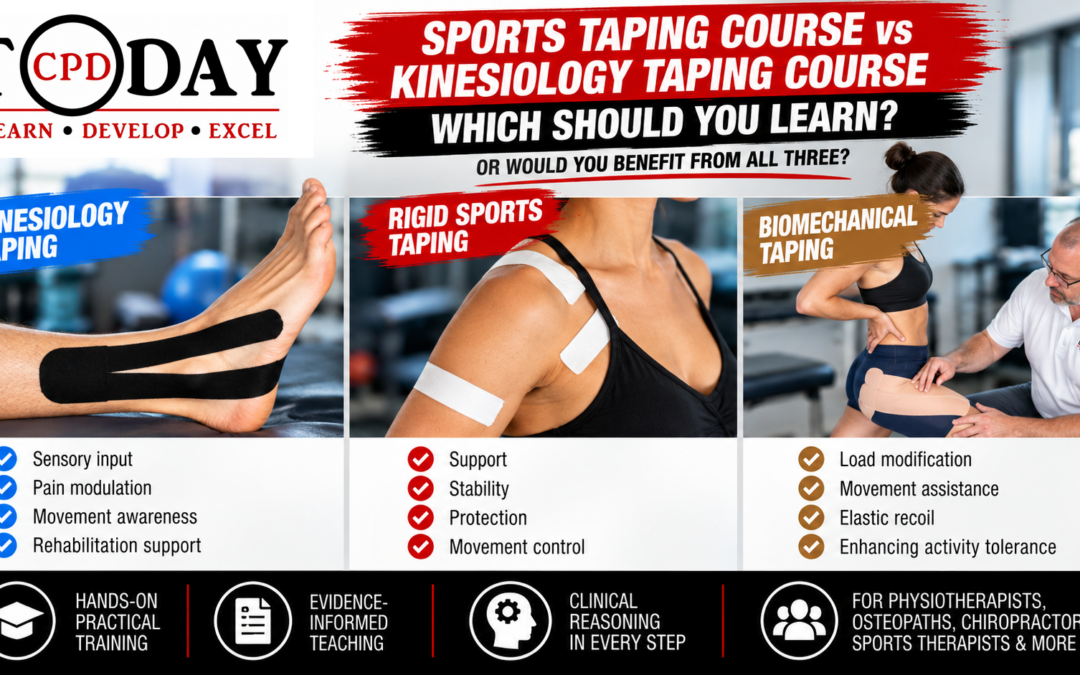
Sports Taping Course vs Kinesiology Taping Course: Which Should You Learn?
A Practical Guide for Physiotherapists, Osteopaths & Sports Therapists
If you’re searching for a taping course in the UK, you’ll probably encounter two options repeatedly:
Sports taping courses and kinesiology taping courses.
But which should you learn?
Is traditional rigid sports strapping more useful in clinical practice? Should you concentrate on kinesiology taping? Or would you benefit from learning both—and adding biomechanical taping to your clinical toolkit as well?
The answer depends less on which tape is “best” and more on a much more important question:
What are you trying to achieve for your patient?
At CPD Today, that’s central to how we teach our Clinical Strapping & Taping Course.
The right tape. For the right patient. For the right reason.
What Is a Sports Taping Course?
A traditional sports taping or sports strapping course generally focuses on rigid or semi-rigid tape.
Unlike elastic tapes, rigid sports tape provides relatively little stretch.
This makes it particularly useful when the clinical objective involves:
- Supporting a joint
- Increasing external stability
- Protecting an injured area
- Controlling unwanted movement
- Restricting a particular direction of movement
- Supporting return to sporting activity
Common areas taught on sports taping courses include the ankle, foot, knee, wrist, thumb and shoulder.
For clinicians working in sport, learning effective rigid strapping techniques can be extremely useful.
What Is a Kinesiology Taping Course?
A kinesiology taping course teaches the use of elastic therapeutic tape, commonly referred to as K-tape.
Unlike rigid sports tape, kinesiology tape generally allows movement rather than deliberately restricting it.
Clinical objectives may include:
- Providing sensory input
- Pain modulation
- Increasing awareness of movement
- Supporting functional activity
- Helping patients participate in rehabilitation
Kinesiology taping is widely used across physiotherapy, osteopathy, sports therapy and other MSK settings.
However, good kinesiology taping training should involve considerably more than memorising where strips of coloured tape should be placed.
Clinicians should understand why they are applying it and what outcome they expect.
Sports Tape vs Kinesiology Tape: What’s the Difference?
The easiest way to understand the difference is to consider their properties and clinical objectives.
| Rigid Sports Tape | Kinesiology Tape | |
|---|---|---|
| Elasticity | Minimal | Elastic |
| Movement | Can restrict/control | Generally allows movement |
| Support | High mechanical support | Lighter support |
| Common objective | Stability/protection | Sensory input/symptom modulation |
| Typical setting | Sport/return to play | MSK/rehabilitation/sport |
| Application | Often layered strapping | Elastic strips/applications |
Neither approach is automatically better.
They simply provide clinicians with different tools for different objectives.
When Might Rigid Sports Taping Be More Appropriate?
Imagine a patient returning to sport following an ankle sprain.
Your assessment identifies a need for additional external support and greater control of inversion during activity.
Your objective is primarily:
Support + stability + movement control
In this situation, rigid sports taping may be the logical choice.
A kinesiology application might allow substantially more movement and therefore may not achieve the same mechanical objective.
When Might Kinesiology Taping Be More Appropriate?
Now consider someone undertaking rehabilitation for persistent knee pain.
You don’t necessarily want to restrict their movement.
In fact, you want them moving and exercising.
Your objective might instead be to provide sensory input or temporarily modify symptoms while they perform their rehabilitation programme.
In that situation, kinesiology tape may be considered.
The important distinction is that you’re choosing the tape according to the objective rather than simply the diagnosis.
But There’s a Third Option: Biomechanical Taping
This is where comparing only sports tape and kinesiology tape can become limiting.
Modern clinical taping also includes biomechanical taping.
Biomechanical tapes are highly elastic and can be applied with the aim of mechanically interacting with movement.
Examples include:
Dynamic Tape® and Strapit Active Tape.
Both sit within the biomechanical taping category.
Depending on the application, objectives may include:
- Load modification
- Movement assistance
- Elastic recoil
- Reducing mechanical demand during a task
- Supporting activity tolerance
This gives clinicians another option between simply restricting movement and providing predominantly sensory input.
Three Taping Approaches – Three Different Objectives
A simple way to think about the three systems is:
🔴 Rigid Sports Taping
Support • Protection • Stability • Movement control
🔵 Kinesiology Taping
Sensory input • Pain modulation • Movement awareness • Rehabilitation
⚫ Biomechanical Taping
Load modification • Movement assistance • Elastic recoil
Once clinicians understand these differences, tape selection becomes much more logical.
Should Physiotherapists Learn Sports Taping or Kinesiology Taping?
For physiotherapists working across MSK, rehabilitation and sport, there’s a strong argument for understanding more than one taping approach.
Your caseload may include:
- Acute sporting injuries
- Persistent MSK pain
- Tendinopathy
- Post-injury rehabilitation
- Return-to-running patients
- Recreational athletes
- Competitive athletes
One type of tape is unlikely to meet every clinical objective.
Learning several approaches allows the physiotherapist to select the intervention according to the individual patient.
What About Osteopaths?
Taping can also be a useful adjunct for osteopaths.
Treatment finishes when the patient leaves the clinic, but rehabilitation and daily activity continue.
Appropriate taping may potentially be incorporated alongside:
- Exercise rehabilitation
- Load management
- Movement advice
- Return to activity
- Sports rehabilitation
For osteopaths, learning rigid, kinesiology and biomechanical taping provides several options rather than relying on a single taping philosophy.
What About Sports Therapists?
For sports therapists, rigid strapping may be particularly relevant because of the demands of sport and return-to-play environments.
But athletes don’t only require protection.
They may also present with:
- Tendon problems
- Persistent pain
- Rehabilitation needs
- Training-load issues
- Movement-related symptoms
Understanding kinesiology and biomechanical taping alongside traditional sports strapping therefore creates a broader practical toolkit.
Why Learning Only One Type of Tape Can Be Limiting
There’s an old saying:
If the only tool you have is a hammer, every problem starts looking like a nail.
The same principle can apply to taping.
If you’ve only attended a kinesiology taping course, you may naturally reach for kinesiology tape.
If you’ve only learned rigid sports strapping, you may approach every problem from the perspective of support and restriction.
Learning different tape properties allows you to start somewhere else:
What does this patient actually need?
Then choose the tape.
Don’t Choose Tape by Diagnosis Alone
This is one of the most important principles we teach.
Consider three people who all report knee pain.
One may need additional support during sport.
Another may benefit from short-term symptom modification while exercising.
Another may require a strategy aimed at modifying mechanical load during a particular activity.
Same anatomical region.
Potentially three different objectives.
Therefore:
Diagnosis → favourite taping recipe
isn’t particularly sophisticated clinical reasoning.
A better approach is:
Assess → Identify Objective → Select Tape → Apply → Reassess
Why Reassessment Matters
Whatever tape you choose, how do you know whether the application has achieved anything useful?
Establish a baseline before taping.
That might be:
- Pain during a squat
- Walking
- Running
- Stairs
- Heel raises
- Shoulder elevation
- Jumping
- A sport-specific task
Apply the tape.
Then repeat the test.
Did something meaningful change?
If not, reconsider the application.
A technically perfect taping technique isn’t necessarily a clinically useful one.
Should You Take Separate Sports and Kinesiology Taping Courses?
You certainly can.
Specialist courses can be useful when you want to develop considerable depth within one particular system.
However, clinicians who are relatively new to taping may benefit from first understanding the differences between the major taping approaches.
That’s one reason the CPD Today Clinical Strapping & Taping Course teaches three approaches together.
Instead of learning:
“This is how you tape a knee.”
we want clinicians asking:
“What am I trying to achieve at this knee—and which tape has the properties that best match that objective?”
That’s a very different way of thinking.
Why Hands-On Taping Training Matters
You can watch hundreds of taping videos online.
But watching someone else tape doesn’t necessarily teach you how the material feels in your hands.
Practical training allows you to develop skills such as:
- Tape handling
- Anchoring
- Direction
- Tension
- Patient positioning
- Application
- Removal
- Reassessment
It also gives you the opportunity to make mistakes, receive feedback and adjust your technique.
That’s difficult to replicate through video alone.
Learn All Three Approaches with CPD Today
The CPD Today Clinical Strapping & Taping Course brings together:
Rigid Sports Taping
Learn practical strapping techniques where support, stability, protection and movement control are the objective.
Kinesiology Taping
Explore elastic therapeutic taping, clinical reasoning and its potential role alongside rehabilitation.
Biomechanical Taping
Learn principles of load modification and movement assistance using biomechanical tapes, including Dynamic Tape® and Strapit Active Tape.
Most importantly, you’ll learn how to decide which approach to use and why.
What Should a Good Taping Course Teach?
Before booking a course, look beyond the number of techniques advertised.
Ask whether the training teaches you:
✅ How different tapes behave
✅ How to select the appropriate tape
✅ Clinical reasoning
✅ Patient positioning
✅ Direction and tension
✅ Practical application skills
✅ Safety and contraindications
✅ Reassessment
✅ How taping integrates with rehabilitation
These skills are transferable.
Memorised recipes are much less so.
Frequently Asked Questions
Is sports taping the same as kinesiology taping?
No. Rigid sports tape provides relatively little elasticity and may be used when support, protection or movement control is required. Kinesiology tape is elastic and generally allows movement.
Which is better: sports tape or kinesiology tape?
Neither is universally better. They have different physical properties and may therefore be selected for different clinical objectives.
What is the best taping course for physiotherapists?
Look for a course that combines practical application with clinical reasoning, safety, reassessment and integration with rehabilitation. Learning several taping approaches can provide a broader clinical toolkit.
Can osteopaths learn sports taping?
Yes. Taping can provide osteopaths with an additional clinical and rehabilitation tool, provided it is used within their professional competence and appropriate patient management.
What is biomechanical taping?
Biomechanical taping uses highly elastic tape with the aim of interacting mechanically with movement, including movement assistance and load modification.
Is Dynamic Tape® the same as kinesiology tape?
No. Dynamic Tape is a biomechanical tape and has different mechanical properties and intended applications from traditional kinesiology tape.
Does CPD Today teach all three taping methods?
Yes. The CPD Today Clinical Strapping & Taping Course combines rigid sports taping, kinesiology taping and biomechanical taping within practical, clinician-focused training.
So, Which Taping Course Should You Choose?
If you only want to learn rigid sports strapping, choose a dedicated sports taping course.
If you only want to learn K-tape applications, a kinesiology taping course may meet your needs.
But if you want to understand how different tapes can be selected for different clinical objectives, consider training that exposes you to several approaches.
That’s exactly what we’ve designed the CPD Today Clinical Strapping & Taping Course to do.
🔴 Rigid Sports Taping
🔵 Kinesiology Taping
⚫ Biomechanical Taping
Hands-on. Evidence-informed. Clinically relevant.
Don’t simply learn where to put the tape.
Learn which tape to choose, why you’re choosing it and how to determine whether it worked.
The right tape. For the right patient. For the right reason.
Book your place on the CPD Today Clinical Strapping & Taping Course and develop practical skills you can take straight back into clinic.
SEO & AI Search Optimisation
SEO title: Sports Taping Course vs Kinesiology Taping Course: Which Should You Learn?
Meta description: Sports taping course or kinesiology taping course? Compare rigid, K-tape and biomechanical taping and discover which training is right for MSK professionals.
Suggested URL: /sports-taping-course-vs-kinesiology-taping-course
Primary search phrase: sports taping course vs kinesiology taping course