SEO Title: Dry Needling Isn’t Just About Trigger Points | Modern Dry Needling Explained
Meta Description: Is dry needling only for trigger points? Explore modern dry needling practice, pain modulation, clinical reasoning and rehabilitation, and discover how CPD Today teaches clinicians to go beyond trigger-point treatment.
Supporting searches: how does dry needling work, modern dry needling, dry needling course UK, myofascial trigger points, dry needling training, dry needling pain relief
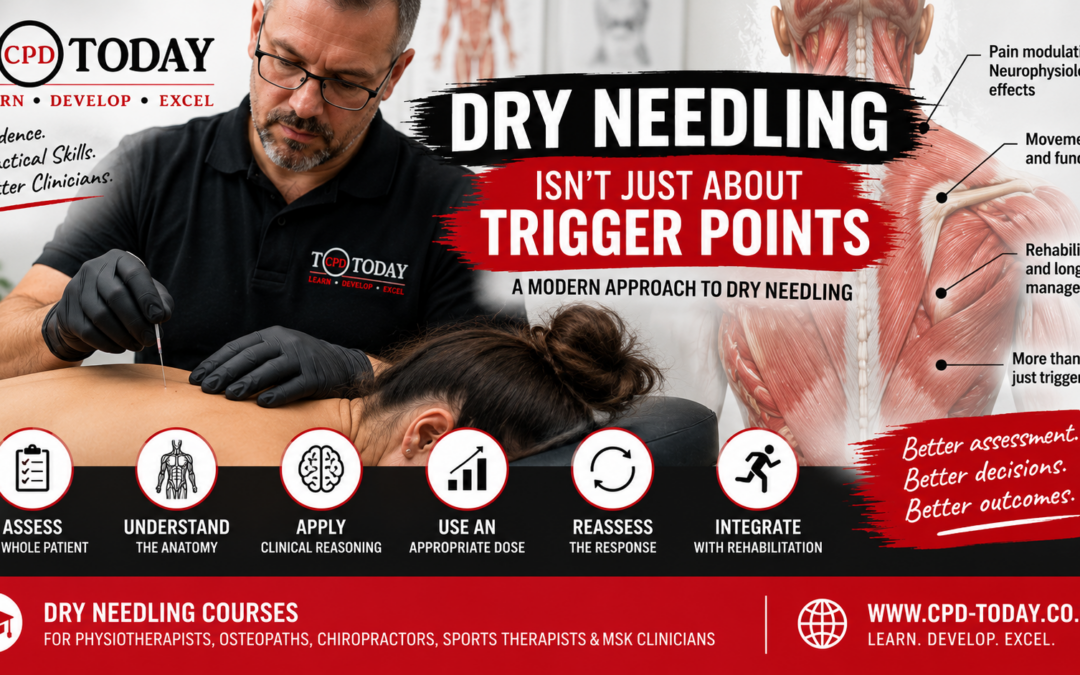
Dry Needling Isn’t Just About Trigger Points
Mention dry needling to many clinicians and one phrase immediately comes to mind:
Trigger points.
For many years, dry needling education centred heavily around identifying a tender or taut area within a muscle, inserting a needle and attempting to produce a local twitch response.
But is that all dry needling is?
No.
Our understanding of musculoskeletal pain has developed considerably, and contemporary dry needling practice is increasingly viewed within a broader framework involving pain modulation, neuromuscular responses, patient expectations, movement and rehabilitation.
At CPD Today, this is an important part of how we teach dry needling.
We don’t want clinicians simply searching for “knots” and needling them.
We want them asking:
Why am I using dry needling? What am I trying to change? And what am I going to do afterwards?
What Is a Trigger Point?
A myofascial trigger point has traditionally been described as a hypersensitive area associated with a taut band of skeletal muscle that may produce local tenderness and sometimes referred symptoms.
Clinically, patients may describe these areas as:
Knots
Tight spots
Tender points
Muscle tension
Areas that reproduce their familiar symptoms
Trigger points have played an important role in the historical development of dry needling.
However, the exact mechanisms and biological nature of trigger points remain debated, and their identification between clinicians is not always consistent.
That doesn’t mean a patient’s tenderness isn’t real.
It means we should be cautious about presenting one explanatory model as the complete explanation for their pain.
The Traditional Trigger-Point Model of Dry Needling
A traditional approach might look something like this:
Find a trigger point → insert a needle → obtain a twitch response → reduce the trigger point.
This model has influenced dry needling teaching for decades.
The local twitch response—a brief involuntary contraction of muscle fibres following stimulation—has consequently sometimes been regarded as evidence that the clinician has successfully treated the target.
But modern clinical reasoning asks a more important question:
Does producing a twitch response actually matter to the outcome we’re trying to achieve?
The answer is more complicated than simply “yes” or “no”.
Do You Need a Local Twitch Response?
Not necessarily.
A twitch response can occur during some dry needling techniques, particularly when stimulating sensitive areas within muscle.
However, obtaining a twitch response shouldn’t automatically become the objective of treatment.
Repeatedly manipulating a needle simply to chase increasingly large twitch responses may increase post-treatment soreness without necessarily producing a proportionally better clinical outcome.
The objective should remain centred on the patient.
For example:
Has pain changed?
Has movement improved?
Has function changed?
Can the patient now engage more effectively with rehabilitation?
These questions are more clinically meaningful than simply asking whether the muscle twitched.
So How Might Dry Needling Work?
This is where modern dry needling becomes particularly interesting.
There probably isn’t a single mechanism explaining every clinical response.
Several peripheral and central neurophysiological mechanisms have been proposed.
Needle stimulation may influence sensory input from the treated area and contribute to changes in pain processing.
Potential mechanisms discussed within the literature include:
Peripheral sensory stimulation
Changes in nociceptive input
Spinal pain-modulating mechanisms
Descending pain modulation
Changes in local tissue sensitivity
Altered motor responses
Contextual and expectation-related effects
Importantly, these mechanisms shouldn’t be presented as proof that dry needling “fixes” damaged tissue.
A change in pain doesn’t necessarily mean a structure has physically changed.
Pain Reduction Can Create an Opportunity
Imagine a patient with shoulder pain who finds reaching overhead painful.
Following an appropriate assessment, dry needling is selected as one component of treatment.
Afterwards, their movement is reassessed.
Their pain has reduced and they can move more comfortably.
What happens next?
This is where the clinician has an opportunity.
Rather than simply telling the patient to return next week for more needling, you might use that temporary improvement to introduce:
Strengthening
Movement retraining
Progressive loading
Mobility exercises
Functional rehabilitation
Dry needling hasn’t necessarily “fixed” the shoulder.
It may have helped create a window in which rehabilitation becomes easier.
That’s a very different clinical philosophy.
Dry Needling Shouldn’t Become “Find the Pain and Needle It”
Another problem with an overly simplistic trigger-point model is the temptation to needle wherever a patient reports tenderness.
But tenderness doesn’t automatically identify the cause of someone’s symptoms.
Consider someone with neck and shoulder pain.
Tenderness in the upper trapezius might be present.
But the wider assessment may reveal:
Cervical involvement
Neural sensitivity
Reduced shoulder capacity
Load-related symptoms
Sleep-related factors
Work-related aggravation
Psychosocial influences
Needling a tender muscle without considering the broader presentation risks reducing clinical care to:
“It hurts here, so I’ll needle here.”
Modern musculoskeletal practice should be more sophisticated than that.
Assessment Comes Before Needling
At CPD Today, we repeatedly return to one principle:
Assessment before intervention.
Before selecting dry needling, clinicians should consider:
What is the patient’s main problem?
What activities are limited?
What does the assessment demonstrate?
What are the patient’s goals?
Are there relevant contraindications or precautions?
Why might dry needling help?
What outcome are we hoping to influence?
How will we measure whether it helped?
Only then should the needle enter the conversation.
Every Needle Should Have a Reason
This has become one of the central principles behind our teaching.
Before inserting a needle, you should be able to explain why you’re doing it.
Not simply:
“Because that muscle is tight.”
Instead:
“Based on my assessment, I think this intervention may help modify the patient’s symptoms sufficiently to allow us to progress their rehabilitation.”
That represents a much stronger clinical rationale.
What About “Muscle Knots”?
Patients frequently use the term “knot”, and clinicians often use it too.
It’s a useful everyday description of how an area feels.
However, we should be careful about explaining pain as though muscles literally develop knots that need to be physically broken apart by a needle.
Musculoskeletal pain is influenced by numerous biological, psychological and contextual factors.
A tender area can be clinically relevant without needing an overly structural explanation.
Good communication helps patients understand treatment without creating unnecessary fear about their body.
Dry Needling Doesn’t Have to Be Painful to Work
Another misconception associated with trigger-point treatment is that treatment needs to be painful or aggressive to be effective.
It doesn’t.
Treatment dosage should consider:
Patient sensitivity
Treatment goals
Area being treated
Previous response
Patient preference
Clinical presentation
More stimulation isn’t automatically better stimulation.
Sometimes a relatively conservative technique may be entirely appropriate.
Clinical Pearl
Don’t judge treatment quality by how much the patient feels during needling. Judge it by what changes afterwards.
Reassessment Is More Important Than the Twitch
If you’re using dry needling to influence a particular clinical finding, reassess that finding.
For example, you might measure:
Pain during movement
Range of motion
Functional task
Strength
Movement confidence
Exercise tolerance
Then treat.
Then repeat the measure.
This gives you clinically useful information.
If nothing changes, that matters too.
It may suggest that the intervention isn’t particularly useful for that patient at that time.
Dry Needling Should Support Rehabilitation
One of the most important principles we teach is:
The needle is rarely the end of treatment.
If dry needling helps modify symptoms, ask:
What can the patient do now that they couldn’t do before?
Perhaps they can:
Load the tendon more comfortably
Move the shoulder further
Perform an exercise with less pain
Turn their neck more easily
Walk more comfortably
Return gradually to sport
Use the change.
That’s where dry needling becomes integrated into rehabilitation rather than becoming a passive treatment that patients feel dependent upon.
What Does the Evidence Say About Dry Needling?
Research into dry needling has reported potential improvements in pain and some measures of function across a range of musculoskeletal presentations, particularly in the short term.
However, findings vary considerably between conditions, techniques, comparison treatments and study designs.
The evidence does not justify presenting dry needling as a cure-all.
Nor does it mean dry needling must be included in every treatment programme.
A more reasonable interpretation is that dry needling may be a useful adjunct for selected patients when supported by appropriate assessment and incorporated within broader evidence-informed management.
That’s the approach we encourage at CPD Today.
Modern Dry Needling Is About Clinical Reasoning
The evolution of dry needling isn’t necessarily about abandoning trigger points.
It’s about recognising that trigger points represent one part of a much broader clinical picture.
A modern approach asks:
Why am I needling?
What response am I trying to achieve?
Is there a safer or simpler alternative?
How much stimulation is appropriate?
How will I measure the response?
What happens afterwards?
Those questions turn dry needling from a technique into a clinically reasoned intervention.
How We Teach Modern Dry Needling at CPD Today
On our Foundation Dry Needling Course, we teach practical needling techniques alongside the clinical reasoning required to use them appropriately.
Our training incorporates:
Relevant anatomy
Surface anatomy and palpation
Current evidence
Safety
Contraindications and precautions
Patient selection
Needle handling
Practical techniques
Clinical reasoning
Reassessment
Exercise and rehabilitation
We discuss trigger points, but we don’t want delegates leaving with the impression that every painful patient is simply a collection of trigger points waiting to be needled.
We teach the clinician—not just the technique.
What Changes at Advanced Level?
Once clinicians have established good foundational skills, advanced training can explore more complex applications and treatment approaches.
This may include more advanced clinical reasoning, additional anatomical areas and electrical stimulation techniques such as electroacupuncture.
But the fundamental principle doesn’t change.
Whether you’re inserting one needle or using a more advanced technique:
Every intervention should have a clinical reason.
Advanced practice isn’t about using increasingly complicated techniques.
It’s about making increasingly thoughtful decisions.
Common Dry Needling Myths
“Dry needling works by breaking up muscle knots.”
This is an oversimplification. Clinical responses are likely to involve several mechanisms, including neurophysiological and contextual effects.
“You need a twitch response for dry needling to work.”
A twitch may occur, but it shouldn’t automatically be considered necessary for a successful clinical outcome.
“The more needles you use, the better the treatment.”
There is no simple relationship between the number of needles and treatment quality.
“If dry needling hurts more, it’s working better.”
Treatment discomfort isn’t a measure of effectiveness.
“Dry needling fixes the underlying problem.”
Sometimes dry needling may help modify symptoms, but long-term management often requires rehabilitation, education, load management and addressing relevant contributing factors.
Clinical Takeaway
Dry needling has historically been strongly associated with myofascial trigger points and local twitch responses.
Those concepts remain part of the conversation, but they shouldn’t define the whole of modern dry needling practice.
Today’s clinician should think more broadly.
Assess the patient.
Understand the anatomy.
Choose the intervention for a reason.
Use an appropriate dose.
Reassess the response.
Then progress rehabilitation.
At CPD Today, that’s what we mean by teaching dry needling as a clinical skill rather than simply a needling technique.
Frequently Asked Questions
Is dry needling the same as trigger-point therapy?
No. Trigger-point needling is one approach associated with dry needling, but contemporary dry needling practice can be considered within a broader clinical and neurophysiological framework.
Does dry needling remove muscle knots?
It’s more accurate to describe potential changes in symptoms, sensitivity or function rather than suggesting a needle physically removes a “knot”.
Does a muscle have to twitch for dry needling to work?
Not necessarily. A local twitch response can occur, but producing one shouldn’t automatically be the primary objective of treatment.
How does dry needling reduce pain?
The exact mechanisms remain under investigation. Proposed explanations include peripheral and central neurophysiological processes affecting nociceptive input and pain modulation, alongside contextual factors.
Is more needling better?
No. Treatment should be appropriately dosed according to the patient, clinical presentation and intended outcome.
Should dry needling be combined with exercise?
Often, yes. Where dry needling produces a useful change in symptoms or movement, that change can provide an opportunity to progress appropriate exercise and rehabilitation.
Do CPD Today courses teach trigger-point dry needling?
Trigger-point concepts can form part of dry needling education, but our teaching places them within a broader framework of anatomy, evidence, safety, clinical reasoning, reassessment and rehabilitation.
Learn Modern Dry Needling with CPD Today
If you’re looking for a Dry Needling Course in the UK, don’t just learn where to put the needle.
Learn why you’re putting it there.
Our Foundation Dry Needling Course helps clinicians develop the anatomy, safety, practical skills and clinical reasoning required to introduce dry needling appropriately into musculoskeletal practice.
Already trained?
Our Advanced Dry Needling & Electroacupuncture Course provides the opportunity to develop your existing skills further.
SEO Title: Foundation vs Advanced Dry Needling Course: Which Should You Choose? | CPD Today
Meta Description: Foundation or Advanced Dry Needling Course? Compare the two levels of CPD Today dry needling training and discover which course is right for your clinical experience and professional development.
If you’re looking for a dry needling course in the UK, one of the first decisions you’ll need to make is:
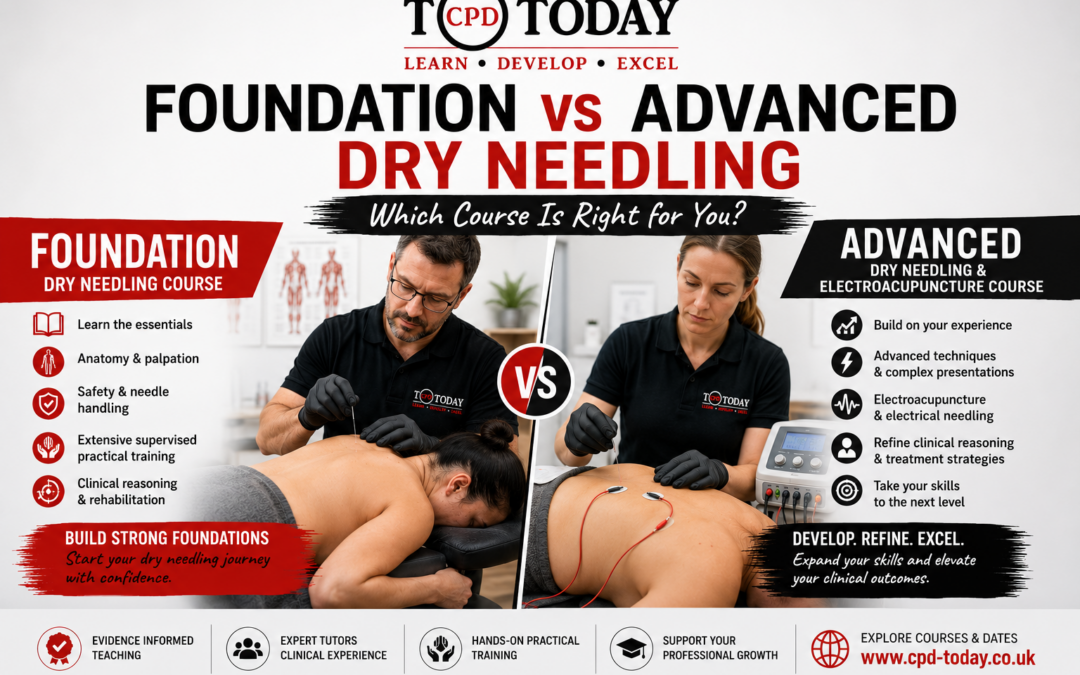
Should I take a Foundation or Advanced Dry Needling Course?
For clinicians completely new to dry needling, the answer is usually straightforward: start with the foundations.
But what if you’ve previously completed some dry needling training? What if you already use needling regularly in clinic? Or perhaps you’re confident treating common musculoskeletal presentations but want to develop your techniques further?
At CPD Today, our Foundation and Advanced Dry Needling training are designed to form a progression.
The Foundation Course develops the essential knowledge, safety, clinical reasoning and practical skills required to begin using dry needling appropriately.
Advanced training builds on those foundations, allowing experienced practitioners to expand their clinical toolkit and explore more advanced applications.
Here’s how to decide which course is right for you.
Quick Answer: Foundation or Advanced Dry Needling?
Choose a Foundation Dry Needling Course if you’re new to dry needling or haven’t previously completed suitable practical training.
Consider an Advanced Dry Needling Course if you already have appropriate foundation-level training, understand safe needling principles and regularly use dry needling within your clinical practice.
The important principle is:
Don’t rush to advanced techniques before you’ve developed strong foundations.
What Is a Foundation Dry Needling Course?
A Foundation Dry Needling Course introduces appropriately qualified healthcare professionals to the principles and practical skills required to begin developing competence in dry needling.
It shouldn’t simply teach you a list of muscles and needle positions.
Good Foundation training should help you understand:
What dry needling is
Current evidence and proposed mechanisms
Patient assessment
Clinical reasoning
Relevant anatomy
Surface anatomy and palpation
Contraindications and precautions
Infection prevention
Safe needle handling
Practical needling techniques
Patient communication and consent
Reassessment
Integration with rehabilitation
At CPD Today, these principles underpin our Foundation training.
Who Is the Foundation Dry Needling Course For?
Foundation training is designed for appropriately qualified clinicians who are new to dry needling.
Depending on eligibility, this may include:
Physiotherapists
Osteopaths
Chiropractors
Sports therapists
Other appropriately qualified musculoskeletal practitioners
You don’t need previous dry needling experience.
In fact, many delegates arrive having never inserted a needle before.
The purpose of Foundation training is to build confidence progressively rather than expecting you to arrive with practical needling skills.
What Will I Learn on a Foundation Course?
The focus is on building strong fundamentals.
We want delegates to progress through a logical sequence:
This is deliberately different from simply memorising:
Condition X = Needle Y.
Patients don’t always fit neat protocols.
Developing clinical reasoning gives you the ability to adapt what you’ve learned to the individual patient.
Why Anatomy Is So Important at Foundation Level
Anatomy is one of the most important foundations of safe dry needling.
Before inserting a needle, you need to understand:
What tissue you’re targeting
Where it is located
What structures surround it
What lies beneath it
How patient positioning changes the anatomy
Relevant safety considerations
That’s why we spend considerable time combining surface anatomy, palpation and practical technique.
The goal isn’t simply to remember where your instructor put the needle.
It’s to understand why it was placed there.
What Is an Advanced Dry Needling Course?
Advanced dry needling training is intended for clinicians who have already established appropriate foundation-level knowledge and practical experience.
Rather than repeating the basics, advanced training allows clinicians to develop their existing skills further.
Depending on the programme, advanced training may include:
More advanced clinical applications
Additional anatomical regions
More complex techniques
Refined clinical reasoning
Challenging patient presentations
Advanced treatment strategies
Electrical needling/electroacupuncture approaches
Integration with wider rehabilitation strategies
The emphasis shifts from learning the fundamental skill towards refining and expanding how you use it clinically.
Who Should Consider Advanced Dry Needling Training?
Advanced training may be appropriate if you:
Have completed recognised Foundation-level dry needling training
Already use dry needling clinically
Are confident with basic needle handling
Understand contraindications and precautions
Have good surface anatomy and palpation skills
Want to expand your range of techniques
Want to develop your clinical reasoning further
Are interested in electroacupuncture or electrical needling applications
Advanced shouldn’t mean simply using more needles.
It should mean developing a deeper understanding of how and why you’re using the technique.
Foundation vs Advanced Dry Needling: At a Glance
Foundation Dry Needling
Advanced Dry Needling
Previous experience
Usually not required
Foundation training expected
Main goal
Build core skills
Develop existing skills
Anatomy
Fundamental anatomy and palpation
Builds on existing anatomical knowledge
Safety
Core safe-practice principles
Applied to more advanced techniques
Needle handling
Introduced and developed
Refined
Clinical reasoning
Fundamental principles
More complex application
Practical training
Extensive supervised practice
Advanced practical application
Electrical techniques
Course dependent
May include electroacupuncture/electrical needling
Best suited to
Beginners
Previously trained clinicians
What If I’ve Done Some Dry Needling Before?
This is where the decision can become less obvious.
Perhaps you attended a short course several years ago.
Maybe you’ve learned some techniques but haven’t used them regularly.
Or perhaps your previous training covered only a small number of areas.
In these circumstances, don’t choose a course purely based on the certificate you already hold.
Consider your current competence and confidence.
Ask yourself:
When did I last perform dry needling?
How frequently do I use it?
Am I confident with relevant anatomy?
Do I understand current safety principles?
Can I recognise contraindications and precautions?
Can I justify why I’m selecting dry needling?
Do I routinely reassess afterwards?
If several of those questions make you uncertain, revisiting Foundation-level training may be more useful than jumping straight into advanced techniques.
Is Repeating Foundation Training a Step Backwards?
Returning to Foundation training can help refresh:
Anatomy
Safety
Palpation
Needle handling
Clinical reasoning
Evidence
Practical confidence
Sometimes improving the fundamentals has a greater impact on clinical practice than simply learning another technique.
What Makes Advanced Training “Advanced”?
It’s easy to assume that advanced means:
More muscles + more needles = more advanced.
We don’t think that’s a particularly useful definition.
Advanced practice should involve more sophisticated decision-making.
An advanced clinician should increasingly be asking:
Why am I choosing this intervention?
What outcome am I trying to achieve?
What does the evidence suggest?
How does this fit into rehabilitation?
What will I do if the patient doesn’t respond?
Technique matters.
But clinical reasoning determines how that technique is used.
Where Does Electroacupuncture Fit?
For clinicians who already have appropriate needling experience, advanced training can provide an opportunity to explore electrical stimulation alongside needling techniques, where appropriate.
This adds another dimension to needling practice and requires clinicians to understand areas such as:
Appropriate patient selection
Equipment
Safety
Treatment parameters
Clinical reasoning
Contraindications and precautions
It shouldn’t simply be viewed as connecting a machine to needles.
As with conventional dry needling, the important question remains:
Why are you choosing this intervention for this patient?
Do I Need Advanced Training to Be a Good Dry Needling Practitioner?
No.
Being a good clinician isn’t determined by how many courses you’ve completed.
A practitioner with excellent anatomy, assessment skills and clinical reasoning who uses a relatively small number of techniques appropriately may provide much better care than somebody who knows dozens of advanced techniques but applies them indiscriminately.
Advanced CPD should develop your clinical practice, not simply increase your collection of techniques.
Should I Take Advanced Training Immediately After Foundation?
Not necessarily.
There can be considerable value in spending time applying your Foundation learning clinically before progressing.
This allows you to discover:
Which techniques you use regularly
Which areas you find challenging
Where your confidence needs developing
What clinical questions arise
Which additional skills would genuinely benefit your patients
Advanced training then becomes much more meaningful because you can relate new learning to genuine clinical experience.
Choosing the Right Dry Needling Course
Before booking, consider three questions.
1. What training have I already completed?
If none, Foundation training is the logical starting point.
2. How confident am I currently?
A previous certificate doesn’t necessarily equal current competence.
3. What do I actually want to learn?
If you need core needling skills, choose Foundation.
If you already have those foundations and want to expand your clinical application, Advanced may be more appropriate.
The CPD Today Dry Needling Training Pathway
At CPD Today, we want professional development to follow a logical progression.
Use your skills appropriately, reassess your patients and continue developing clinical experience.
↓
Advanced Dry Needling & Electroacupuncture
Develop your skills further.
Expand your techniques, clinical reasoning and understanding of more advanced applications.
This creates progression rather than simply collecting disconnected CPD courses.
Why Choose CPD Today?
Our philosophy is reflected in three words:
Learn. Develop. Excel.
Our dry needling training combines:
Evidence-informed education
Functional anatomy
Surface anatomy and palpation
Clinical reasoning
Safety
Extensive practical training
Rehabilitation
Real-world clinical application
Whether you’re attending Foundation or Advanced training, the aim isn’t simply to teach you another technique.
It’s to help you become a more knowledgeable, confident and thoughtful clinician.
Clinical Takeaway
Choosing between Foundation and Advanced Dry Needling shouldn’t be about selecting the course with the most impressive list of techniques.
Choose the course that matches where you are clinically now.
If you’re new to dry needling, build strong foundations.
If you’ve already established those foundations and have clinical experience, advanced training can help you develop further.
And if you’re unsure?
There’s nothing wrong with strengthening the basics.
Advanced clinical practice is built on excellent fundamentals.
Frequently Asked Questions
Which dry needling course should a beginner take?
Clinicians without previous appropriate dry needling training should generally begin with a Foundation Dry Needling Course.
Do I need Foundation training before an Advanced Dry Needling Course?
Advanced courses normally expect previous appropriate needling education. Check the individual course entry requirements before booking.
Can I attend Advanced training if I completed Foundation training several years ago?
Potentially, but consider your current competence and how regularly you’ve used dry needling. A refresher may be valuable if your practical experience has been limited.
Is Advanced Dry Needling better than Foundation?
No. They serve different purposes. Foundation training develops essential skills; advanced training builds upon them.
Does Advanced Dry Needling include electroacupuncture?
This depends on the individual course. CPD Today’s advanced training pathway includes Advanced Dry Needling & Electroacupuncture content where specified.
How do I know which CPD Today course to book?
If you’re completely new to dry needling, start with Foundation. If you’re already appropriately trained and want to develop your skills further, consider Advanced training. If you’re uncertain about your eligibility, contact CPD Today before booking.
Which Course Is Right for You?
New to dry needling?
Start with the CPD Today Foundation Dry Needling Course.
Build your anatomy, safety, clinical reasoning and hands-on practical skills from the foundations upwards.
Already trained?
Explore our Advanced Dry Needling & Electroacupuncture training and take the next step in your professional development.
SEO Title: Why Anatomy Matters in Dry Needling | CPD Today Dry Needling Course UK
Meta Description: Discover why anatomy is essential for safe dry needling and how CPD Today teaches surface anatomy, palpation and clinical reasoning on our Foundation Dry Needling Course.
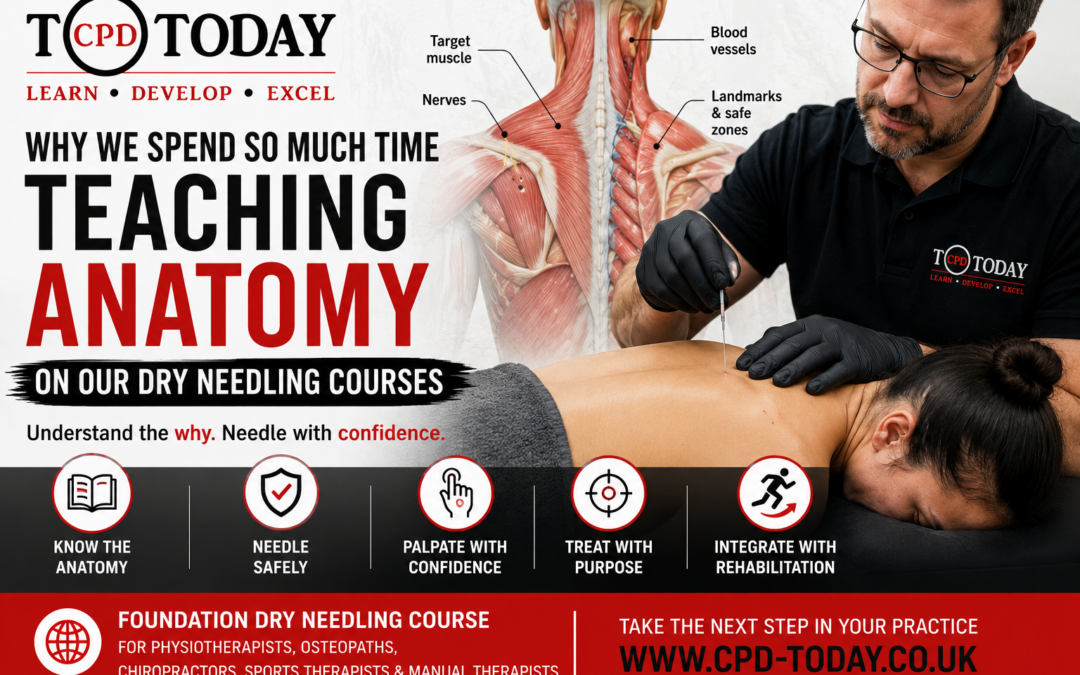
Why We Spend So Much Time Teaching Anatomy on Our Dry Needling Courses
When clinicians first attend a dry needling course, there’s understandably one thing they’re particularly keen to do:
Pick up a needle and start needling.
But at CPD Today, we deliberately spend considerable time on something that comes before the needle:
Anatomy.
Why?
Because knowing a technique isn’t enough.
If you’re going to insert a needle through the skin and into underlying tissues, you need to understand exactly what you’re aiming for, what surrounds it and what structures you need to avoid.
That’s why anatomy isn’t simply a theory session at the beginning of our Foundation Dry Needling Course.
It’s embedded throughout our practical teaching.
Anatomy Is One of Your Most Important Safety Tools
Dry needling is an invasive technique.
A clinician therefore needs more than a general understanding of where a muscle is located.
You need to consider structures such as:
Nerves
Blood vessels
Bone
Joints
Thoracic structures
Adjacent muscles
Other vulnerable anatomical structures
The relationship between the target tissue and these surrounding structures influences how—and whether—you approach a particular area.
For us, anatomy and safety cannot be separated.
Clinical Pearl
The needle doesn’t know what’s underneath the skin. You need to.
Knowing the Muscle Isn’t Enough
Most healthcare professionals attending a dry needling course already have substantial anatomical knowledge.
But remembering an illustration from an anatomy textbook is very different from locating a structure accurately on a real person.
A textbook might show a muscle clearly separated from everything around it.
Real patients aren’t like that.
Body shape varies. Muscle bulk varies. Position changes anatomical relationships. Landmarks may be easier or harder to identify.
That’s why practical anatomy matters.
Surface Anatomy Comes Before Needle Placement
Before needling a structure, we want delegates to be able to identify it confidently.
That means developing surface anatomy skills.
During practical teaching we consider:
Bony landmarks
Muscle borders
Muscle direction
Adjacent structures
Patient positioning
Tissue depth
Individual anatomical differences
This provides a much stronger foundation than simply copying where an instructor placed a needle.
Palpation Is a Clinical Skill
Palpation is sometimes underestimated.
In dry needling, it can be an important bridge between anatomical knowledge and practical technique.
Delegates learn to combine what they know from anatomy with what they can identify clinically.
The anatomy becomes something you apply, rather than simply something you remember.
Why Supervised Learning Matters
When learning dry needling, small changes can matter.
An instructor may help a delegate adjust:
Patient positioning
Palpation
Hand position
Needle direction
Technique
Clinical reasoning
Immediate feedback allows delegates to understand not only what needs changing, but why.
This is difficult to replicate through videos or diagrams alone.
It’s one reason extensive supervised practical teaching forms an important part of our Foundation Dry Needling Course.
Does Better Anatomy Knowledge Improve Confidence?
In our teaching experience, one of the biggest drivers of confidence is understanding what lies beneath your fingers.
Uncertainty creates hesitation.
Understanding creates informed decision-making.
When a clinician can confidently identify the target tissue, surrounding anatomy and appropriate approach, practical needling becomes far less intimidating.
This is why we don’t rush anatomy simply to increase the number of muscles covered during a course.
More techniques don’t necessarily mean better training.
We would rather delegates understand the techniques they’re learning properly.
How We Teach Anatomy at CPD Today
Our approach combines anatomy with practical clinical application.
Rather than separating anatomy into one isolated lecture, we revisit it throughout practical sessions.
Depending on the technique being taught, delegates consider:
What structure are we treating?
Why might we treat it?
How do we identify it?
What structures surround it?
How should the patient be positioned?
What are the relevant safety considerations?
How does this technique fit into the overall treatment plan?
This means anatomy, safety and clinical reasoning develop together.
Anatomy, Dry Needling and Rehabilitation
Knowing anatomy isn’t only useful for inserting needles.
It also helps clinicians understand movement, loading and rehabilitation.
If dry needling is used to modify pain or movement temporarily, the next question should be:
What are we going to do with that change?
Treatment may progress into:
Strengthening
Mobility work
Progressive loading
Movement retraining
Functional rehabilitation
Return to sport or activity
Understanding anatomy therefore supports the entire clinical process—not simply the needling technique.
What Should You Look for in a Dry Needling Course?
If you’re comparing dry needling courses in the UK, don’t simply compare how many muscles each provider promises to cover.
Ask:
How is anatomy taught?
Is surface anatomy included?
Will I practise palpation?
Is safety integrated into practical sessions?
How much supervised hands-on training is provided?
Are instructors available to correct technique?
Is clinical reasoning taught?
Does the course discuss rehabilitation?
Will I understand why I’m using each technique?
A long list of muscles may look impressive.
But understanding what you’re doing is far more valuable than simply collecting techniques.
Why Choose CPD Today for Foundation Dry Needling Training?
At CPD Today, our goal isn’t to produce clinicians who simply know where to insert needles.
We want to develop clinicians who can assess, reason and practise safely.
Our Foundation Dry Needling training combines:
Functional anatomy
Surface anatomy
Palpation
Evidence-informed teaching
Contraindications and precautions
Clinical reasoning
Extensive supervised practical training
Rehabilitation principles
Real-world clinical discussion
We believe that combination is fundamental to developing confidence.
Clinical Takeaway
If you remember one principle from this article, make it this:
Don’t memorise where the needle goes. Understand why it goes there.
Strong anatomical knowledge allows clinicians to identify structures more confidently, understand relevant risks and adapt techniques to the individual patient.
Combine that with clinical reasoning and supervised practical experience, and you have the foundations for safer dry needling practice.
That’s why we spend so much time teaching anatomy on our CPD Today Foundation Dry Needling Course.
It’s not something we need to get through before the practical work begins.
It is part of the practical work.
Frequently Asked Questions
How much anatomy do I need to know before learning dry needling?
Clinicians should already have an appropriate anatomical background for their profession. A good Foundation Dry Needling Course should then revisit relevant anatomy and apply it directly to practical techniques.
Why is surface anatomy important in dry needling?
Surface anatomy helps clinicians translate textbook knowledge onto an individual patient by identifying relevant landmarks, muscles and surrounding structures.
Do CPD Today courses include practical anatomy?
Yes. Anatomy, palpation and relevant safety considerations are incorporated into practical teaching rather than treated purely as theoretical subjects.
Is dry needling just about learning muscle locations?
No. Safe dry needling requires appropriate assessment, anatomical knowledge, clinical reasoning, patient selection and an understanding of contraindications and precautions.
Should I choose the dry needling course that teaches the most muscles?
Not necessarily. The number of techniques taught doesn’t automatically indicate the quality of training. Consider the depth of anatomy, supervised practice, safety education, clinical reasoning and instructor support.
Can anatomy make me more confident with dry needling?
A strong understanding of relevant anatomy can help reduce uncertainty and allow clinicians to make more informed decisions about palpation, positioning and practical technique.
Learn Dry Needling with CPD Today
If you’re looking for a Foundation Dry Needling Course in the UK, choose training that goes beyond simply showing you where to place needles.
At CPD Today, we combine anatomy, clinical reasoning, evidence, safety and extensive hands-on practical training to help healthcare professionals develop confidence in dry needling.
Learn the anatomy. Understand the reasoning. Develop the practical skills.
Frequently Asked Questions Before Booking a Dry Needling Course
SEO Title: Dry Needling Course FAQs: Everything You Need to Know Before Booking | CPD Today
Suggested URL:/dry-needling-course-faq
Meta Description: Thinking about booking a dry needling course in the UK? Get answers about eligibility, safety, practical training, qualifications, insurance and choosing the best dry needling course.
If you’re considering learning dry needling, you probably have questions before committing to a course.
Who can learn dry needling? Do you need previous experience? Is it difficult? How much practical training should you receive? And how do you choose a good dry needling course?
At CPD Today, we teach dry needling to healthcare professionals who want practical, clinically relevant training that they can integrate into musculoskeletal practice.
We’ve brought together some of the most common questions clinicians ask before booking a Foundation Dry Needling Course in the UK.
Quick Answer: What Should I Look for in a Dry Needling Course?
A good dry needling course should combine anatomy, safety, clinical reasoning, evidence-informed teaching and extensive supervised practical training.
You shouldn’t simply learn where to insert needles.
You should understand:
Why you’re selecting dry needling
When it may be appropriate
When it isn’t appropriate
Relevant anatomy
Contraindications and precautions
Safe needling principles
How to reassess the patient
How to integrate dry needling with rehabilitation
This approach forms the basis of our teaching at CPD Today.
Dry Needling Course FAQs
1. What Is Dry Needling?
Dry needling is a clinical technique involving the insertion of fine, solid filament needles into selected tissues as part of the management of some musculoskeletal presentations.
Unlike an injection, nothing is injected into the tissue—hence the term “dry” needling.
Modern dry needling should not simply involve needling wherever a patient reports pain. Treatment selection should be based on assessment, anatomy, clinical reasoning, patient goals and an understanding of the available evidence.
2. Who Can Learn Dry Needling?
Eligibility depends on your professional background, scope of practice, insurer requirements and the entry criteria of the training provider.
CPD Today courses are aimed at appropriately qualified healthcare and manual therapy professionals. Depending on the course and relevant requirements, this may include professionals such as:
Physiotherapists
Osteopaths
Chiropractors
Sports therapists
Other appropriately qualified musculoskeletal practitioners
Before booking any dry needling training, clinicians should check that the technique falls within their professional scope and that their insurer will provide appropriate cover.
3. Can Physiotherapists Learn Dry Needling?
Dry needling is used by many physiotherapists as one component of musculoskeletal practice, subject to appropriate education, competence, professional requirements and insurance.
A physiotherapist learning dry needling should receive training that covers more than needle insertion.
At CPD Today, our approach emphasises anatomy, assessment, safety, clinical reasoning and rehabilitation alongside practical needling skills.
4. Can Osteopaths Learn Dry Needling?
Appropriately trained osteopaths may incorporate dry needling within their clinical practice where this is consistent with their professional responsibilities, competence and insurance arrangements.
Dry needling can complement an osteopathic approach particularly well when it is integrated with assessment, manual therapy, exercise and rehabilitation rather than viewed as an isolated technique.
5. Can Sports Therapists Learn Dry Needling?
Eligibility can depend on the therapist’s qualification level, professional membership, insurer and course entry requirements.
Sports therapists considering dry needling should therefore check their individual eligibility before booking.
At CPD Today, we encourage clinicians to contact us if they’re uncertain whether their qualification meets the entry requirements for a particular course.
6. Do I Need Previous Dry Needling Experience?
For a Foundation Dry Needling Course, previous dry needling experience is generally not expected.
Foundation training should introduce the technique progressively.
At CPD Today, we build from core principles including:
This helps delegates understand the reasoning behind the intervention rather than simply memorising needle placements.
7. Do I Need to Be Confident with Needles Before Attending?
No.
It’s common for delegates to feel apprehensive about performing their first dry needling technique.
Confidence should develop gradually through good teaching, anatomical understanding, demonstration, supervised practice and instructor feedback.
You shouldn’t be expected to walk into a Foundation Course already confident with needles.
Developing that confidence is part of the learning process.
8. Is Dry Needling Difficult to Learn?
The basic handling of a needle can be learned relatively quickly.
Becoming a good dry needling clinician involves considerably more.
You need to understand:
Anatomy
Palpation
Patient positioning
Contraindications
Precautions
Infection control
Clinical reasoning
Patient communication
Treatment selection
Rehabilitation
That’s why we believe dry needling education should focus on developing the clinician, rather than simply teaching a collection of techniques.
9. Is Dry Needling Safe?
Dry needling is an invasive clinical technique and therefore requires appropriate training, anatomical knowledge, hygiene procedures, patient consent and risk management.
Clinicians should understand both common minor responses and the potential for more significant adverse events associated with inappropriate technique or particular anatomical regions.
A high-quality dry needling course should therefore make safety a core component of practical teaching, not simply a short theoretical section.
10. Why Is Anatomy So Important for Dry Needling?
Because the needle passes through the skin and into underlying tissues.
Clinicians need to understand not only the target muscle but also the structures surrounding it.
This may include:
Nerves
Blood vessels
Bone
Joints
Thoracic structures
Other vulnerable anatomical structures
Detailed surface anatomy and palpation therefore form an important part of safe dry needling practice.
At CPD Today, we believe:
Anatomical knowledge is one of your most important safety tools.
11. Will I Actually Practise Dry Needling on the Course?
Practical training should form a substantial part of a Foundation Dry Needling Course.
Watching demonstrations or completing online theory cannot replicate supervised hands-on skill development.
Our CPD Today Foundation Course places strong emphasis on practical learning, allowing delegates to develop palpation, positioning, needle handling and treatment skills with instructor guidance.
12. Why Is Supervised Practical Training Important?
Because dry needling is a practical clinical skill.
An experienced instructor can observe details such as:
Your positioning
Hand placement
Palpation
Needle handling
Communication
Technique selection
and provide immediate feedback.
That feedback is often what turns theoretical understanding into practical confidence.
13. What Should a Good Foundation Dry Needling Course Teach?
We believe a comprehensive Foundation Course should cover several interconnected areas:
Principles and evidence
Relevant anatomy
Palpation
Patient assessment
Contraindications and precautions
Infection prevention and safe practice
Needle handling
Practical techniques
Clinical reasoning
Reassessment
Integration with rehabilitation
If a course concentrates almost entirely on where to put needles, it’s worth asking what is missing.
14. Should Dry Needling Be Used as a Stand-Alone Treatment?
Not routinely.
Dry needling is better considered as one potential component of a broader management strategy.
Depending on the patient’s presentation, this might also include:
Exercise
Progressive loading
Manual therapy
Patient education
Movement retraining
Activity modification
Self-management
The question shouldn’t simply be:
“Where should I needle?”
It should be:
“What does this patient need?”
15. How Important Is Clinical Reasoning?
Extremely important.
Knowing how to perform a technique doesn’t automatically tell you when to use it.
Before needling, clinicians should consider questions such as:
What is the clinical presentation?
What am I trying to change?
Why have I selected this tissue?
Is dry needling appropriate?
Are there contraindications or precautions?
How will I measure the response?
What happens after needling?
At CPD Today, one of our core teaching principles is:
Every needle should have a reason.
16. Can I Use Dry Needling Immediately After Completing a Course?
Completing a course is only one component of professional competence.
Before incorporating dry needling into practice, clinicians should ensure that they meet the requirements of their profession, employer where relevant, insurer and individual scope of practice.
You should also only use techniques for which you feel appropriately trained and competent.
Professional development doesn’t stop when the course finishes.
17. Do I Need Insurance for Dry Needling?
You should confirm appropriate professional indemnity arrangements before providing dry needling clinically.
Requirements can vary depending on profession, insurer, qualification and workplace.
If you’re unsure, contact your insurer directly and confirm what training or certification they require.
Don’t assume that completing any particular course automatically guarantees insurance cover.
18. How Long Does It Take to Become Confident at Dry Needling?
There isn’t a single answer.
Confidence depends on factors including previous clinical experience, anatomical knowledge, practical exposure and continued use of the technique.
A good Foundation Course should give you the framework and supervised practical experience needed to begin developing competence.
Confidence then continues to grow through appropriate clinical experience, reflection and further professional development.
19. What Is the Difference Between Foundation and Advanced Dry Needling?
A Foundation Dry Needling Course is designed to establish the core knowledge and practical skills required for safe clinical practice.
Advanced training builds upon those foundations.
Depending on the programme, advanced education may explore more complex anatomical areas, additional techniques, more detailed clinical applications and other approaches such as electroacupuncture/electrical needling techniques.
At CPD Today, our training pathway allows clinicians to establish strong foundations before progressing their skills further.
20. Should I Take a Foundation or Advanced Dry Needling Course?
If you haven’t previously completed appropriate dry needling training, the Foundation Course is usually the appropriate starting point.
If you’re already trained and regularly using dry needling clinically, advanced education may be more suitable.
Online education can be valuable for theory, anatomy revision, evidence and continuing professional development.
However, dry needling itself is a practical invasive skill.
We believe initial practical training benefits considerably from face-to-face demonstration, supervised practice and immediate instructor feedback.
For clinicians learning dry needling for the first time, practical education should be a major consideration when comparing courses.
22. How Do I Choose the Best Dry Needling Course in the UK?
Don’t choose solely on price or the number of muscles listed in the course description.
Ask:
Who teaches the course?
What are their clinical and teaching backgrounds?
How much supervised practical training is included?
Is anatomy taught?
Is safety embedded throughout?
Does the course teach contraindications and precautions?
Is current evidence discussed?
Is clinical reasoning included?
Is rehabilitation discussed?
What happens after the course?
A course should help you become a better clinician, not simply add another certificate to your portfolio.
Why Choose CPD Today for Dry Needling Training?
At CPD Today, our philosophy is simple:
Learn. Develop. Excel.
Our dry needling education is designed around the realities of clinical practice.
We combine:
Evidence-informed teaching
Functional and surface anatomy
Safety
Clinical reasoning
Extensive supervised practical learning
Individual feedback
Patient assessment
Rehabilitation
Real-world clinical discussion
Our aim isn’t to teach delegates to needle every patient.
It’s to help healthcare professionals develop the confidence to understand when dry needling may be useful, how to apply the techniques they’ve learned safely and when another approach may be more appropriate.
Looking for a Foundation Dry Needling Course in the UK?
If you’re a physiotherapist, osteopath, chiropractor, sports therapist or another eligible healthcare professional considering learning dry needling, choosing the right education matters.
The CPD Today Foundation Dry Needling Course combines practical training with anatomy, evidence, safety and clinical reasoning to help clinicians develop skills they can integrate into modern musculoskeletal practice.
If you’ve never used a needle before, that’s exactly what Foundation training is designed for.
Start with the foundations. Build your confidence. Develop your clinical skills.
From Nervous Beginner to Confident Clinician: Learning Dry Needling
Nervous about learning dry needling? Discover how CPD Today’s Foundation Dry Needling Course takes clinicians from their first needle to safer, confident, evidence-based clinical practice.
If you’ve thought about learning dry needling but felt slightly apprehensive about actually putting a needle into a patient, you’re certainly not alone.
It’s something we regularly see at the beginning of our CPD Today Foundation Dry Needling Course.
Even experienced physiotherapists, osteopaths, chiropractors and sports therapists can feel nervous when learning dry needling for the first time.
Questions commonly include:
What if I put the needle in the wrong place?
How deep should the needle go?
How do I know which structures are underneath?
What if the patient reacts unexpectedly?
What if I don’t feel confident enough to use it afterwards?
These are completely reasonable questions.
That’s why we don’t expect delegates to simply pick up a needle and start practising.
Confidence is built progressively.
Our Foundation Dry Needling Course takes delegates through anatomy, assessment, safety, clinical reasoning and supervised practical training so that each new skill builds on the one before it.
Everyone Has to Insert Their First Needle
No clinician starts as an experienced dry needling practitioner.
Everyone has a first needle.
For some delegates, the biggest challenge isn’t understanding the theory—it’s overcoming the apprehension associated with performing a new invasive technique.
That’s why the learning environment matters.
A Foundation Dry Needling Course should allow you to learn progressively, ask questions and practise under appropriate supervision rather than feeling pressured to master everything immediately.
At CPD Today, we want delegates to develop confidence through understanding and practice, not simply repetition.
Step 1: Understanding What You’re Doing
Before we concentrate on practical techniques, delegates need to understand what dry needling is and why they might use it.
We explore areas including:
Current evidence
Proposed mechanisms
Clinical indications
Limitations
Patient selection
Contraindications and precautions
How dry needling fits within musculoskeletal rehabilitation
This immediately changes the emphasis from:
“Where should I put the needle?”
to:
“Why would I choose dry needling for this patient?”
That distinction is fundamental to the way we teach.
Step 2: Anatomy Builds Confidence
One of the best ways to reduce anxiety around dry needling is to improve your understanding of anatomy.
When you understand exactly what lies beneath your fingers, needling becomes far less intimidating.
Delegates develop their understanding of:
Surface anatomy
Muscle borders
Bony landmarks
Neurovascular structures
Relevant underlying structures
Safe approaches
Appropriate needle direction and depth
We don’t want delegates simply memorising photographs of where somebody else placed a needle.
We want them to understand the anatomy well enough to make safe decisions themselves.
Clinical Pearl
Anatomical knowledge is one of your most important safety tools.
The greater your understanding of the anatomy, the more confidently you can approach a technique.
Step 3: Palpate Before You Needle
Before inserting a needle, you need to know what you’re trying to treat.
Palpation therefore forms an important part of our practical teaching.
Delegates learn to identify anatomical landmarks and relevant tissues before progressing to needle insertion.
Rather than blindly following predetermined needling points, delegates learn to connect assessment findings with anatomy and treatment decisions.
Step 4: Your First Needle
Eventually comes the moment every beginner remembers:
your first needle.
By this point, you’ve already discussed safety, anatomy, patient positioning and needle handling.
The technique is demonstrated before you perform it yourself.
And importantly, you’re not learning alone.
Practical sessions are supervised so instructors can provide immediate feedback on positioning, palpation, handling and technique.
That first successful needle often changes the atmosphere completely.
Something that seemed intimidating earlier in the day suddenly becomes a practical clinical skill that can be learned and refined.
Step 5: Repetition Builds Practical Skill
Like any manual skill, dry needling becomes more comfortable with appropriate practice.
Throughout the course, delegates have opportunities to repeat techniques and develop their:
Needle handling
Hand positioning
Palpation
Patient positioning
Communication
Treatment selection
Clinical reasoning
But repetition alone isn’t enough.
Practice needs feedback.
An experienced instructor can identify small changes in positioning or technique that can make a significant difference to confidence and safety.
That’s one of the major advantages of supervised face-to-face practical training.
Step 6: Learning That More Needles Aren’t Better
As confidence develops, beginners can sometimes move from worrying about using needles to wanting to needle everything.
That’s another important stage of learning.
Dry needling isn’t about how many muscles you can treat.
It’s about choosing the most appropriate intervention for the individual patient.
Sometimes one carefully selected technique may be appropriate.
Sometimes several areas may be relevant.
And sometimes dry needling isn’t the right treatment at all.
Knowing when not to use a technique is an important part of becoming a confident clinician.
Step 7: Learning to Reassess
How do you know whether your treatment achieved anything?
You reassess.
After an intervention, we encourage delegates to consider:
Has pain changed?
Has range of movement changed?
Has strength changed?
Has function improved?
Did the intervention achieve the intended objective?
This turns dry needling from simply performing a procedure into part of a clinical decision-making process.
If the treatment hasn’t produced the response you expected, that information helps determine what you do next.
Step 8: Moving Beyond the Needle
One of the biggest changes we want to see during our Foundation Course is delegates moving beyond thinking about dry needling as a stand-alone treatment.
Dry needling may potentially help modify pain or movement in some patients.
But then what?
That’s where rehabilitation becomes important.
Depending on the patient, treatment may then progress into:
Strengthening
Progressive loading
Mobility work
Movement retraining
Patient education
Self-management
Return to activity or sport
The needle isn’t necessarily the destination.
Sometimes it’s simply one step within a wider rehabilitation programme.
Confidence Doesn’t Mean Needling Everyone
There’s an important distinction between being confident and being overconfident.
A confident dry needling practitioner should be comfortable saying:
“Dry needling isn’t appropriate for this patient.”
They should understand contraindications, recognise precautions and be prepared to choose another intervention when necessary.
That’s why our Foundation Course places such a strong emphasis on clinical reasoning.
Our aim isn’t to create clinicians who use dry needling on every patient.
It’s to develop clinicians who know when it may be useful and when it isn’t.
What Does Confidence Actually Look Like?
By the end of Foundation-level training, confidence shouldn’t mean:
“I can needle every muscle.”
Instead, we want delegates thinking:
“I can assess the patient, identify whether dry needling is appropriate, understand the relevant anatomy, perform the techniques I’ve been taught safely and integrate them into a wider treatment plan.”
That’s a much more meaningful form of clinical confidence.
Why Learn Dry Needling with CPD Today?
At CPD Today, we don’t believe a Foundation Dry Needling Course should simply provide a certificate and a collection of techniques.
Our training combines:
Evidence-informed education
Detailed functional anatomy
Patient assessment
Clinical reasoning
Contraindications and precautions
Safe needling principles
Extensive hands-on practical training
Instructor feedback
Rehabilitation and exercise integration
Real-world clinical discussion
Our focus is on helping clinicians understand why, when and how they may use dry needling safely within their professional practice.
Who Is the Foundation Dry Needling Course For?
Our Foundation Dry Needling training is aimed at appropriately qualified healthcare professionals who want to develop their practical musculoskeletal skills.
This may include physiotherapists, osteopaths, chiropractors, sports therapists and other eligible clinicians, subject to professional scope of practice and insurance requirements.
If you’re searching for a Foundation Dry Needling Course in the UK, it’s important to choose training that goes beyond needle placement and develops the clinical reasoning that surrounds the technique.
Clinical Takeaway
Being nervous before learning dry needling doesn’t prevent you from becoming a confident practitioner.
Confidence develops through knowledge, anatomy, supervised practice, feedback and clinical reasoning.
The aim isn’t to remove all caution. Appropriate caution is part of safe clinical practice.
Instead, good training transforms uncertainty into understanding.
At CPD Today, that’s what we want delegates to take away from our Foundation Course: not simply the confidence to pick up a needle, but the confidence to make better decisions about whether, why and how to use it.
Frequently Asked Questions
Is a Foundation Dry Needling Course suitable for complete beginners?
Yes. Foundation training is intended to introduce appropriately qualified clinicians to dry needling progressively, starting with the principles required for safe practice.
What if I’m nervous about needles?
Many delegates are apprehensive initially. The course progresses from theory, anatomy and safety into supervised practical training so that confidence can develop gradually.
Will I actually practise dry needling?
Yes. Hands-on supervised practical training is an important component of our Foundation Course.
Do I need to know every muscle before attending?
Clinicians attending should already have an appropriate professional anatomy background. During the course we revisit relevant functional and surface anatomy and connect this directly with practical techniques.
Will I be ready to use dry needling after the course?
The course is designed to provide the foundation knowledge and practical training required to begin developing dry needling within your professional scope. Clinicians should always practise within their competence, professional requirements and insurance arrangements.
Is dry needling taught as a stand-alone treatment?
No. We emphasise integrating dry needling with appropriate rehabilitation, exercise, education and other aspects of musculoskeletal management.
Ready to Take Your First Step?
If you’ve been considering learning dry needling but have been hesitant about taking that first step, our CPD Today Foundation Dry Needling Course is designed to provide a supportive route into practical needling.
Learn the anatomy. Understand the evidence. Develop your clinical reasoning. Practise under supervision. Build your confidence.
Learn. Develop. Excel.
Explore upcoming CPD Today Foundation Dry Needling Courses at www.cpd-today.co.uk.