From Nervous Beginner to Confident Clinician: Learning Dry Needling
Nervous about learning dry needling? Discover how CPD Today’s Foundation Dry Needling Course takes clinicians from their first needle to safer, confident, evidence-based clinical practice.
If you’ve thought about learning dry needling but felt slightly apprehensive about actually putting a needle into a patient, you’re certainly not alone.
It’s something we regularly see at the beginning of our CPD Today Foundation Dry Needling Course.
Even experienced physiotherapists, osteopaths, chiropractors and sports therapists can feel nervous when learning dry needling for the first time.
Questions commonly include:
What if I put the needle in the wrong place?
How deep should the needle go?
How do I know which structures are underneath?
What if the patient reacts unexpectedly?
What if I don’t feel confident enough to use it afterwards?
These are completely reasonable questions.
That’s why we don’t expect delegates to simply pick up a needle and start practising.
Confidence is built progressively.
Our Foundation Dry Needling Course takes delegates through anatomy, assessment, safety, clinical reasoning and supervised practical training so that each new skill builds on the one before it.
Everyone Has to Insert Their First Needle
No clinician starts as an experienced dry needling practitioner.
Everyone has a first needle.
For some delegates, the biggest challenge isn’t understanding the theory—it’s overcoming the apprehension associated with performing a new invasive technique.
That’s why the learning environment matters.
A Foundation Dry Needling Course should allow you to learn progressively, ask questions and practise under appropriate supervision rather than feeling pressured to master everything immediately.
At CPD Today, we want delegates to develop confidence through understanding and practice, not simply repetition.
Step 1: Understanding What You’re Doing
Before we concentrate on practical techniques, delegates need to understand what dry needling is and why they might use it.
We explore areas including:
Current evidence
Proposed mechanisms
Clinical indications
Limitations
Patient selection
Contraindications and precautions
How dry needling fits within musculoskeletal rehabilitation
This immediately changes the emphasis from:
“Where should I put the needle?”
to:
“Why would I choose dry needling for this patient?”
That distinction is fundamental to the way we teach.
Step 2: Anatomy Builds Confidence
One of the best ways to reduce anxiety around dry needling is to improve your understanding of anatomy.
When you understand exactly what lies beneath your fingers, needling becomes far less intimidating.
Delegates develop their understanding of:
Surface anatomy
Muscle borders
Bony landmarks
Neurovascular structures
Relevant underlying structures
Safe approaches
Appropriate needle direction and depth
We don’t want delegates simply memorising photographs of where somebody else placed a needle.
We want them to understand the anatomy well enough to make safe decisions themselves.
Clinical Pearl
Anatomical knowledge is one of your most important safety tools.
The greater your understanding of the anatomy, the more confidently you can approach a technique.
Step 3: Palpate Before You Needle
Before inserting a needle, you need to know what you’re trying to treat.
Palpation therefore forms an important part of our practical teaching.
Delegates learn to identify anatomical landmarks and relevant tissues before progressing to needle insertion.
Rather than blindly following predetermined needling points, delegates learn to connect assessment findings with anatomy and treatment decisions.
Step 4: Your First Needle
Eventually comes the moment every beginner remembers:
your first needle.
By this point, you’ve already discussed safety, anatomy, patient positioning and needle handling.
The technique is demonstrated before you perform it yourself.
And importantly, you’re not learning alone.
Practical sessions are supervised so instructors can provide immediate feedback on positioning, palpation, handling and technique.
That first successful needle often changes the atmosphere completely.
Something that seemed intimidating earlier in the day suddenly becomes a practical clinical skill that can be learned and refined.
Step 5: Repetition Builds Practical Skill
Like any manual skill, dry needling becomes more comfortable with appropriate practice.
Throughout the course, delegates have opportunities to repeat techniques and develop their:
Needle handling
Hand positioning
Palpation
Patient positioning
Communication
Treatment selection
Clinical reasoning
But repetition alone isn’t enough.
Practice needs feedback.
An experienced instructor can identify small changes in positioning or technique that can make a significant difference to confidence and safety.
That’s one of the major advantages of supervised face-to-face practical training.
Step 6: Learning That More Needles Aren’t Better
As confidence develops, beginners can sometimes move from worrying about using needles to wanting to needle everything.
That’s another important stage of learning.
Dry needling isn’t about how many muscles you can treat.
It’s about choosing the most appropriate intervention for the individual patient.
Sometimes one carefully selected technique may be appropriate.
Sometimes several areas may be relevant.
And sometimes dry needling isn’t the right treatment at all.
Knowing when not to use a technique is an important part of becoming a confident clinician.
Step 7: Learning to Reassess
How do you know whether your treatment achieved anything?
You reassess.
After an intervention, we encourage delegates to consider:
Has pain changed?
Has range of movement changed?
Has strength changed?
Has function improved?
Did the intervention achieve the intended objective?
This turns dry needling from simply performing a procedure into part of a clinical decision-making process.
If the treatment hasn’t produced the response you expected, that information helps determine what you do next.
Step 8: Moving Beyond the Needle
One of the biggest changes we want to see during our Foundation Course is delegates moving beyond thinking about dry needling as a stand-alone treatment.
Dry needling may potentially help modify pain or movement in some patients.
But then what?
That’s where rehabilitation becomes important.
Depending on the patient, treatment may then progress into:
Strengthening
Progressive loading
Mobility work
Movement retraining
Patient education
Self-management
Return to activity or sport
The needle isn’t necessarily the destination.
Sometimes it’s simply one step within a wider rehabilitation programme.
Confidence Doesn’t Mean Needling Everyone
There’s an important distinction between being confident and being overconfident.
A confident dry needling practitioner should be comfortable saying:
“Dry needling isn’t appropriate for this patient.”
They should understand contraindications, recognise precautions and be prepared to choose another intervention when necessary.
That’s why our Foundation Course places such a strong emphasis on clinical reasoning.
Our aim isn’t to create clinicians who use dry needling on every patient.
It’s to develop clinicians who know when it may be useful and when it isn’t.
What Does Confidence Actually Look Like?
By the end of Foundation-level training, confidence shouldn’t mean:
“I can needle every muscle.”
Instead, we want delegates thinking:
“I can assess the patient, identify whether dry needling is appropriate, understand the relevant anatomy, perform the techniques I’ve been taught safely and integrate them into a wider treatment plan.”
That’s a much more meaningful form of clinical confidence.
Why Learn Dry Needling with CPD Today?
At CPD Today, we don’t believe a Foundation Dry Needling Course should simply provide a certificate and a collection of techniques.
Our training combines:
Evidence-informed education
Detailed functional anatomy
Patient assessment
Clinical reasoning
Contraindications and precautions
Safe needling principles
Extensive hands-on practical training
Instructor feedback
Rehabilitation and exercise integration
Real-world clinical discussion
Our focus is on helping clinicians understand why, when and how they may use dry needling safely within their professional practice.
Who Is the Foundation Dry Needling Course For?
Our Foundation Dry Needling training is aimed at appropriately qualified healthcare professionals who want to develop their practical musculoskeletal skills.
This may include physiotherapists, osteopaths, chiropractors, sports therapists and other eligible clinicians, subject to professional scope of practice and insurance requirements.
If you’re searching for a Foundation Dry Needling Course in the UK, it’s important to choose training that goes beyond needle placement and develops the clinical reasoning that surrounds the technique.
Clinical Takeaway
Being nervous before learning dry needling doesn’t prevent you from becoming a confident practitioner.
Confidence develops through knowledge, anatomy, supervised practice, feedback and clinical reasoning.
The aim isn’t to remove all caution. Appropriate caution is part of safe clinical practice.
Instead, good training transforms uncertainty into understanding.
At CPD Today, that’s what we want delegates to take away from our Foundation Course: not simply the confidence to pick up a needle, but the confidence to make better decisions about whether, why and how to use it.
Frequently Asked Questions
Is a Foundation Dry Needling Course suitable for complete beginners?
Yes. Foundation training is intended to introduce appropriately qualified clinicians to dry needling progressively, starting with the principles required for safe practice.
What if I’m nervous about needles?
Many delegates are apprehensive initially. The course progresses from theory, anatomy and safety into supervised practical training so that confidence can develop gradually.
Will I actually practise dry needling?
Yes. Hands-on supervised practical training is an important component of our Foundation Course.
Do I need to know every muscle before attending?
Clinicians attending should already have an appropriate professional anatomy background. During the course we revisit relevant functional and surface anatomy and connect this directly with practical techniques.
Will I be ready to use dry needling after the course?
The course is designed to provide the foundation knowledge and practical training required to begin developing dry needling within your professional scope. Clinicians should always practise within their competence, professional requirements and insurance arrangements.
Is dry needling taught as a stand-alone treatment?
No. We emphasise integrating dry needling with appropriate rehabilitation, exercise, education and other aspects of musculoskeletal management.
Ready to Take Your First Step?
If you’ve been considering learning dry needling but have been hesitant about taking that first step, our CPD Today Foundation Dry Needling Course is designed to provide a supportive route into practical needling.
Learn the anatomy. Understand the evidence. Develop your clinical reasoning. Practise under supervision. Build your confidence.
Learn. Develop. Excel.
Explore upcoming CPD Today Foundation Dry Needling Courses at www.cpd-today.co.uk.
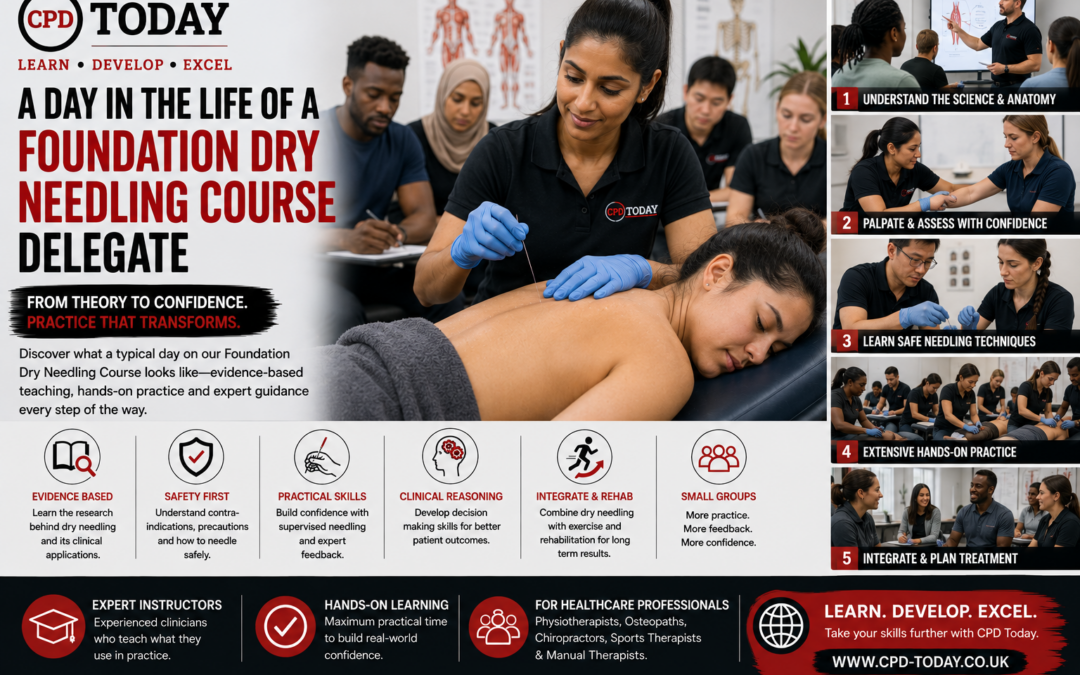
A Day in the Life of a Foundation Dry Needling Course Delegate
Thinking of learning dry needling? Discover what a typical day on a CPD Today Foundation Dry Needling Course looks like, from anatomy and safety to supervised hands-on practical training.
A Day in the Life of a Foundation Dry Needling Course Delegate
You’ve decided you’d like to learn dry needling.
You’ve looked at different courses, read about the evidence and perhaps spoken to colleagues who already use dry needling in practice.
But there’s probably still one question:
What is actually going to happen when I walk through the door?
For clinicians who have never used needles before, attending a Foundation Dry Needling Course can understandably feel a little daunting.
At CPD Today, our aim is to make the learning environment practical, supportive and enjoyable while giving you the knowledge and hands-on experience required to start developing confidence with dry needling.
Here’s what a typical day might look like.
Arriving at the Course
You’ll meet your instructors and the other healthcare professionals attending the course.
Delegates come from a range of clinical backgrounds, which may include:
Physiotherapy
Osteopathy
Chiropractic
Sports therapy
Other appropriate musculoskeletal and manual therapy professions
Some delegates have years of clinical experience. Others are relatively early in their careers.
What they have in common is a desire to add another evidence-informed treatment option to their clinical toolkit.
And importantly, you don’t need previous dry needling experience to attend our Foundation Course.
First Things First: Understanding Dry Needling
Before anyone picks up a needle, we establish the foundations.
We explore what dry needling is, how it differs from other needling approaches and where it may fit within modern musculoskeletal practice.
This includes discussion around:
Current evidence
Proposed physiological mechanisms
Pain modulation
Clinical indications
Limitations of dry needling
Patient selection
We don’t want delegates simply memorising techniques.
We want them to understand why they might use them.
Safety Before Technique
One of the most important parts of learning dry needling is understanding how to practise safely.
Before practical needling begins, we discuss areas including:
Infection control
Needle handling
Sharps disposal
Patient positioning
Consent
Contraindications
Precautions
Potential adverse events
Relevant anatomy
Safety isn’t something we teach once and forget.
It runs through the entire course.
Then Comes Anatomy
Ask an experienced dry needling practitioner what makes them confident and they’ll often give a similar answer:
Anatomy.
Knowing the name of a muscle isn’t enough.
You need to understand what lies underneath, beside and around it.
Our teaching therefore incorporates:
Surface anatomy
Palpation
Muscle borders
Bony landmarks
Neurovascular structures
Relevant underlying structures
Safe approaches
Delegates palpate structures before progressing to needle placement.
This is an important part of developing safe clinical practice.
Time to Pick Up a Needle
For many delegates, this is the moment they’ve been waiting for—and sometimes the moment they’ve been slightly nervous about.
The first practical session is carefully supervised.
We demonstrate techniques before delegates practise them themselves.
You’ll work through:
Identify → Palpate → Position → Needle → Reassess
Rather than rushing through large numbers of muscles, we focus on understanding each technique properly.
Learning by Doing
Dry needling is a practical clinical skill.
You cannot learn it properly by watching videos alone.
As the course progresses, delegates spend increasing amounts of time practising under supervision.
Your instructors can observe:
Your patient positioning
Palpation
Needle handling
Technique
Communication
Clinical reasoning
and provide immediate feedback.
This is where confidence really starts to develop.
Questions Are Encouraged
One of the advantages of face-to-face practical education is being able to ask questions as they arise.
And there are usually plenty.
For example:
“Would you needle this patient?”
“Which muscle would you consider here?”
“What if the patient doesn’t respond?”
“Would you combine this with exercise?”
These discussions are often some of the most valuable parts of the course because they connect practical techniques with real clinical situations.
It’s Not About Needling Everything
As delegates become more comfortable with the technique, another important lesson emerges:
More needles don’t necessarily mean better treatment.
We encourage delegates to think about what they are trying to achieve.
Instead of asking:
“What else can I needle?”
we want you asking:
“What does this patient actually need?”
Sometimes the answer may be dry needling.
Sometimes it may be exercise, education, manual therapy, load modification—or simply reassurance.
Clinical reasoning determines the treatment.
Reassess, Reassess, Reassess
One of the habits we encourage throughout the course is reassessment.
After treatment, consider:
Has movement changed?
Has pain changed?
Has function improved?
Did the intervention achieve what you expected?
If you don’t reassess, how do you know whether your intervention helped?
This simple principle can significantly improve clinical decision-making.
Integrating Dry Needling with Rehabilitation
As the day progresses, the focus begins shifting from simply performing a technique to understanding how it fits within a complete treatment plan.
Dry needling might help reduce pain or improve movement.
But what happens next?
That could involve:
Strengthening
Mobility exercises
Movement retraining
Progressive loading
Patient education
Self-management
At CPD Today, we see dry needling as a potential gateway into rehabilitation, rather than the end of treatment.
Learning from Other Clinicians
One of the often-overlooked benefits of attending a practical CPD course is learning from the other delegates.
Physiotherapists, osteopaths, chiropractors and sports therapists may approach the same clinical presentation slightly differently.
Discussing cases and treatment approaches can generate valuable conversations and new ideas.
Good CPD isn’t simply about listening to the lecturer.
It’s about clinicians learning from each other too.
From Nervous to Confident
At the beginning of the course, some delegates are understandably cautious about inserting their first needle.
As their understanding of anatomy improves and they gain supervised practical experience, that apprehension often begins to reduce.
By the end of the training, the aim isn’t for delegates to think:
“I can needle everything.”
It’s for them to think:
“I understand how to decide when dry needling is appropriate and how to perform the techniques I’ve learned safely.”
That’s a very different kind of confidence.
What Makes the CPD Today Approach Different?
Our philosophy is straightforward:
Don’t just teach the technique. Teach the clinician.
Our Foundation Dry Needling Course therefore brings together:
Evidence-informed education
Detailed anatomy
Clinical reasoning
Safety
Extensive hands-on practice
Individual feedback
Rehabilitation
Real-world clinical discussion
We want delegates to understand not only how to use dry needling, but why, when and when not to use it.
Clinical Pearl
Confidence doesn’t come from memorising where to put a needle. It comes from understanding the anatomy, knowing why you’re treating and practising the technique properly.
That’s why supervised practical learning is such an important part of our Foundation Course.
Clinical Takeaway
Your first dry needling course should give you more than a collection of techniques.
It should provide a framework for safe assessment, clinical reasoning, anatomy, treatment and rehabilitation.
At CPD Today, we want delegates to leave understanding that dry needling is not the treatment plan—it’s one potential part of a much broader approach to musculoskeletal care.
The aim is simple: better knowledge, better clinical decisions and greater confidence in practice.
Frequently Asked Questions
Will I actually practise dry needling on the course?
Yes. The Foundation Course includes extensive supervised practical training. Practical experience is a central part of learning the technique.
I’ve never used a needle before. Is that a problem?
No. The course is designed as Foundation-level training and builds progressively from the fundamentals.
Is the course mostly theory?
No. Theory, evidence, anatomy and safety provide the foundations, but hands-on practical learning forms a major part of the course.
Do you teach clinical reasoning?
Yes. This is one of the most important aspects of our teaching. We want delegates to understand why they’re selecting an intervention rather than simply following predetermined protocols.
Will I learn how to combine dry needling with other treatments?
Yes. We discuss how dry needling can be incorporated alongside exercise, rehabilitation, education and other appropriate approaches to musculoskeletal management.
Thinking About Learning Dry Needling?
If you’re a healthcare professional considering adding dry needling to your clinical practice, choosing the right training is important.
The CPD Today Foundation Dry Needling Course combines evidence-informed teaching with extensive hands-on practical experience, anatomy, safety and clinical reasoning.
Whether you’re a physiotherapist, osteopath, chiropractor, sports therapist or another appropriately qualified clinician, our aim is to help you develop the knowledge and confidence to integrate dry needling appropriately into your clinical practice.
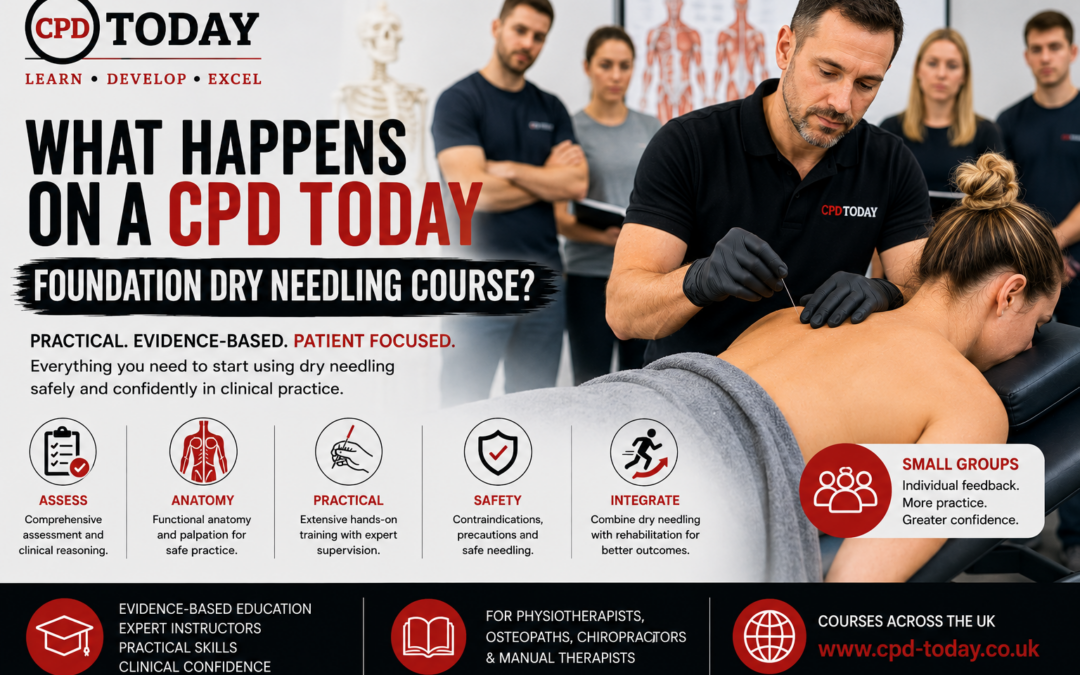
What Happens on a CPD Today Foundation Dry Needling Course? A Complete Guide
Meta Description: Thinking about learning dry needling? Discover what happens on CPD Today’s Foundation Dry Needling Course, what you’ll learn, who it’s for and why clinicians across the UK choose our evidence-based training.
What Happens on a CPD Today Foundation Dry Needling Course?
If you’ve been thinking about adding dry needling to your clinical practice, you may be wondering:
What actually happens on the course?
Will there be enough practical teaching?
Do I need previous experience?
Will I feel confident treating patients afterwards?
These are some of the most common questions we hear from delegates before they book.
At CPD Today, we’ve designed our Foundation Dry Needling Course to provide far more than just practical techniques. Our goal is to help clinicians develop the confidence, clinical reasoning and practical skills needed to integrate dry needling safely into modern musculoskeletal practice.
Here’s what you can expect.
Before You Arrive
There’s no need to have previous dry needling experience.
Our Foundation Course starts with the fundamentals before progressing to more advanced practical techniques.
The course is suitable for appropriately qualified healthcare professionals, including:
Physiotherapists
Osteopaths
Chiropractors
Sports Therapists
Other manual therapists working within their professional scope of practice
Whether you’re newly qualified or have many years of clinical experience, the course is structured to support your learning.
Understanding the Science
Before picking up a needle, we explore the evidence behind dry needling.
This includes:
Current research
Pain science
Neurophysiology
Clinical effectiveness
Benefits and limitations
When dry needling should—and shouldn’t—be used
Understanding the evidence helps delegates make informed treatment decisions.
Assessment Before Treatment
One of the first practical lessons is that successful dry needling starts with a thorough assessment.
We cover:
Patient history
Functional assessment
Movement analysis
Clinical reasoning
Differential diagnosis
Patient selection
This ensures delegates understand why they are treating—not simply where they are treating.
Learning Functional Anatomy
Detailed anatomical knowledge is fundamental to safe practice.
Delegates develop confidence in:
Surface anatomy
Palpation
Muscle function
Safe needle depth
Needle angles
Anatomical landmarks
High-risk structures
Rather than memorising techniques, delegates learn how to identify structures confidently.
Extensive Hands-On Practical Training
Practical teaching forms the heart of the course.
Delegates spend significant time practising:
Safe needle handling
Patient positioning
Palpation skills
Dry needling techniques
Communication
Consent
Clinical reasoning
Our experienced instructors provide continuous supervision and individual feedback throughout.
Small teaching groups ensure everyone receives plenty of practical experience.
Safety Is Embedded Throughout
Patient safety isn’t a single lecture—it’s woven into every session.
Topics include:
Contraindications
Precautions
Infection prevention
Managing adverse events
Safe disposal of needles
Professional standards
Learning safe practice is just as important as learning practical techniques.
Rehabilitation and Clinical Integration
Dry needling should never be viewed as a stand-alone treatment.
We demonstrate how to combine it with:
Exercise therapy
Manual therapy
Load management
Patient education
Rehabilitation planning
Delegates learn how to use dry needling to support long-term patient outcomes.
Learning from Experienced Clinicians
Our instructors continue to work in musculoskeletal practice and education.
This allows delegates to benefit from:
Real clinical case discussions
Practical tips
Common pitfalls
Clinical pearls
Evidence-based teaching
The emphasis is always on helping delegates apply learning in everyday practice.
What Delegates Often Say
One comment we hear repeatedly is:
“I expected to learn dry needling—I didn’t expect to improve my assessment and clinical reasoning as well.”
That’s exactly what we aim to achieve.
We don’t just teach a technique.
We help clinicians become more confident in every stage of patient management.
Why Choose CPD Today?
Our Foundation Dry Needling Course is built around developing clinicians—not technicians.
You’ll gain:
Evidence-based knowledge
Extensive practical experience
Small-group teaching
Individual feedback
Clinical reasoning skills
Confidence in assessment
Rehabilitation strategies
Ongoing professional development
Whether you’re introducing dry needling into practice for the first time or looking to strengthen your clinical decision-making, our course is designed to support your professional growth.
Clinical Pearl
Confidence doesn’t come from inserting more needles—it comes from understanding why you’re using them.
That’s why every practical skill we teach is supported by anatomy, assessment and clinical reasoning.
Clinical Takeaway
A high-quality dry needling course should do far more than teach techniques. It should develop your understanding of anatomy, patient assessment, safety, rehabilitation and evidence-based clinical reasoning. At CPD Today, our Foundation Dry Needling Course is designed to give delegates the practical skills and confidence to integrate dry needling safely and effectively into everyday musculoskeletal practice.
Frequently Asked Questions
Do I need previous dry needling experience?
No. The course is suitable for clinicians with no previous dry needling experience.
Is there plenty of practical teaching?
Yes. Practical sessions form a major part of the course, with supervised hands-on training throughout.
Will I learn clinical reasoning as well as techniques?
Absolutely. Clinical reasoning is central to everything we teach and underpins every practical session.
Will I be confident treating patients afterwards?
Our aim is for every delegate to leave with the knowledge, practical skills and confidence to begin integrating dry needling safely into clinical practice within their professional scope.
Ready to Learn with CPD Today?
If you’re looking for practical, evidence-based training that goes beyond teaching techniques, our Foundation Dry Needling Course is designed to help you become a safer, more confident and more effective clinician.
Join hundreds of healthcare professionals who have developed their skills with CPD Today and discover why our courses focus on learning, developing and excelling in modern musculoskeletal practice.
Meta Description (155 characters): Discover what sports strapping is, how it works, when to use it, and the latest evidence. Learn how CPD Today’s Sports Strapping & Taping Course develops practical clinical skills.
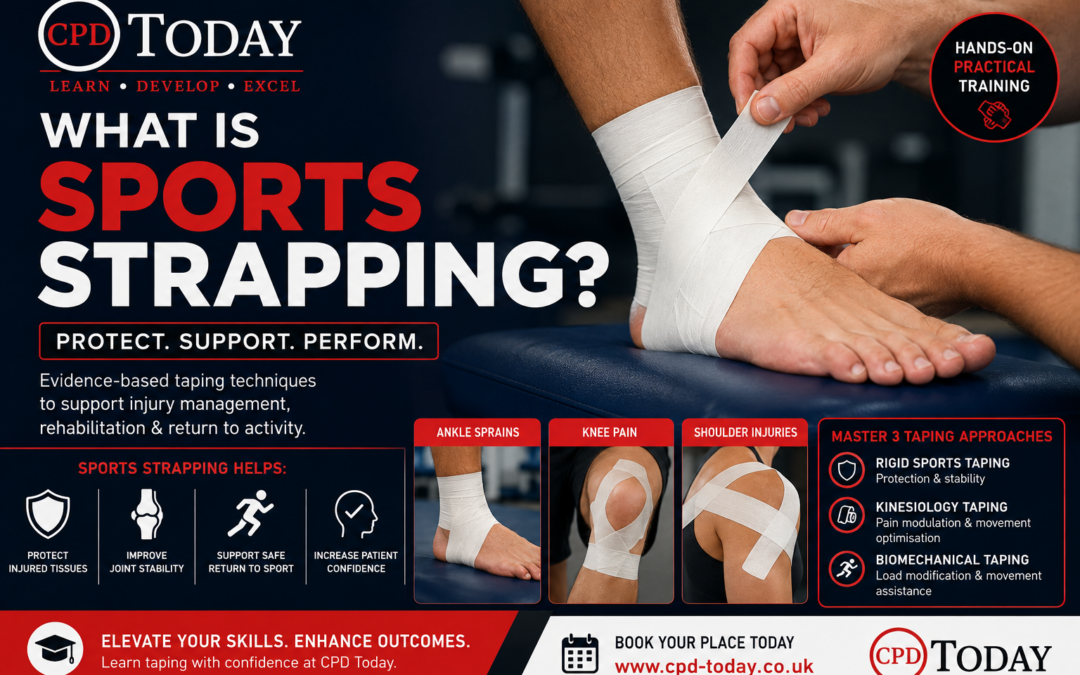
What Is Sports Strapping? A Complete Guide for Healthcare Professionals
Sports strapping has been a cornerstone of musculoskeletal and sports injury management for decades. From elite athletes to recreational runners and everyday patients, rigid sports taping remains one of the most effective methods of providing external support, protecting injured tissues and facilitating a safe return to activity.
Despite advances in rehabilitation and sports medicine, sports strapping continues to play an important role when used appropriately and combined with evidence-based rehabilitation.
In this guide, we’ll explain what sports strapping is, how it works, when it should be used, what the research tells us, and why healthcare professionals should develop this valuable clinical skill.
What Is Sports Strapping?
Sports strapping, also known as rigid sports taping or athletic taping, involves applying non-elastic adhesive tape to support joints, ligaments, muscles or tendons.
Unlike kinesiology tape, which stretches with movement, rigid sports tape is designed to:
Restrict excessive or potentially harmful movement
Improve joint stability
Protect healing tissues
Reduce mechanical stress
Support safe return to activity
Increase confidence during rehabilitation
Sports taping is commonly used in physiotherapy clinics, osteopathic practice, chiropractic care, sports medicine, pitch-side environments and orthopaedic rehabilitation.
Why Do Clinicians Use Sports Strapping?
The purpose of sports strapping is rarely to “fix” an injury.
Instead, it forms part of a comprehensive rehabilitation programme by helping patients remain active while protecting healing tissues.
Potential benefits include:
Improved joint stability
Reduced pain during movement
Protection of injured ligaments
Controlled range of movement
Improved confidence
Earlier return to exercise
Enhanced sporting performance following rehabilitation
Reduced risk of re-injury in selected patients
Importantly, taping should complement exercise therapy, manual therapy and patient education rather than replace them.
How Does Sports Strapping Work?
Sports strapping works through several mechanisms.
This is particularly useful following ligament injuries where excessive movement may delay healing.
2. Improved Proprioception
The pressure created by the tape stimulates skin receptors, increasing sensory feedback and improving movement awareness.
This enhanced proprioception may improve joint position sense and movement control during functional activities.
3. Increased Patient Confidence
Many patients report feeling more secure when taped.
This psychological benefit can encourage earlier movement and greater confidence during rehabilitation, although clinicians should avoid creating long-term dependence on taping.
4. Load Modification
By influencing movement patterns, sports taping may reduce excessive loading through painful structures, allowing patients to tolerate rehabilitation exercises more comfortably.
Common Conditions Treated with Sports Strapping
Sports strapping can be applied to numerous musculoskeletal presentations, including:
Lower Limb
Lateral ankle sprains
Syndesmosis injuries
Achilles tendinopathy
Plantar fasciitis
Medial tibial stress syndrome
Patellofemoral pain syndrome
Knee ligament injuries
Hamstring strains
Upper Limb
Thumb collateral ligament injuries
Wrist sprains
Tennis elbow
Shoulder instability
Acromioclavicular joint injuries
Finger injuries
Sports Applications
Rugby
Football
Athletics
Running
Tennis
Cricket
Gymnastics
Netball
Sports Strapping vs Kinesiology Taping
One of the most common misconceptions is that all tape serves the same purpose.
In reality, different taping systems are designed to achieve different clinical goals.
Sports Strapping
Kinesiology Taping
Rigid tape
Elastic tape
Restricts movement
Allows movement
Joint protection
Pain modulation
Mechanical support
Sensorimotor input
Return to sport
Functional rehabilitation
Choosing the correct taping system depends on the patient’s presentation, goals and stage of rehabilitation.
What Does the Research Say?
Rigid sports taping has a well-established role in sports medicine, particularly for preventing recurrent ankle sprains and supporting injured joints during rehabilitation.
Research suggests sports taping may:
Reduce recurrent ankle sprain risk in previously injured athletes
Improve perceived joint stability
Support earlier return to activity
Improve confidence during rehabilitation
Enhance functional performance in selected patients
However, taping is not a substitute for rehabilitation.
Current clinical guidelines consistently recommend combining taping with:
Progressive strengthening
Balance training
Neuromuscular rehabilitation
Load management
Patient education
Sport-specific conditioning
The greatest clinical outcomes occur when taping is integrated into a comprehensive rehabilitation programme rather than used in isolation.
Common Sports Strapping Mistakes
Even experienced clinicians can make errors when learning sports taping.
Common mistakes include:
Applying excessive tension
Incorrect anchor placement
Poor anatomical positioning
Using inappropriate tape selection
Attempting to tape without clear clinical reasoning
Over-reliance on taping
Failing to reassess movement following application
These mistakes may reduce effectiveness or create unnecessary discomfort.
Why Hands-On Training Matters
Watching online videos is useful, but it cannot replace supervised practical education.
Successful sports strapping requires:
Accurate anatomical knowledge
Correct tape tension
Patient positioning
Clinical reasoning
Functional assessment
Practical repetition
Receiving immediate feedback from experienced instructors significantly improves confidence and technique.
Learn Sports Strapping with CPD Today
At CPD Today, our Clinical Strapping & Taping Course teaches far more than tape applications.
You’ll develop a structured clinical reasoning process, enabling you to decide:
Which taping system to use
When to use it
Why it is appropriate
How to integrate it with rehabilitation
How to maximise patient outcomes
Our evidence-based course includes:
Rigid Sports Taping
Kinesiology Taping
Biomechanical Taping (including Dynamic Tape® and Strapit Active Tape)
Practical workshops
Current research
Clinical case discussions
Immediate clinical application
Whether you’re a physiotherapist, osteopath, chiropractor or sports therapist, you’ll leave with practical skills that can be implemented in clinic immediately.
Frequently Asked Questions
Is sports strapping the same as kinesiology taping?
No. Sports strapping uses rigid tape to provide mechanical support and limit excessive movement, whereas kinesiology taping uses elastic tape to support movement, pain modulation and sensorimotor feedback.
Can sports taping prevent injuries?
Research supports sports taping as one strategy for reducing recurrent injuries, particularly ankle sprains, when combined with rehabilitation and appropriate conditioning. It should not be considered a guarantee against injury.
Can patients exercise while wearing sports tape?
Yes. One of the primary aims of sports strapping is to support patients during rehabilitation, exercise and return to sport, provided this is clinically appropriate.
Is sports taping suitable for all injuries?
No. Tape selection should be based on a thorough clinical assessment. Some injuries require immobilisation, bracing or medical referral instead.
Who should attend a sports strapping course?
Healthcare professionals involved in musculoskeletal care, including physiotherapists, osteopaths, chiropractors, sports therapists and rehabilitation practitioners, can benefit from developing sports strapping skills.
Conclusion
Rigid sports strapping remains one of the most valuable practical skills for clinicians managing musculoskeletal injuries. When used alongside evidence-based rehabilitation, it can improve joint stability, support injured tissues, increase patient confidence and facilitate a safe return to activity.
Understanding when to use sports strapping—and when another taping approach may be more appropriate—is just as important as mastering the application itself.
At CPD Today, our evidence-based Clinical Strapping & Taping Course combines hands-on practical teaching with current research and clinical reasoning, helping healthcare professionals develop the confidence and competence to integrate sports strapping into everyday clinical practice.
Further Reading
Continue your learning with the next articles in our series:
Kinesiology Taping vs Sports Strapping: What’s the Difference?
What Separates a Good Dry Needling Course from a Great One?
Meta Description: Discover what to look for when choosing a dry needling course. Learn why clinical reasoning, anatomy, practical training and ongoing support are essential for becoming a confident, evidence-based clinician.
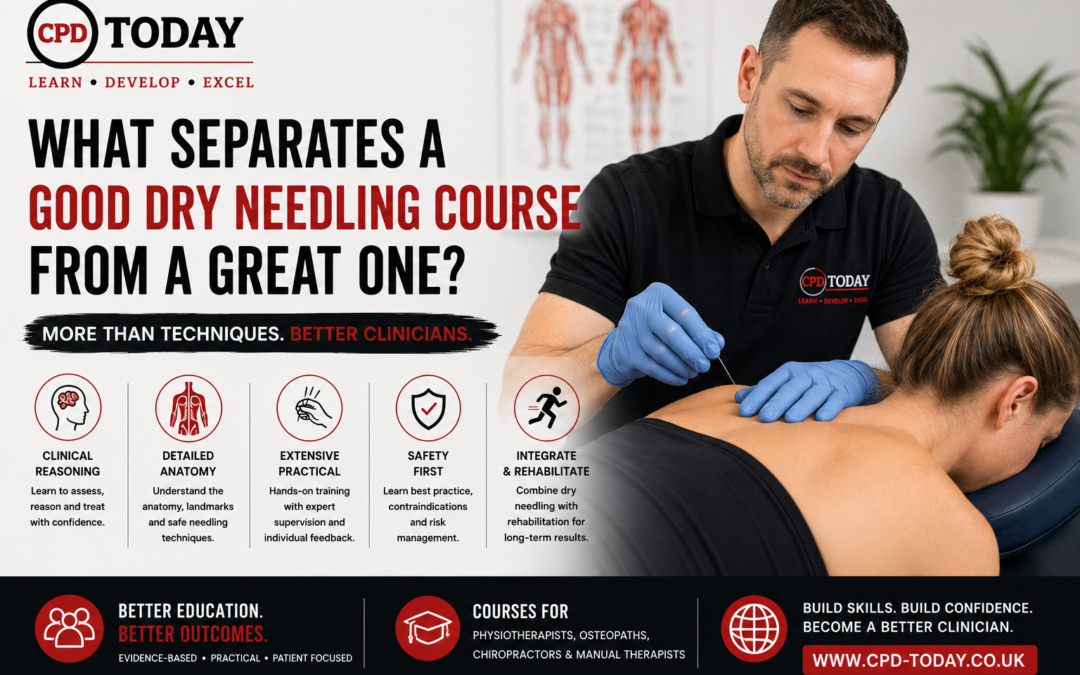
What Separates a Good Dry Needling Course from a Great One?
If you’re considering learning dry needling, you’ll quickly discover there are many courses available. They all promise practical skills, increased confidence and improved patient outcomes—but are they all the same?
The simple answer is no.
A good dry needling course will teach you how to insert a needle safely.
A great dry needling course will teach you how to think like a clinician, make evidence-based decisions and integrate dry needling into modern musculoskeletal practice.
At CPD Today, we believe the difference isn’t measured by how many muscles are covered—it’s measured by the quality of education, the confidence it builds and how well delegates can apply their learning in everyday clinical practice.
So, what should you look for when choosing a dry needling course?
1. Clinical Reasoning Comes Before Needle Placement
One of the biggest misconceptions about dry needling is that success depends on knowing where to insert a needle.
In reality, success depends on understanding:
Is dry needling appropriate?
Why am I choosing this treatment?
What am I trying to achieve?
What should I do after treatment?
The best courses develop clinical decision-making, not just technical ability.
How We Teach This at CPD Today
Clinical reasoning underpins every practical session. Before delegates perform dry needling, they learn how to assess patients, interpret findings and justify every treatment decision.
2. Strong Anatomy Teaching
Dry needling is impossible to perform safely without a detailed understanding of anatomy.
A high-quality course should teach more than muscle names. It should include:
Functional anatomy
Surface anatomy
Palpation
Neurovascular structures
Safe needle angles
Needle depth
Anatomical variations
Understanding anatomy builds confidence and improves patient safety.
How We Teach This at CPD Today
Delegates spend significant time developing palpation skills and identifying anatomical landmarks before practical needling begins.
3. Plenty of Supervised Practical Experience
Watching demonstrations is useful.
Actually practising under expert supervision is where confidence develops.
Look for courses that provide:
Small teaching groups
Individual feedback
Repeated practice
Real clinical scenarios
Time to ask questions
The more supervised practice you receive, the more confident you’ll feel returning to clinic.
How We Teach This at CPD Today
Our courses maximise hands-on learning, with experienced instructors providing continuous feedback throughout practical sessions.
4. Safety Is Never an Afterthought
Patient safety should be embedded into every aspect of a dry needling course.
A quality programme should cover:
Contraindications
Precautions
Infection prevention
Adverse event management
Consent
Safe disposal of needles
High-risk anatomical regions
Learning when not to needle is just as important as learning how to needle.
5. Evidence-Based Teaching
The field of musculoskeletal healthcare continues to evolve.
Great educators continually review current evidence and update their teaching accordingly.
Look for courses that discuss:
Current research
Clinical guidelines
Realistic treatment expectations
Benefits and limitations
Multimodal rehabilitation
Evidence should support teaching—not simply confirm existing habits.
6. Rehabilitation Is Part of the Course
Dry needling is not a stand-alone treatment.
Research consistently supports combining dry needling with:
Exercise therapy
Manual therapy
Patient education
Load management
Rehabilitation
The best courses teach delegates how to integrate dry needling into a complete management programme.
How We Teach This at CPD Today
Every practical technique is linked to rehabilitation strategies, ensuring delegates understand how to turn short-term symptom relief into meaningful functional improvement.
7. Experienced Educators Matter
The quality of a course often reflects the experience of those delivering it.
When choosing a provider, ask:
Are the instructors experienced clinicians?
Do they teach regularly?
Do they continue to practise?
Can they relate theory to real patient cases?
Learning from clinicians who actively manage musculoskeletal patients every day provides valuable practical insights that go beyond textbooks.
8. Ongoing Support After the Course
Learning doesn’t end when the course finishes.
The best education providers continue to support delegates through:
Follow-up guidance
Educational resources
Advanced courses
Refresher training
Access to experienced instructors
Confidence grows through continued learning.
Why Clinicians Choose CPD Today
At CPD Today, our goal is simple:
To develop confident, safe and evidence-based clinicians.
Our Foundation and Advanced Dry Needling Courses combine:
Evidence-based education
Extensive practical training
Functional anatomy
Clinical reasoning
Rehabilitation principles
Small-group teaching
Experienced instructors
Ongoing professional development
We don’t believe in teaching techniques in isolation. We teach clinicians how to make better decisions, communicate effectively with patients and integrate dry needling into high-quality musculoskeletal care.
What Our Delegates Tell Us
One of the most common pieces of feedback we receive is:
“I expected to learn dry needling techniques—I didn’t expect to improve my overall clinical reasoning.”
That reflects exactly what we aim to achieve.
Our delegates leave with more than a new skill; they leave with greater confidence in assessment, diagnosis and patient management.
Clinical Pearl
A great dry needling course doesn’t just teach you where to put a needle—it teaches you why, when and whether to use one at all.
That difference shapes every treatment decision you make.
Clinical Takeaway
Choosing a dry needling course is an investment in your professional development. While many courses teach practical techniques, the best programmes also develop clinical reasoning, anatomical knowledge, patient communication and rehabilitation planning. These skills not only improve confidence but also help clinicians deliver safer, more effective and more evidence-based patient care. At CPD Today, we believe that developing better clinicians—not just better technicians—is what truly separates a good dry needling course from a great one.
Frequently Asked Questions
What should I look for in a dry needling course?
Choose a course that combines evidence-based teaching, detailed anatomy, extensive practical training, clinical reasoning, safety and rehabilitation—not just needling techniques.
Is hands-on practice important?
Absolutely. Supervised practical sessions with experienced instructors are essential for developing confidence and competence.
Why is clinical reasoning emphasised so much?
Because successful dry needling depends on selecting the right treatment for the right patient at the right time—not simply inserting a needle.
Does CPD Today provide advanced training?
Yes. After completing our Foundation Course, delegates can progress to our Advanced Dry Needling & Electroacupuncture Course to develop more advanced techniques and clinical skills.
Ready to Learn with Confidence?
If you’re looking for a dry needling course that goes beyond teaching techniques, CPD Today offers evidence-based, hands-on education designed to help healthcare professionals become safer, more confident and more effective clinicians.
Whether you’re starting your dry needling journey or looking to refine your skills, our courses provide the practical experience, clinical reasoning and ongoing support needed to apply dry needling with confidence.
Explore our upcoming Foundation and Advanced Dry Needling Courses at www.cpd-today.co.uk.
Internal Links (SEO)
Link this article to:
What Is Dry Needling?
Which Dry Needling Course Should I Take?
5 Clinical Pearls Every Dry Needling Delegate Learns
Why Clinical Reasoning Is More Important Than Needle Placement
How We Teach Dry Needling for Shoulder Pain on Our Foundation Course
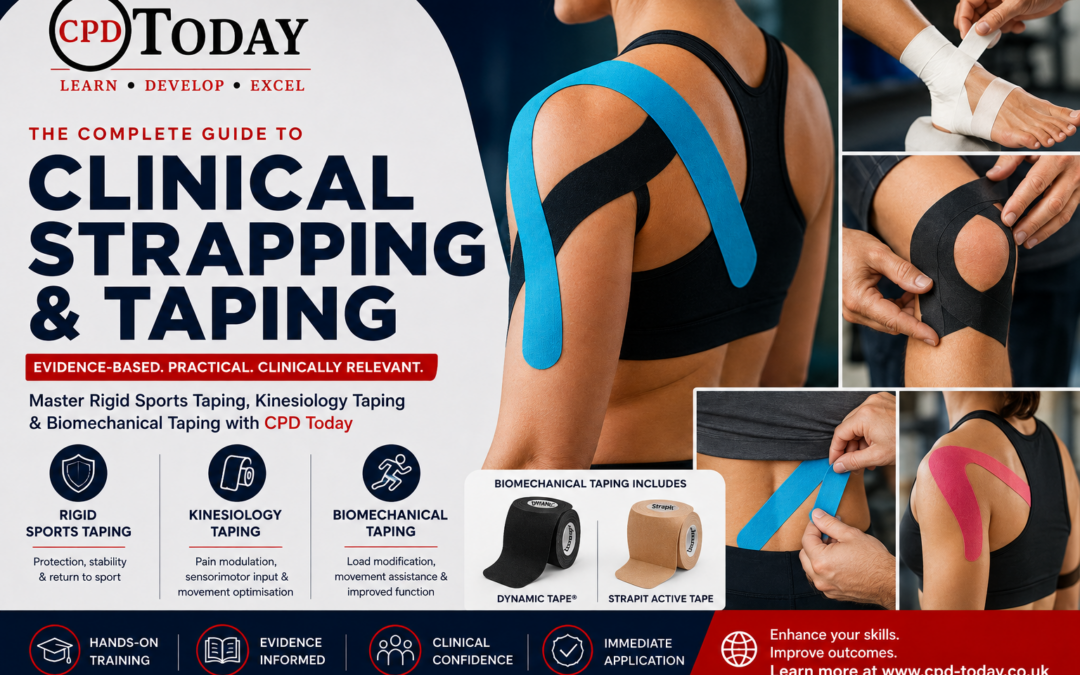
Clinical strapping and taping has become an integral part of modern musculoskeletal (MSK) practice. Whether you’re supporting an acute sports injury, managing a chronic tendinopathy, or helping a patient return to activity, selecting the right taping technique can improve confidence, optimise movement and complement a comprehensive rehabilitation programme.
At CPD Today, we don’t simply teach taping techniques—we teach clinical reasoning. Our evidence-based Strapping & Taping Course equips healthcare professionals with the knowledge and practical skills to choose the right tape, for the right patient, at the right time.
Unlike many taping courses that focus on a single method, our course covers the three principal taping approaches used in contemporary MSK practice:
Rigid Sports Taping
Kinesiology Taping
Biomechanical Taping (including Dynamic Tape® and Strapit Active Tape)
By understanding the strengths, limitations and evidence behind each approach, you’ll be able to integrate taping confidently into your everyday clinical practice.
Why Learn Clinical Strapping & Taping?
Clinical taping is far more than simply applying tape to an injured body part. Effective taping requires an understanding of anatomy, biomechanics, tissue healing, movement analysis, pathology and patient goals.
When used appropriately, taping can help:
Reduce pain during movement
Improve function and confidence
Modify mechanical loading
Support injured tissues
Assist return to work, exercise and sport
Enhance rehabilitation outcomes
Complement manual therapy and exercise prescription
Improve patient adherence to rehabilitation
Taping should not be viewed as a stand-alone treatment, but as one component of an evidence-informed, patient-centred management plan.
The Three Clinical Taping Systems
Rigid Sports Taping
Rigid sports taping is designed to restrict excessive movement, improve joint stability and protect injured tissues during activity.
It is commonly used for:
Lateral ankle sprains
Thumb injuries
Wrist injuries
Patellofemoral disorders
Shoulder instability
Return-to-play support
Rigid taping is particularly valuable during the acute and subacute stages of rehabilitation, helping patients remain active while protecting healing tissues.
Kinesiology Taping
Kinesiology tape is an elastic therapeutic tape designed to move with the body rather than restrict movement.
Current research suggests kinesiology taping can provide clinically meaningful short-term improvements in pain and function for several chronic musculoskeletal conditions, particularly when combined with active rehabilitation, manual therapy and exercise.
It may assist with:
Pain modulation
Movement awareness
Sensorimotor feedback
Functional movement
Patient confidence during rehabilitation
Common clinical applications include:
Chronic low back pain
Neck pain
Shoulder pain
Patellofemoral pain
Achilles tendinopathy
Plantar heel pain
Tennis elbow
Pregnancy-related pelvic girdle pain
Throughout the course, we critically evaluate the latest systematic reviews and meta-analyses, helping clinicians understand where the evidence is strongest and how to apply it effectively in practice.
Biomechanical Taping
Biomechanical taping focuses on modifying movement and reducing mechanical stress placed on painful or overloaded tissues.
On the CPD Today course, we teach the principles of biomechanical taping using:
Dynamic Tape®
Strapit Active Tape
These highly elastic tapes are designed to:
Reduce tissue load
Assist movement
Improve movement efficiency
Redistribute mechanical forces
Support functional rehabilitation
Biomechanical taping is increasingly used for conditions such as:
Achilles tendinopathy
Plantar fasciitis
Running injuries
Knee pain
Hip pain
Shoulder disorders
Tendinopathies
Load-sensitive musculoskeletal conditions
Importantly, our course focuses on clinical reasoning, helping you determine when biomechanical taping is the most appropriate option and when another taping strategy may be more suitable.
An Evidence-Based Approach
At CPD Today, evidence-based practice underpins everything we teach.
Our course explores:
Current systematic reviews
Meta-analyses
Clinical practice guidelines
Biomechanical principles
Clinical reasoning
Patient-centred care
Practical application of research
We also discuss where evidence remains limited, ensuring clinicians develop realistic expectations and apply taping appropriately within modern MSK rehabilitation.
Integrating Taping into Clinical Practice
Taping should enhance—not replace—good clinical care.
During the course, you’ll learn how to integrate taping with:
Manual therapy
Exercise rehabilitation
Strength and conditioning
Load management
Patient education
Return-to-sport planning
Functional rehabilitation
This integrated approach reflects current best practice and helps maximise patient outcomes.
Conditions Covered
The principles taught throughout the course can be applied to a wide range of musculoskeletal presentations, including:
Ankle sprains
Achilles tendinopathy
Plantar fasciitis
Patellofemoral pain syndrome
Knee osteoarthritis
Rotator cuff-related shoulder pain
Tennis elbow
Golfer’s elbow
Neck pain
Low back pain
Sacroiliac joint pain
Hip pain
Running injuries
Sports injuries
Muscle strains
Tendinopathies
Pregnancy-related pelvic girdle pain
Why Choose CPD Today?
Our courses are delivered by experienced clinicians who use these techniques daily in clinical practice.
You’ll benefit from:
Extensive hands-on practical sessions
Small group teaching
Individual feedback
Evidence-informed education
Clinical reasoning throughout
Techniques you can apply immediately in practice
Rather than simply teaching tape applications, we teach you how to think clinically, enabling you to adapt techniques to individual patients rather than memorising recipes.
Frequently Asked Questions
Who is this course suitable for?
The course is designed for physiotherapists, osteopaths, chiropractors, sports therapists and other appropriately qualified healthcare professionals managing musculoskeletal conditions.
Do I need previous taping experience?
No. The course is suitable for beginners as well as experienced clinicians looking to refine and expand their taping skills.
Will I learn more than kinesiology taping?
Yes. Unlike many CPD courses, we cover rigid sports taping, kinesiology taping and biomechanical taping, giving you a comprehensive toolkit for clinical practice.
Is the course evidence based?
Absolutely. Every technique is taught alongside the current evidence, biomechanical principles and clinical reasoning to support informed decision-making.
Can I use these techniques immediately in clinic?
Yes. The course is highly practical, allowing you to implement what you’ve learned straight away with appropriate clinical reasoning.
Develop Your Clinical Taping Skills with CPD Today
Whether you’re looking to improve patient outcomes, expand your treatment options or build greater confidence in managing musculoskeletal conditions, the CPD Today Strapping & Taping Course provides the practical skills, evidence base and clinical reasoning needed to integrate taping effectively into everyday practice.
Join us to master rigid sports taping, kinesiology taping and biomechanical taping through hands-on, evidence-based training designed for today’s MSK clinician.
Related Articles
As part of this series, explore our in-depth guides on:
What Is Sports Strapping?
Kinesiology Taping: The Evidence Explained
What Is Biomechanical Taping?
Dynamic Tape® and Strapit Active Tape in Clinical Practice